Sintra-Portugal.com
The best independent guide to Sintra
Sintra-Portugal.com
The best independent guide to Sintra
Sintra: the best sights and attractions in 2026
The picturesque town of Sintra captures the imagination like nowhere else in Portugal. From mist-veiled forests to windswept cliffs, Sintra summons a sense of wild Romanticism, matched only by the flamboyant architecture found throughout the town.
The town revels in its 19th-century Romanticist heritage, with opulent palaces and wondrous villas flaunting whimsical and theatrical design elements. The most famous is the colourful Palacio de Pena, but equally fascinating are the Arabian-inspired Palácio de Monserrate and the mystical gardens of the Quinta da Regaleira.
Venturing beyond the well-trodden tourist trails reveals an alternative side of Sintra, one with dense forests, rugged coastlines, secluded religious sites, and wondrous viewpoints, all awaiting exploration by intrepid travellers.
Sintra is often only visited as a day trip from Lisbon, but such a fleeting visit barely scratches the surface. To truly immerse in the magic of Sintra, a longer stay is essential. This guide details the best sights and activities of Sintra, helping you to make the most of your time here.
What are the highlights of Sintra?
Palácio da Pena
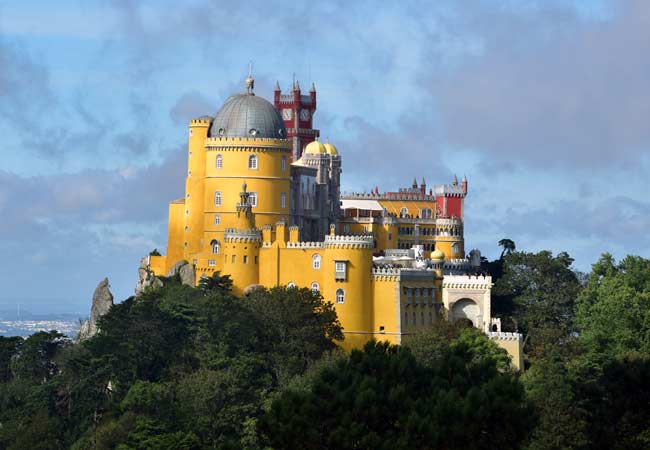
A vibrant fairy-tale castle crowning the highest peak of the Sintra hills. This masterpiece of 19th-century Romanticism is a dazzling fantasy of domes, battlements, and pastel hues, seemingly imagined from a storybook - Pena Palace guide
Quinta da Regaleira
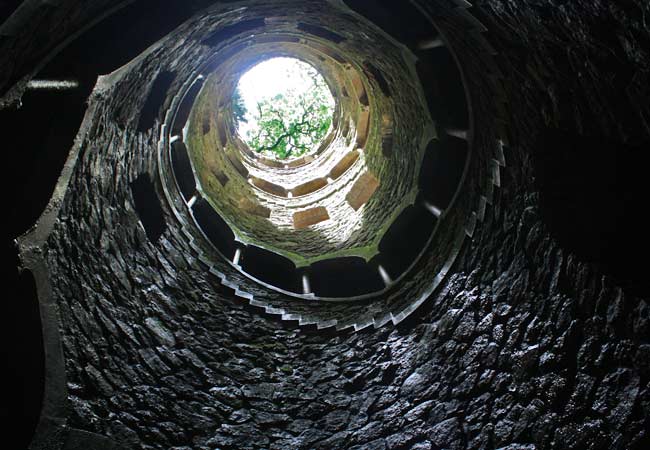
A Gothic villa with gardens of esoteric symbolism and Templar lore. Its centrepiece is the Initiation Well, an inverted tower that symbolises a journey into darkness and rebirth, before leading into a series of caves - Quinta da Regaleira guide
Castelo dos Mouros
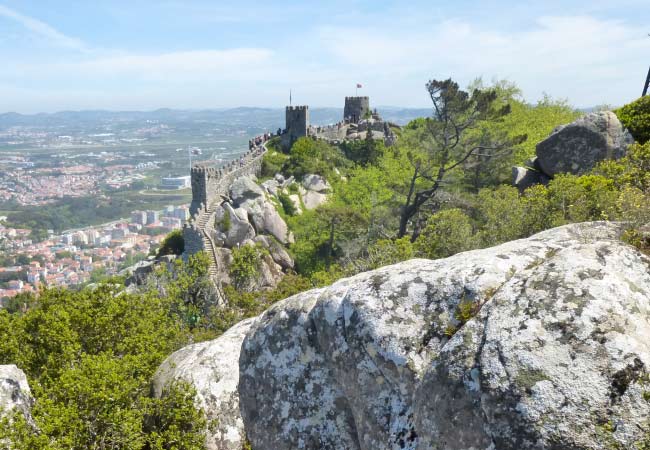
An ancient Moorish fortress commanding the highest peaks over Sintra. Climb its fortified battlements and towers for the same panoramic views that guarded this region for centuries - Castelo dos Mouros guide
Palácio Nacional de Sintra
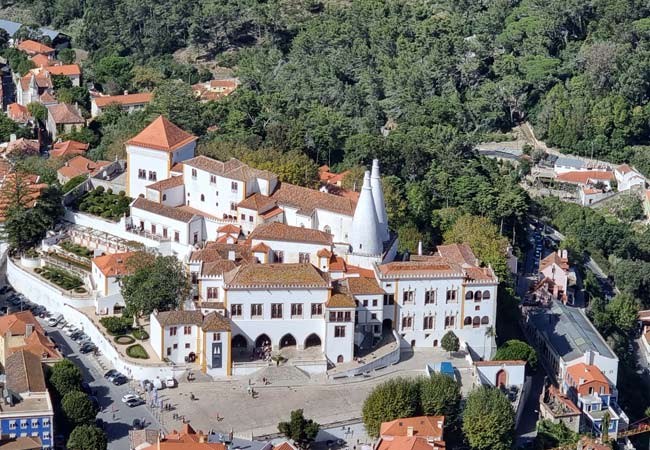
Instantly recognisable by its two colossal conical chimneys rising over Sintra. This is Portugal’s best-preserved medieval royal palace, serving as a seat of power for over eight centuries.
Palácio de Monserrate
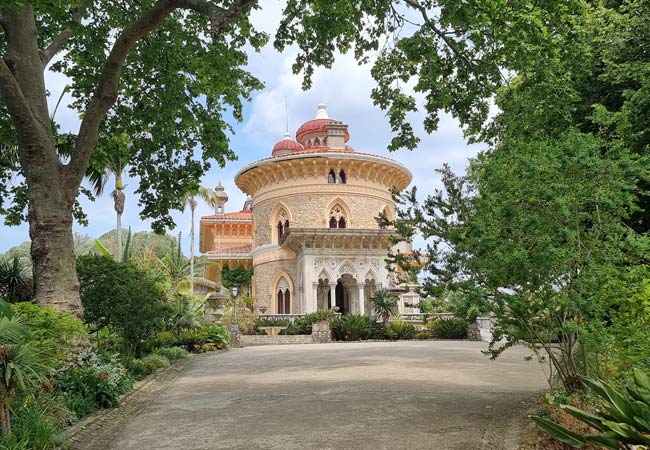
An exotic and romantic palace, celebrated for its intricate, lace-like stonework inspired by Indian and Moorish designs. This hidden gem offers a tranquil escape from Sintra's well-trodden paths - Monserrate guide
Convento dos Capuchos
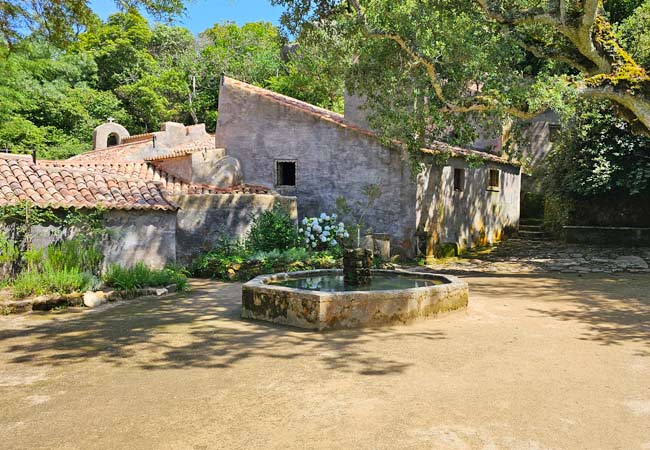
A stark contrast to the palaces, this humble 16th-century monastery is built directly into the granite and cork of the forest. It presents an austere and contemplative atmosphere, showing a simpler way of life - Convento dos Capuchos guide
Palácio Biester
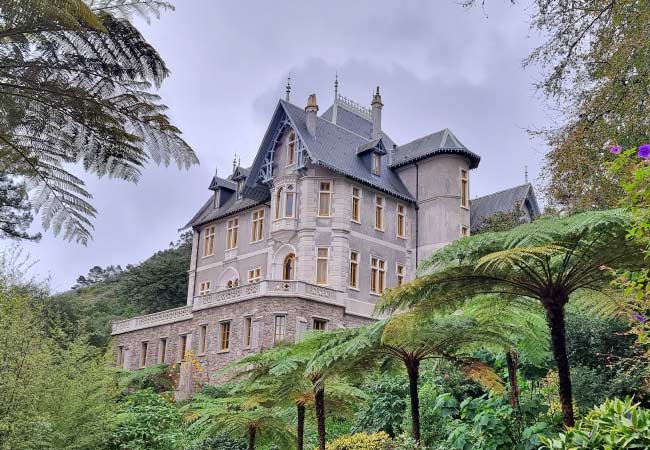
A masterpiece of late Romanticism with theatrical interiors. Discover a dark, artistic sanctuary of intricate woodwork and stained glass, surrounded by a lush botanical park .
Cabo da Roca

The westernmost point of mainland Europe, a raw and windswept headland where granite cliffs plunge into the untamed Atlantic - Cabo da Roca guide
Exploring the Wider Sintra Region
While the palaces are Sintra's main draw, the surrounding Serra de Sintra natural park holds many further treasures. This stunning landscape of forested hills and rugged coastline is best explored by car and offers a different perspective on the region.
The Atlantic Coastline The region's dramatic coastline is defined by powerful waves and towering cliffs, culminating at Cabo da Roca, the westernmost point of mainland Europe. Along this coast, you will find a string of magnificent beaches, from the wild surfing shores of Praia do Guincho and Praia Grande to the secluded natural beauty of Praia da Ursa and the cliff-backed sands of Praia da Adraga The coastline is also dotted with charming seaside settlements, including the picturesque village of Azenhas do Mar and the popular beach town of Praia das Maçãs, which is connected to Sintra by a traditional tram.
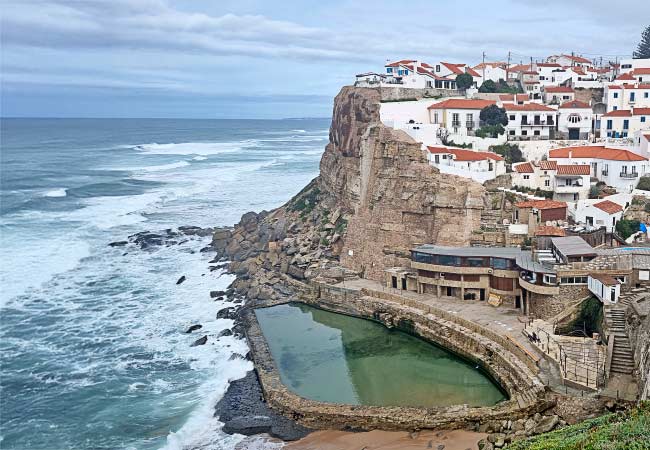
Azenhas do Mar
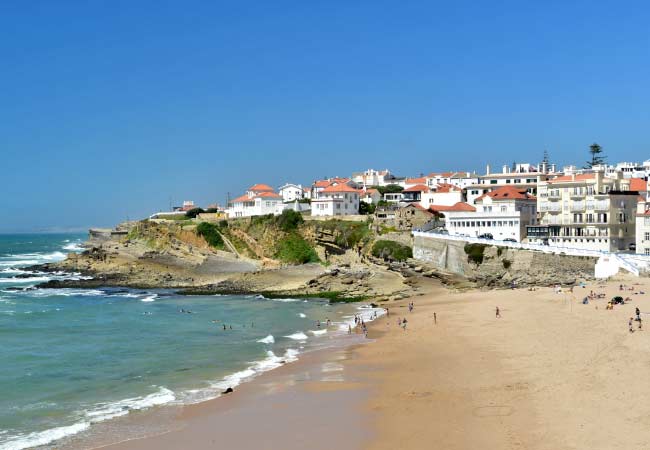
Praia das Maçãs
Venturing inland from the coast reveals dense forests and spectacular viewpoints. The scenic N247 road winds through the hills, connecting many of these locations. Hidden deep within the forest is the humble Convento dos Capuchos, a monastery built in harmony with nature. For one of the best views, head to the Santuário da Peninha, a small chapel perched atop a rocky outcrop that provides a stunning panorama over the entire coastline.
On the route between Lisbon and Sintra, you will find the magnificent Palácio de Queluz, an opulent 18th-century palace that served as a lavish summer retreat for Portuguese royalty.
Map of Sintra’s Sights
The interactive map below shows the locations of all of these sights. The green markers show the sights of Sintra, while the blue markers are the sights of the surrounding region. (Note: Zoom out to see all of the points)
Sights of Sintra: 1) Palácio da Pena 2) Quinta da Regaleira 3) Castelo dos Mouros 4) Palácio de Monserrate 5) Palácio Nacional de Sintra 6) Palácio Biester 7) Palácio de Seteais 8) Vila Sassetti 9) Chalet da Condessa d'Edla
Sights of the Sintra region: 10) Cabo da Roca 11) Palácio de Queluz 12) Convento dos Capuchos 13) Capela da Peninha 14) Praia das Maçãs 15) Praia do Guincho 16) Praia da Ursa 17) Praia Grande 18) Praia da Adraga 19) Azenhas do Mar 20) N247 road
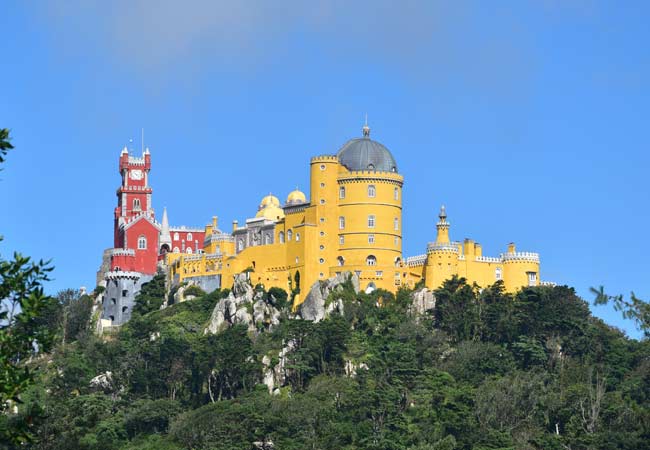
The beautiful Palácio Nacional da Pena is always a highlight of a day trip to Sintra
Sintra for a day trip
A typical day trip to Sintra visits the Palácio da Pena and Castelo dos Mouros (if time allows) in the morning, then heads to the historic centre for lunch and the Quinta da Regaleira later in the day. You may choose to visit the Palácio Nacional de Sintra, which is in the town centre, instead of the Castelo dos Mouros. Another option is to spend longer in the grounds of the Palácio da Pena and skip the Castelo dos Mouros (or the Palácio Nacional de Sintra).
The Palácio da Pena is the highlight of the day, but it can get extremely busy. It is advisable to visit the Palácio da Pena as early in the day as possible to avoid the worst of the peak-season crowds (10:30 am to 3:00 pm). The Quinta da Regaleira is always busy in the morning but is typically quieter in the afternoon (after 3:00 pm).
Important - Pena Palace Tickets: Entry to the state rooms of the Pena Palace requires a ticket with a pre-booked time slot. During the peak season, the most popular times sell out well in advance, so it is essential to purchase them before your trip. You can purchase timed tickets from purchased from GetYourGuide here.
For a day which avoids the large numbers of tourists, consider visiting the Palácio de Monserrate, the Palácio Biester and the Palácio Nacional de Sintra. The Palácio de Monserrate offers an exquisite beauty that rivals the Pena Palace, while the Palácio Biester has a mystical Gothic atmosphere similar to Quinta da Regaleira, as they were both designed by the same architect.
A longer stay in Sintra
If you are fortunate enough to be planning a longer trip to Sintra, a recommended itinerary is:
• Day 1) Palácio da Pena (as early as possible), Parque da Pena, and Castelo dos Mouros.
• Day 2) Palácio de Monserrate, Palácio Nacional de Sintra, and Quinta da Regaleira.
• Day 3) Tram ride to Praia das Maçãs, walk to Praia Grande, then head to the Cabo da Roca at sunset. If you have a car, the third day could also include the Convento dos Capuchos, the Capela da Peninha viewpoint, and a drive along the scenic N247 road.
The remainder of this guide will detail the best sights and attractions of Sintra.

Would a tour suit you better?
After twenty-five years of visits, I know how tiring a day in Sintra can be. A well-run tour takes that hassle off your hands. These are the Sintra tours I've used and happily recommend to friends and family:
The links above are affiliate links, which means I earn a small commission if you book through them, at no extra cost to you. I really appreciate it, as it helps me keep this site free and running.
The Palácio da Pena
The Palácio da Pena is the ultimate expression of 19th-century Romanticism, the personal fantasy of the artist-king, Ferdinand II. He transformed the ruins of a 16th-century monastery, heavily damaged in the 1755 earthquake, into a lavish palace that he personally designed in a style celebrating imagination and emotion. Its vivid yellow and red terraces offer sweeping views across the Serra de Sintra and out to the Atlantic Ocean, best enjoyed from the Queen's Terrace.
A walk around the exterior reveals an eclectic blend of architectural styles, from Neo-Gothic towers to Neo-Manueline stonework that celebrates Portugal's Age of Discovery. The most dramatic feature is the figure of Triton above the gateway, a mythological half-man, half-fish who symbolises the creation of the world.
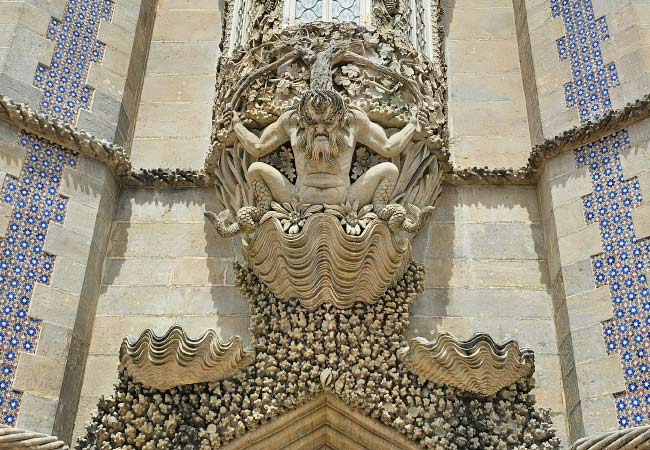
The figure of Triton.
At the palace's core lies the original monastery's Manueline cloister and chapel, which house a delicate alabaster altarpiece by the renowned sculptor Nicolau Chanterene.
The interior has been carefully preserved to reflect its appearance in 1910, the final year of the Portuguese monarchy. Each room is a rich display of royal life. Highlights include the opulent Great Hall, the elaborately decorated Arab Room with its intricate painted illusions, and the private chambers of King Carlos I and Queen Amélia. Even the original kitchens are on display, offering an insight into the daily workings of this unique royal residence.
Related articles: The Palácio da Pena
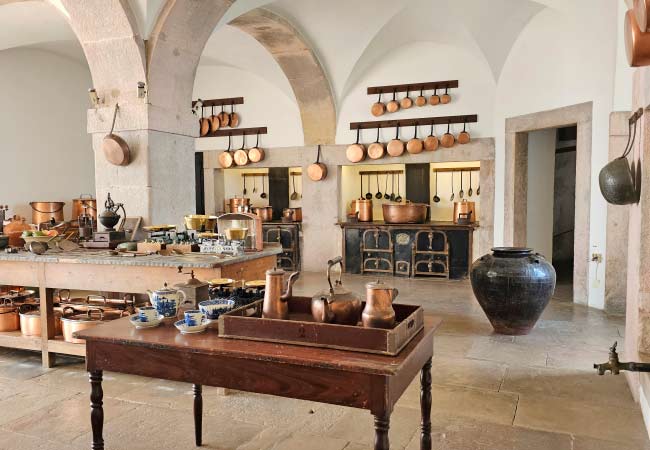
The palace kitchen
The Parque da Pena
The Parque da Pena is as much a masterpiece of Romanticism as the palace it surrounds. Following the same ideals, King Ferdinand II transformed the hills into a forested landscape, reflecting the 19th-century fascination with the natural world. He curated a vast botanical collection, importing species from across the globe. Today, the park is home to towering North American sequoias, lush tree ferns from Australia and New Zealand, and colourful camellias from Asia, all thriving in Sintra’s unique microclimate.
The landscape was meticulously designed with winding paths, hidden clearings, and surprising viewpoints to create an idealized version of wild nature. Within the grounds is the highest point of the Serra de Sintra, the Cruz Alta (High Cross), which at 529 metres provides stunning 360-degree views of the entire region. However, the more remote Alto do Chá (Tea Hill) offers the best unobstructed view of the Palácio da Pena and the distant coastline.
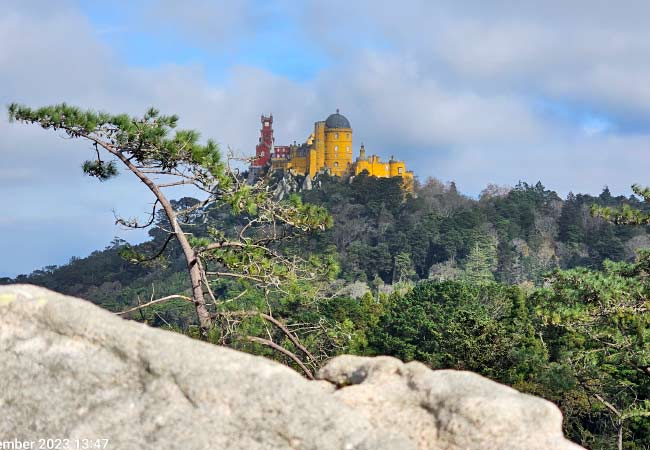
The view from the Alto do Chá
Deeper within the park, visitors can discover the serene Valley of the Lakes, with its five interconnected ponds and mock-medieval duck houses, and the watchful bronze Statue of the Warrior. A separate highlight is the Chalet da Condessa d'Edla, a charming alpine-style cottage built for Ferdinand’s second wife, Elise Hensler. Its unique cork-clad exterior and intimate design provide a wonderful contrast to the grandiosity of the palace.
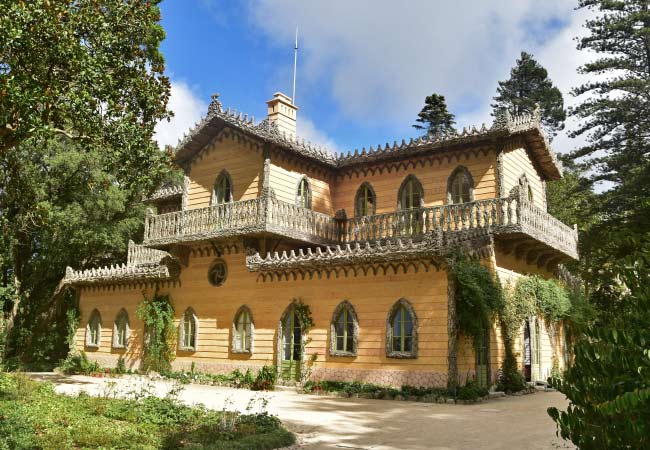
The Chalet da Condessa d'Edla
The Quinta da Regaleira
The Quinta da Regaleira is an enigmatic estate where the architecture and landscape are drenched in symbolism and mystery. This was the personal project of the wealthy António Monteiro who, with the help of Italian architect Luigi Manini, created a landscape that reflects his fascination with esoteric traditions, including the Knights Templar and alchemy.
The estate’s main residence is a flamboyant display of Neo-Manueline design, with Gothic pinnacles, gargoyles, and an octagonal tower. Adjoining it is a richly decorated Catholic chapel, but the true secrets of the estate lie within its gardens.
The grounds are a labyrinth of discovery, designed to lead visitors on a symbolic journey. A hidden network of tunnels and grottoes connects many of the grounds’ key features, such as the Lake of the Waterfall and the Portal of the Guardians.
The highlight is the incredible Poço Iniciático, or Initiation Well. This is not a water well but an inverted tower that descends 27 metres into the earth. Its spiral staircase has nine platforms, thought to be an allusion to Dante's nine circles of Hell. The descent symbolises a journey into darkness, with the path upwards through the tunnels representing a rebirth into the light.
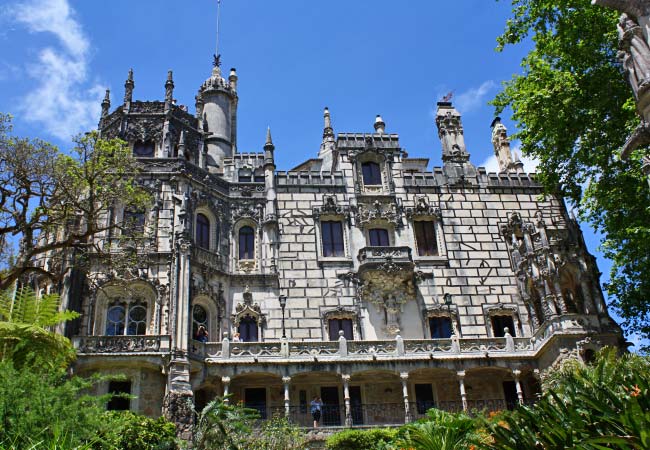
The Quinta da Regaleira
The Initiation Wells (Poço Iniciático) in the Quinta da Regaleira
The Palácio Nacional de Sintra
Instantly recognisable by the two colossal conical chimneys that rise above its kitchens, the Palácio Nacional de Sintra is the best-preserved medieval royal residence in Portugal. Located in the heart of the old town, this palace was continuously inhabited by Portuguese royalty from the early 15th until the late 19th century, making it the most lived-in of all the royal palaces. Its long history is evident in the harmonious blend of Gothic, Manueline, and Moorish architectural styles.
While its white-washed exterior appears relatively simple, the palace's true treasures are found within its extensive series of state rooms. The most splendid is the Sala dos Brasões (Coats of Arms Room), a grand hall decorated with the coats of arms of 72 of Portugal’s most important noble families, centred around the emblem of King Manuel I.
One of the main highlights is the Sala dos Cisnes (Swan Room), featuring a ceiling beautifully painted with 27 unique swans. Equally fascinating is the Sala das Pegas (Magpie Room), where the ceiling is decorated with 146 magpies, a response by King John I to court gossip.
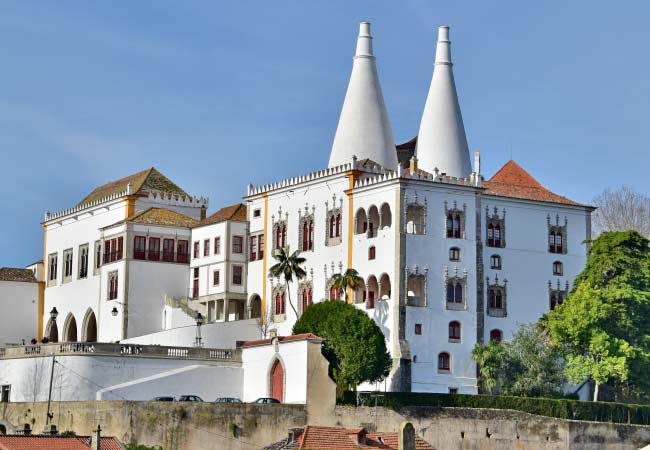
The Gothic exterior of the Palacio Nacional Sintra
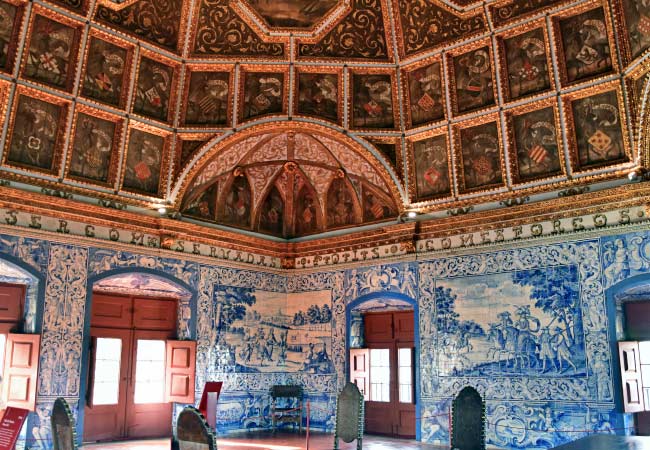
The Sala dos Brasões
The Castelo dos Mouros
Stretching across two high ridges of the Serra de Sintra, the Castelo dos Mouros offers a stark and fascinating contrast to the opulent palaces. This is not a royal residence but a formidable military fortress, with origins dating back to the 8th and 9th centuries during the period of Moorish occupation. Its primary function was strategic: to guard the agricultural lands around Sintra and watch the coastline for invading ships.
The castle’s most prominent feature is its stone ramparts, punctuated by fortified towers, that snake along the granite landscape. These windswept battlements were strategically positioned to provide a commanding vantage point over the entire region.
After falling into ruin after the Christian Reconquista in the 12th century, the castle was given new life in the 19th century by King Ferdinand II. He had the walls restored, not for military use, but to serve as a dramatic historical feature within the landscape of his Pena Park. The highest tower was named the Torre Real (Royal Tower) and became a favourite spot for King Ferdinand, who would often retreat here to paint, after climbing the 227 steps to the summit.
Related articles: The Castelo dos Mouros
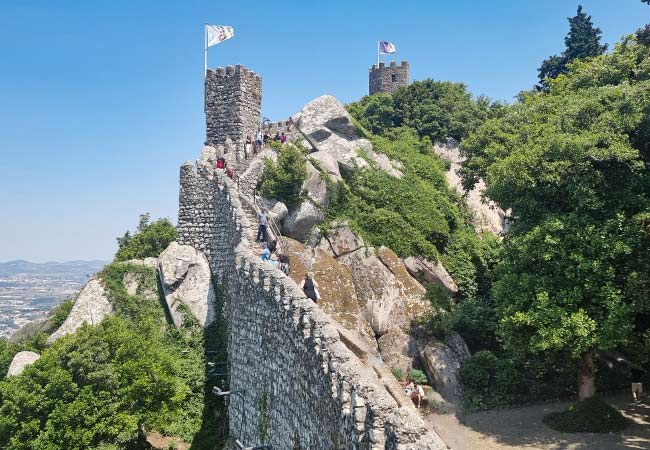
The Moorish castle stands high above Sintra
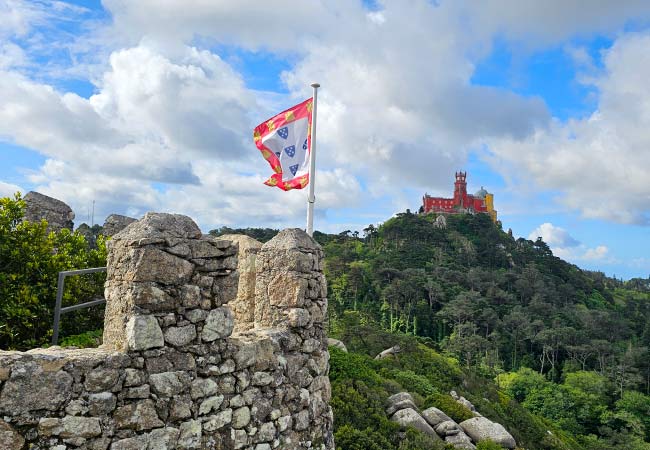
The Torre Real and the view to the Palácio da Pena
The Palácio de Monserrate
The Palácio de Monserrate is an exotic and romantic villa that offers a tranquil escape from Sintra's more frequented sights. This stunning building was the vision of Sir Francis Cook, a wealthy 19th-century English industrialist who created his summer retreat on a site once praised by the poet Lord Byron. The palace is celebrated for its intricate, lace-like stonework, which was heavily inspired by the architecture of India and the Moorish world. The result is a delicate and fantastical structure of domes, cupolas, and exquisite arches.
The interior is just as detailed, designed around a central octagonal rotunda from which the main wings of the palace extend. This grand hall, along with rooms like the Music Room and the Library, is filled with intricate plasterwork and geometric patterns that create a light and airy atmosphere.
The palace's gardens are considered a masterpiece of landscape design and are among Portugal’s richest botanical collections. The grounds are ingeniously arranged into distinct geographical areas, allowing visitors to walk from a Mexican garden with cacti and yuccas to a Japanese garden with camellias and bamboo. The collection includes lush tree ferns from Australia, rhododendrons from the Himalayas, and a romantic ruined chapel.
Related articles: The Palácio de Monserrate
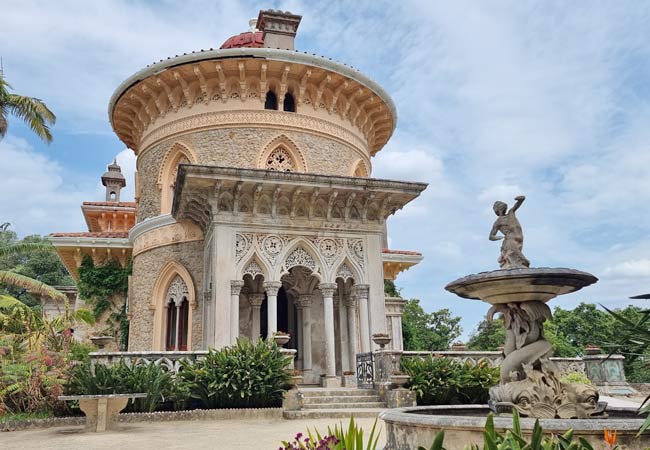
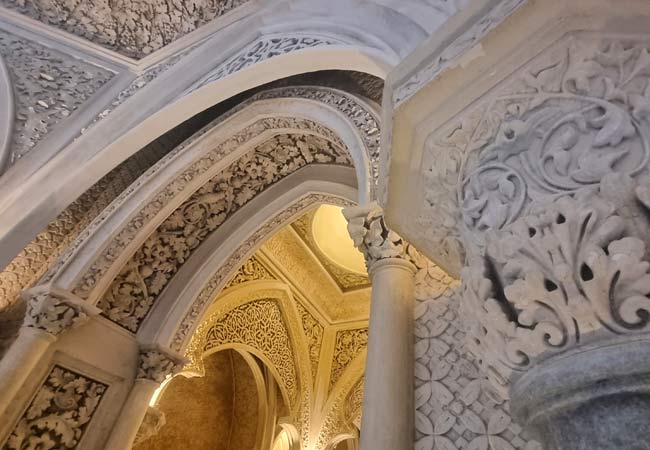
The beautiful stone carvings inside Monserrate

The Ruínas da Capela de Monserrate, with ancient trees growing over the chapel walls
The Convento dos Capuchos
Offering a profound contrast to the opulence of Sintra’s palaces, the Convento dos Capuchos is a humble and spiritual retreat deep within the forested hills. Founded in the 16th century, this austere Franciscan monastery embodies the belief in a life of extreme poverty and harmony with the natural world. The small complex was built directly into the granite landscape, with structures designed to blend seamlessly with the surrounding rocks and ancient trees, barely disturbing the environment.
Its most distinctive feature is the extensive use of cork to insulate the spartan cells and tiny chapels, earning it the nickname the 'Cork Convent'. The architecture is deliberately diminutive; low doorways force visitors to stoop in a gesture of humility, and the tiny cells offer just enough space for one person. A stone above one entrance carries the inscription: "where the world ends and heaven begins". Even the main chapel is built around a giant granite boulder, fully integrating the convent with its environment.
Abandoned in 1834 following the dissolution of religious orders, the convent has been slowly reclaimed by the forest, creating a serene and introspective atmosphere. For those seeking to understand a different side of Sintra's history, one of quiet contemplation rather than royal grandeur, this unassuming site is an unforgettable experience.
Related articles: The Convento dos Capuchos
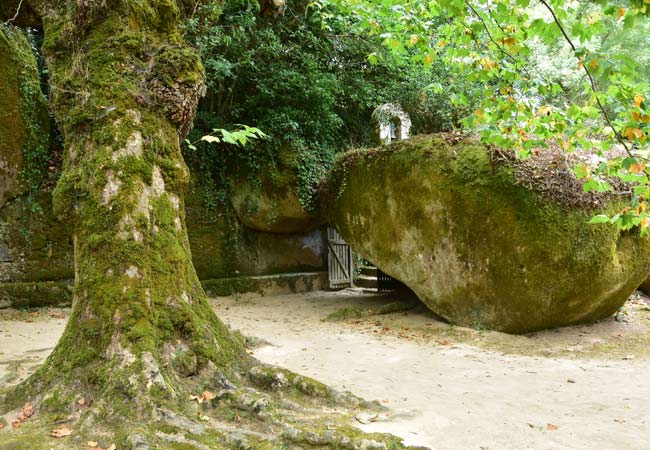
Massive boulders and ancient trees of the Convento dos Capuchos
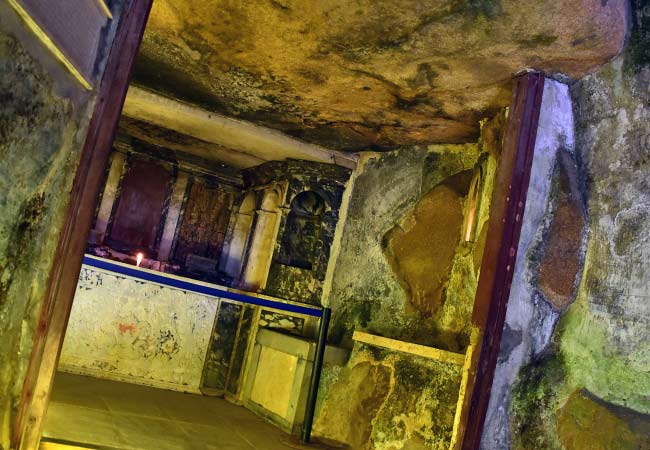
The chapel beneath the huge boulder
The Palácio de Seteais
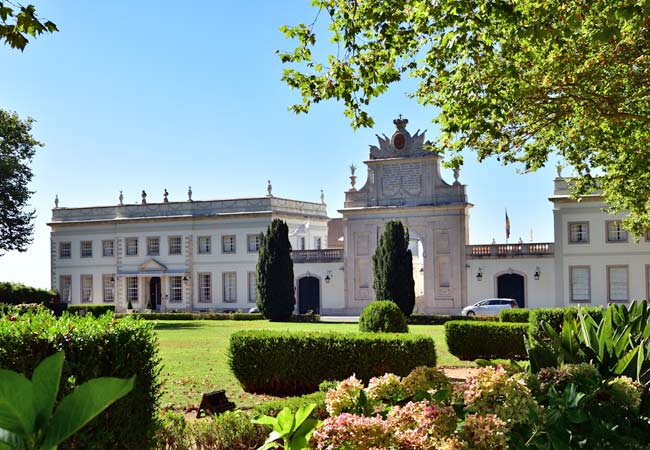
An elegant example of neoclassical architecture, the Palácio de Seteais was built in the late 18th century for a Dutch consul. Today, it operates as a luxury hotel, but non-guests are welcome to explore its beautiful grounds and terrace.
The palace is composed of two wings linked by a grand triumphal arch, which was constructed to commemorate a royal visit in 1802. This arch famously frames a perfect vista of the distant Palácio da Pena on one side and the valley on the other, creating a popular photo opportunity. Visitors can wander through the manicured gardens, which include intricate box-hedge mazes and lemon trees.
The Cabo da Roca
Cabo da Roca is the westernmost point of mainland Europe, a dramatic headland where rugged cliffs rise over 140 metres above the turbulent Atlantic Ocean. This raw and windswept landscape for centuries was consider to be the edge of the world. A stone monument topped with a cross marks the location, inscribed with the famous words of Portuguese poet Luís de Camões: "Where the land ends and the sea begins".
Dominated by its iconic 18th-century lighthouse, Cabo da Roca is not a place of buildings but of immense natural forces. It is an essential stop for anyone wishing to experience the wild beauty of the Portuguese coast and stand at the very edge of the European continent.
Related articles: Cabo da Roca guide
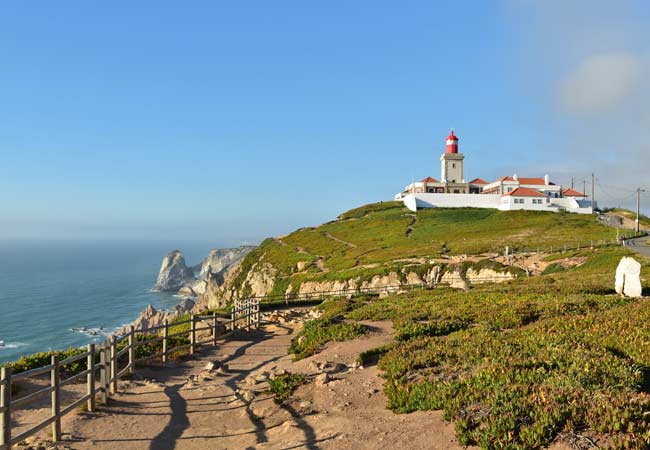
The Cabo da Roca with the powerful lighthouse to the rear
Queijada de Sintra
No visit to Sintra is complete without trying its most historic sweet treat, the Queijada de Sintra. This small, round pastry has a history dating back to the medieval period and offers a unique taste of the region.
The Queijada consists of a sweet, dense filling made from fresh cheese (queijo fresco), sugar, and eggs, lightly dusted with cinnamon. What makes it distinctive is its paper-thin, crisp pastry case, which provides a satisfying crunch against the soft centre.
While many local cafés sell them, the most famous and historic producer is the Casa Piriquita, a family-run bakery located in the town centre that has used a secret recipe since 1756.

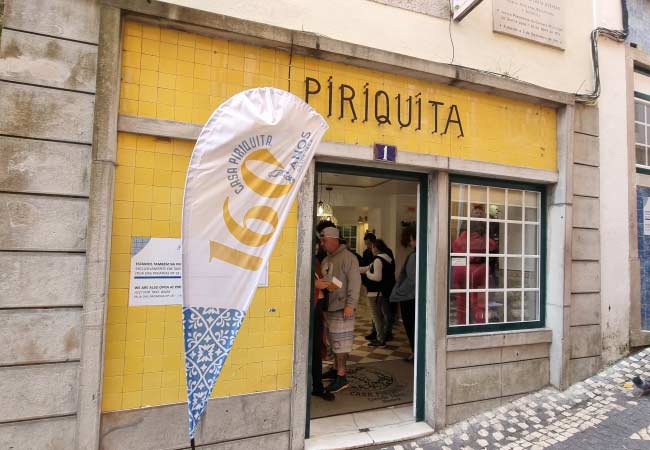
Praia das Maçãs and the Sintra Tram
Praia das Maçãs is a charming coastal resort town that offers the largest and most easily accessible beach from Sintra. This wide, golden sandy bay is a popular summer destination, especially for families, and the town is well-equipped with seafood restaurants and cafés. Its name, "Beach of Apples," originates from when apples from inland orchards would fall into a stream and wash up on the shore.
Part of the town's appeal is the journey itself. A historic heritage tram connects Sintra to Praia das Maçãs, trundling leisurely along the 13km route. This delightful ride in vintage wooden carriages passes through the scenic countryside, offering a completely different perspective of the region.
Related articles: Guide to Praia das Maçãs
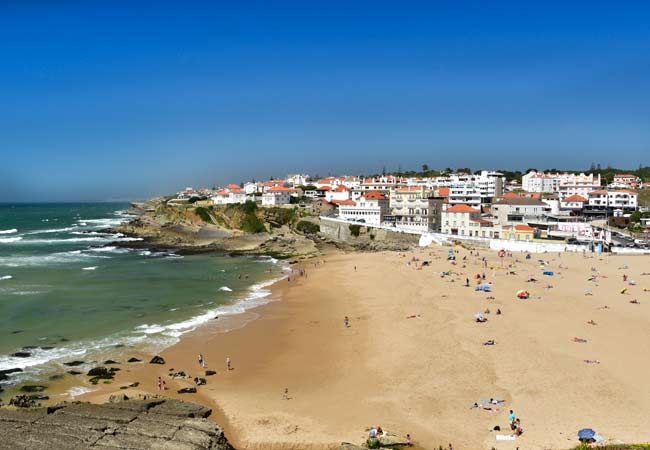
The Praia das Maçãs is a fantastic beach
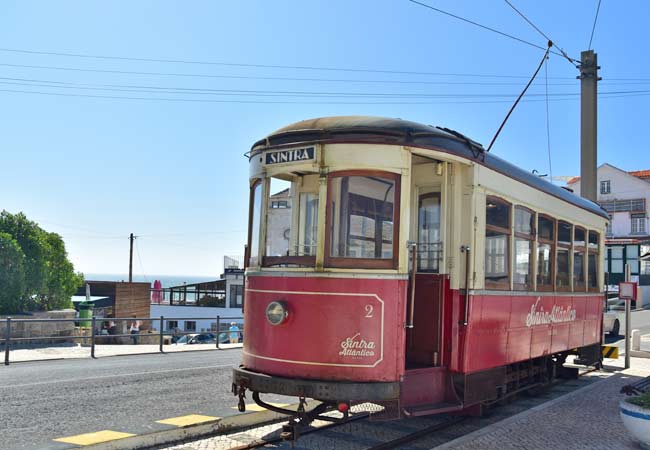
The delightful tram connecting Sintra to Praia das Maçãs
Santuário da Peninha
Perched atop a dramatic rocky outcrop at 488 metres, the Santuário da Peninha offers what is arguably the most spectacular viewpoint in the entire Serra de Sintra. On a clear day, the 360-degree panorama extends from the coastlines of Cascais and Ericeira to the Arrábida peninsula south of Lisbon.
The site itself is a curious mix of the sacred and the romantic. It includes the small, 17th-century Capela de Nossa Senhora da Peninha, built on a spot where the Virgin Mary is said to have appeared. Beside it stands the shell of an unfinished, romanticist-style chalet from 1918, which adds to the windswept and mysterious atmosphere.
While reaching the summit requires a car, the breathtaking views make it a worthwhile detour, easily combined with the scenic drive along the N247.
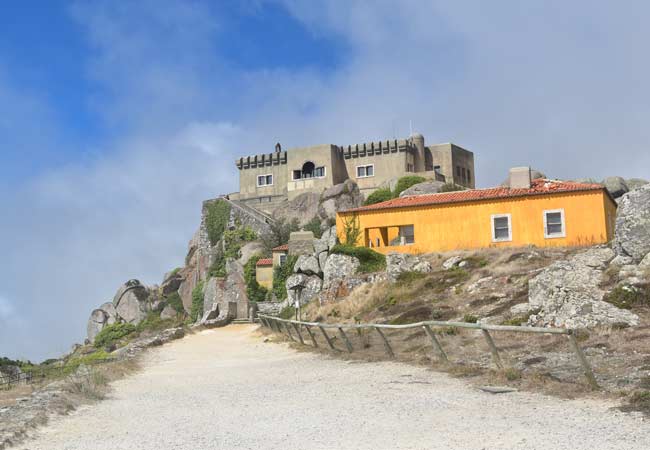
The Santuario da Peninha
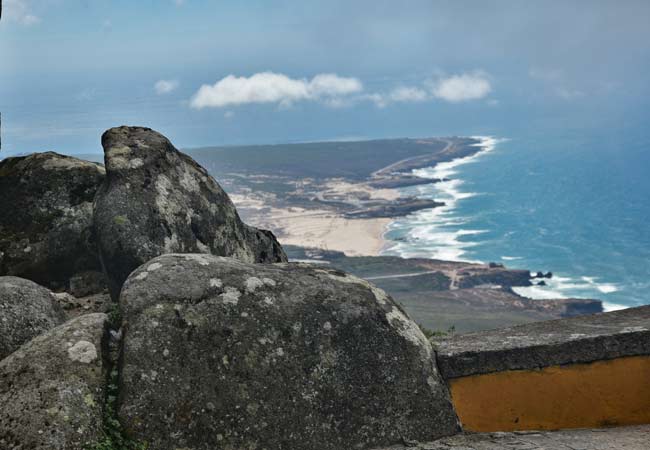
The view over the Sintra coastline from Peninha
The Palácio de Queluz
The Palácio de Queluz is a splendid 18th-century palace that stands as one of the last great Rococo buildings to be designed in Europe. Located between Lisbon and Sintra, it was conceived not as a formal seat of power, but as a lavish summer retreat for leisure and entertainment for King Pedro III.
The palace's interior is a showcase of exuberant artistry. The opulent Throne Room, with its gilded carvings and mirrored walls, hosted grand balls, while the elegant Music Room was the setting for concerts and operas. However, the palace also has a more sombre history. It became the place of confinement for Queen Maria I following the death of her husband and her subsequent period of severe mental illness. Queluz was also the final residence of the Portuguese royal family before they fled to Brazil in 1807 to escape Napoleon’s invading army.
Just as impressive are the magnificent formal gardens, inspired by French design. They feature intricate parterres, fountains, and statues. A highlight is the Canal dos Azulejos, a grand canal lined with blue and white azulejo tiles, which could be flooded to allow the royal court to enjoy boat rides

The highlight of the Palácio de Queluz are the gardens and exterior of the palace

The Sala dos Embaixadores (Ambassadors Room)
Praia da Ursa
For those seeking one of the most visually stunning and wild beaches on the Sintra coastline, Praia da Ursa is an unforgettable destination. Its remote location at the base of steep cliffs ensures it remains a peaceful escape from the region's more crowded spots.
The beach is named for its colossal sea stacks, which are sections of harder rock that have resisted the constant power of the Atlantic waves. One of these formations, the ‘Rocha da Ursa’, is said to resemble a bear (ursa in Portuguese) protecting its cub.
Reaching this secluded cove is part of the experience. Access requires a hike along uneven dirt tracks, followed by a scramble down a steep path on the cliff face. Sturdy footwear is essential. The most rewarding approach is the scenic 1.7km coastal trail from Cabo da Roca, making it a perfect, adventurous extension to a visit to Europe’s westernmost point.
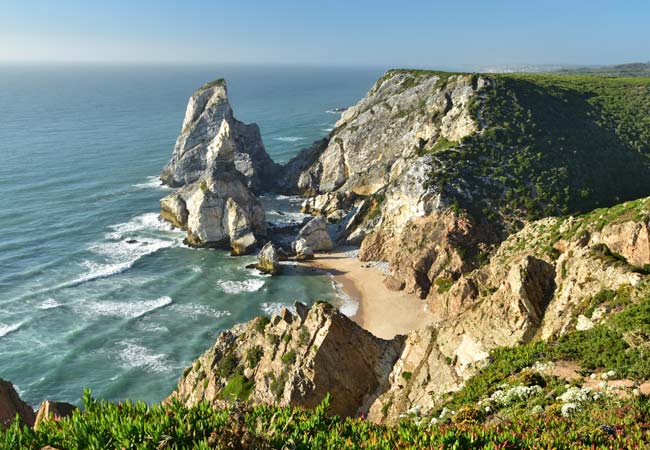
The Praia da Ursa is a picturesque beach that faces the powerful Atlantic Ocean.
The N247 Scenic Drive
For those with a car, the drive along the N247 between the village of Azóia and the town of Cascais is one of the most rewarding scenic routes in the region.
Starting high in the hills of the Serra de Sintra, the road twists and descends from the cool, dense forests, opening up to reveal a spectacular coastline. This stretch offers wonderful panoramic views over the windswept cliffs and the Atlantic Ocean. A major highlight is the section that passes the vast, sandy expanse of Praia do Guincho, a beach famous for its powerful surf. From there, the road continues along the coast before arriving at the charming resort town of Cascais.
Related articles: The best driving routes in the Lisbon region
Câmara Municipal de Sintra
The Câmara Municipal de Sintra (Sintra Town Hall) is a wonderful final flourish of the town’s distinctive Romanticist architecture. Inaugurated in 1909, this civic building is a fantasy in the Neo-Manueline style, drawing inspiration from Portugal’s golden Age of Discovery.
Its most striking feature is the flamboyant central tower, crowned with a tiled, conical roof that resembles a fairytale turret. The main façade is equally elaborate, featuring pointed arches, the national coat of arms, and decorative stonework.
As this is a functioning administrative building, the interior is not open to the public. However, its impressive exterior is well worth admiring and is conveniently located a short walk from the train station, in the more modern part of town.
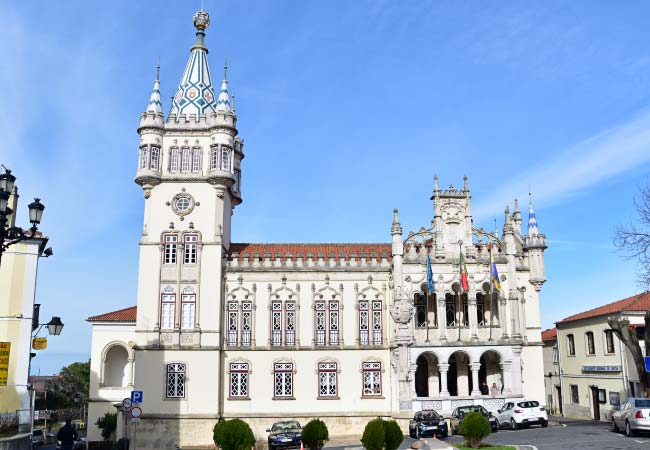
Discover more of Sintra with our most popular guides


About this guide I'm Philip Giddings. I have been exploring Portugal since 2001, and writing the independent guides at Sintra-Portugal.com since 2008. I live in Lisbon with my Portuguese wife, Carla, who first took me up to Sintra on one of my earliest trips to the country. We have been going back ever since: summer crowds, autumn fog, the quiet Sunday afternoons of January. The region has changed a great deal in twenty-five years of visits, and we have watched it happen.
The site takes no payment from tourist boards, tour operators, or attractions for inclusion. It is funded by affiliate commissions on tour bookings, disclosed on every page that contains them. Every practical detail in these guides (ticket prices, opening hours, bus routes, time-slot policies) is checked against the official Parques de Sintra site, and verified in person on visits two or three times a year. Read my full bio here.