Sintra-Portugal.com
The best independent guide to Sintra
Sintra-Portugal.com
The best independent guide to Sintra
Lisbon to Sintra: how to travel to Sintra in 2026
Twenty-five kilometres. Forty minutes. One direct train. That is all that stands between the centre of Lisbon and one of the most extraordinary towns in Europe. The train from Rossio to Sintra is the best-value trip in Portugal, and it is the reason you do not need a car, a tour bus, or a clever plan to reach the painted palaces in the hills.
Two train lines run from central Lisbon directly into Sintra, both inexpensive and both frequent. The trickier questions are the ones that come before and after the train: which station to depart from, when to set off, how to reach the Pena Palace once you arrive, and why driving to Sintra is the one thing you must not do.
I have been exploring Portugal since 2001, and after five years of living in Lisbon with my Portuguese wife, the train to Sintra has become as familiar as the walk to our local café. This guide will help you choose the right station, buy the right ticket, and step off the train in Sintra ready to enjoy the town rather than untangle it.
Related articles: Sintra introduction - Day trip to Sintra
Never drive to Sintra: The historic centre is closed to traffic, the road up to the Palácio da Pena was built for carriages rather than coaches, and the few parking spaces in town fill before nine. By midday in peak season the whole place is gridlocked. Take the train.
Lisbon to Sintra: an overview
Two train lines run from central Lisbon to Sintra, and choosing between them comes down to where you are starting your day. Both are inexpensive, both are frequent, and both deliver you to the same station 25 kilometres west of the capital.
• Rossio to Sintra is the line most visitors will want, and the one I take nine times out of ten. Rossio station sits in the heart of Lisbon, a short walk from the Baixa and Chiado, and the journey to Sintra takes 40 minutes.
• Oriente to Sintra is the better choice if you are coming from the airport, the east of the city, or arriving in Lisbon by intercity train. This route is marginally longer at 47 minutes but is much quicker and cheaper than crossing the city from the airport by Uber or Taxi.
Buses do run between Lisbon and Sintra, but they are slower than the train and the bus stations are less conveniently placed for most visitors. Unless you have a specific reason to take one, the train is the answer.
The interactive map below shows both routes, with the Rossio line in green and the Oriente line in blue. Zoom in or out to see every stop.
Rossio to Sintra (Green): 1) Rossio 2) Campolide 3) Queluz 4) Sintra
Oriente to Sintra (Blue): 5) Oriente 6) Braço de Prata 7) Roma-Areeiro 8) Entrecampos 9) Sete-Rios 3) Queluz 4) Sintra
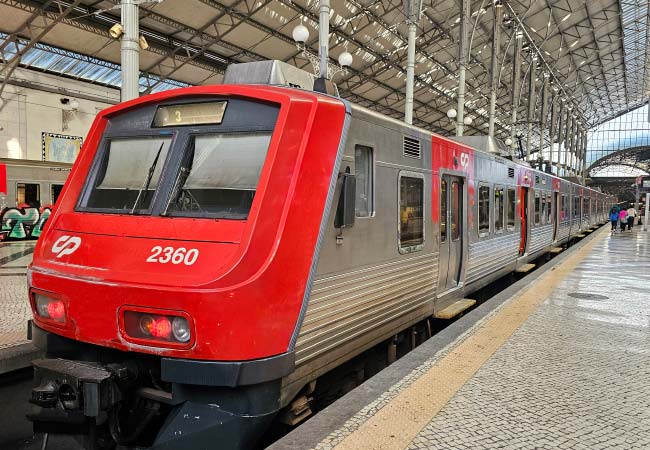
The train to Sintra, waiting at Rossio station
Details of the Sintra train services
Both lines are run by Comboios de Portugal (CP), the national train company, as part of the Lisbon urban network. These are working commuter routes, which is good news for visitors: trains depart every 20 minutes or so from early morning until late at night, and seats are almost always easy to find. The journey takes 40 minutes from Rossio and 47 minutes from Oriente. For the latest timetable, see the CP website:
www.cp.pt
The link opens a PDF, which may download on some mobile devices.
Tickets cannot be booked in advance, as this is an urban service rather than an intercity one. In practice this rarely matters, since the trains are long and the seats plentiful. What can matter, particularly in summer, is the queue for the ticket machines at Rossio, which can stretch out of the station door by mid-morning.
The best advice I can give is the simplest: go early. A train caught before nine will save you a queue at Rossio, a queue at Pena, and a queue for lunch. I have rarely regretted setting an alarm in Sintra; I have often regretted not setting one.
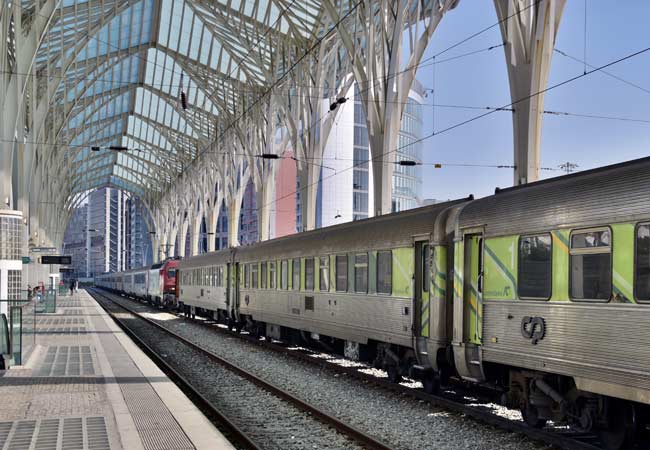
The Estação do Oriente train station sits in the east of Lisbon
Sintra-Lisbon fares and tickets
The fare to Sintra is the same from every train station in Lisbon, so you do not need to factor cost into your choice of departure station. A single adult ticket costs €2.55, a child ticket €1.30, and there is no discount for buying a return: a round trip is simply the price of two singles. For the full pricing policy, see the CP website:
www.cp.pt
(The link opens a PDF)
There is one quirk worth understanding before you reach the ticket machine. The fare is not a paper ticket but a charge loaded onto a reusable card called the Navegante, the same card used across Lisbon's metro, buses, and trams. The card itself costs €0.50, holds the fare for one person only, and must be empty of any other unused fares before a Sintra ticket can be added to it.
A 24-hour unlimited urban-train ticket is also available for €6.70, but it only pays for itself if you are making more than three journeys in a day, which most visitors are not.
Zapping: the smarter way to pay
There is a better way to handle the Navegante card, and almost no first-time visitor knows about it. It is called Zapping, and it does two useful things at once: it cuts the fare to Sintra to €2.05, and it lets you skip the ticket queue at Rossio entirely.
Zapping works like a pay-as-you-go credit balance loaded onto the same Navegante card. The catch, and the reason most visitors never discover it, is that you can only top it up at a metro station, not at the train station you are travelling from. Walk into any metro ticket machine, add credit, then tap through the barriers at Rossio or Oriente and the fare is deducted automatically. The same balance also covers Lisbon's metro, trams, and buses, so a single card carries you across the whole network.
When friends come to stay, I load a Navegante with €15 of Zapping credit before they arrive. It saves them queuing at every machine in the city, and it usually lasts the weekend. If you are in Lisbon for more than a day, I would do the same.
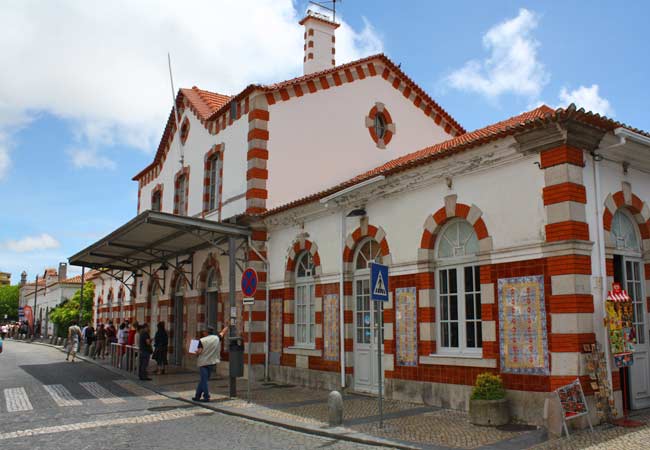
The only time I see Sintra station this empty is before 8am. Expect a very different scene when you arrive.
Should you join an organised tour?
Honestly, yes, for a lot of visitors. Sintra is unusual among Portuguese day trips in that an organised tour often produces a better day than going alone. The main sights sit on steep wooded hills, the 434 bus fills up by mid-morning, and timed-entry tickets to Pena routinely sell out by lunchtime. A tour solves all three with a driver, pre-booked entries, and a route tested against the day's crowds.
I have worked with GetYourGuide.com for the last seven years, and the tours below are the ones I would send friends on.
The links above are affiliate links, and I earn a small commission if you book through them. I really appreciate it, as it helps me keep this website running.
If you want to see both in a single day, a tour is the only realistic way to do it. Public transport between the two eats most of the daylight. Both towns deserve a full day each, and I would urge you to find one for Cascais if you can, but if the calendar will not stretch, a tour is the answer.
Uber and Bolt between Lisbon and Sintra
For some journeys, a ride-hailing app is the better answer. Uber and Bolt both operate widely between Lisbon and Sintra, the fares are more reasonable than you might expect, and there are moments when the convenience is worth every cent.
The clearest case is travel with children. When my brother was visiting with his young family, we took an Uber up to the Pena Palace and another back into Lisbon at the end of the day, and the second journey alone justified the cost. Tired children and a packed evening train are a combination best avoided. Uber and Bolt also earn their place if your accommodation in Lisbon is nowhere near Rossio or Oriente, or if you simply want to start the day without the queues at the ticket machine.
The base fare from central Lisbon to Sintra is around €30, though the exact price depends on demand, traffic, and the address you give as your drop-off point. Mid-morning is the easy time: drivers are plentiful and fares are at their lowest. The trouble comes later in the day, when every visitor in Sintra is trying to leave at once, and again during the Lisbon rush hour. At these times fares can rise by 50 per cent, and you may wait twenty minutes for a car to accept the trip.
A few practical notes from years of using both apps. Uber is marginally more expensive than Bolt, but in my experience the cars are newer and the drivers more reliable, which is why I almost always choose it. For the Lisbon to Sintra run, I would book the Comfort tier rather than the standard one. It costs around 15 per cent more, gets you a larger car, and, just as usefully, attracts drivers more quickly at peak times, since a Comfort driver can accept either fare and will always take the better-paying one.
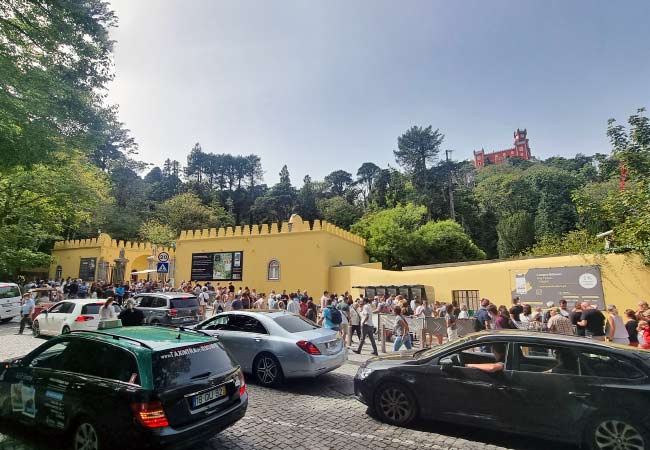
Driving to Sintra
I made the mistake once, in 2007, and I have never made it again. The narrow mountain road up to the Palácio da Pena was built for horse-drawn carriages rather than coaches, and the few parking spaces in town fill before nine in the morning. If it was bad in 2007, with a fraction of today's visitor numbers, I can only imagine what it is like now, especially now that the historic centre is closed to traffic. By midday in peak season the whole place is gridlocked, with frustrated drivers circling streets that have no spaces to give. Take the train. Every line of this guide assumes you will.
If you must drive
If your itinerary really does require a car, here is the least painful way to do it. The main road from Lisbon is the A37, which moves freely outside rush hour but slows badly during the morning and evening commutes. Aim to drive out of Lisbon before 8am or after 10am, and the journey takes around 40 minutes.
The best parking is at Portela de Sintra (GPS 38.800, -9.381), the secondary train station about a kilometre east of the main one. Leave the car here, walk over to the station, and catch the 434 bus that departs from this stop. The queue is almost always shorter than at the main Sintra station. There have been reports of theft from this car park, so leave nothing visible inside the car, and nothing at all of any value.
Useful train Information
Rossio train station
Rossio train station (Estação Ferroviária do Rossio) sits just to the north of Rossio plaza in the heart of the Baixa district (GPS: 38.714, -9.140). It is served by Rossio metro station on the green line, but the metro exit puts you on the wrong side of Rossio plaza, so you will need to cross the square to reach the platforms.
The station itself is small and easy to navigate, and every train departing from here is heading to Sintra. The catch is the crowd. Between 10am and midday, Rossio fills with tourists, and the queues for the ticket office and machines can stretch out of the door. This is the single best reason to arrive early, or to load Zapping credit onto a Navegante card the day before.
Related articles: Rossio station
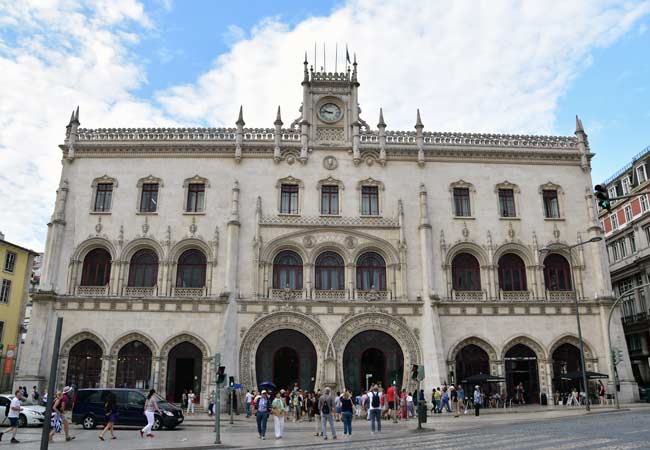
The ornate façade of Rossio station
Estação do Oriente
Estação do Oriente GPS: 38.7675, -9.099 sits in the northeast of the city, in the Parque das Nações district, just 2.5km from the airport and directly connected to the red metro line.
As Lisbon's main intercity station, Oriente is part of a larger transport interchange that brings together trains, the metro, and the city's principal bus terminal. The complex is always busy, but it is well organised and, in my experience, easier to travel from than Rossio. The train platforms are on the top level, with the ticket offices on the floor below. Across the road, the Vasco da Gama shopping centre has an excellent food court if you arrive with time to spare before your train.
Related articles: Estação do Oriente - Parque das Nações
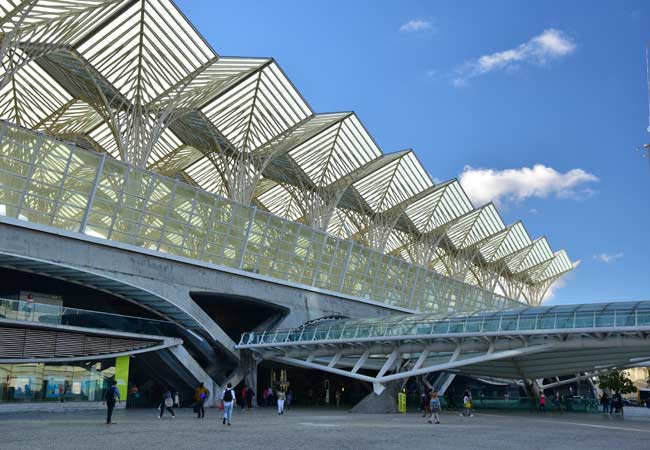
Oriente station is ultra-modern and was constructed for Expo ‘98
Sintra train stations
Both lines terminate at Sintra train station, which sits 1.5km east of the historic centre (GPS: 38.798, -9.386). It is a pleasant walk from the station into town, or, if you are heading straight up to the Palácio da Pena, the 434 tourist bus is the answer.
A warning about the scene on arrival. Step out of Sintra station and you will be met by a small crowd of guides, drivers, and salespeople offering tours, tuk-tuks, and every other way of exploring the town. Most of it can be ignored. The 434 bus is the cheapest and most efficient way up the hill to Pena, and if you want a guided tour of Sintra, the better option is one that includes pick-up from your Lisbon accommodation, which spares you the public transport at both ends of the day.
Before you set off sightseeing, the Café Cintia opposite the station is a reliable place for a coffee and a pastry at sensible prices. This is where I start my day in Sintra, cake and strong coffee!
Sintra has a secondary station, Portela de Sintra, but it sits further from the historic centre and is of little practical use to visitors. The one reason you might consider it is that a second 434 bus departs from here, and the queue is always shorter than at the main station.
Train safety
The Lisbon to Sintra line is safe by day, and I have travelled it hundreds of times without incident. It is worth knowing, though, that the route passes through some of the poorest and most deprived suburbs of Lisbon, areas most tourists will never otherwise see, and the carriages can reflect that. By daylight this is rarely a problem. After dark it pays to be more careful.
My wife, who grew up in Portugal and knows the line far better than I do, will not board a late carriage unless there are other tourists or families already in it. She picks her carriage rather than taking the first one she reaches, and she will move at the next stop if the one she is in feels off. Do not lay a camera on the seat beside you, and if you are travelling back to Lisbon at night, aim for a carriage with other visibly tourist passengers. None of this should put you off the train. It is the right way to reach Sintra, but the line is not a Disneyland shuttle.
The 434 bus
The Palácio da Pena and the Castelo dos Mouros are the two finest attractions in Sintra, and both sit at the top of a very steep hill above the town. There is a footpath, the Caminho de Santa Maria, which climbs to the palaces in around 55 minutes, but it is a demanding walk and most visitors will be better off taking the 434 tourist bus.
The 434 runs as a one-way loop, picking up at the train station, calling at the historic centre, and then climbing the hill to the Castelo dos Mouros and the Palácio da Pena before looping back down. Buses leave from outside the train station up to four times an hour.
Related articles: 434-tourist bus
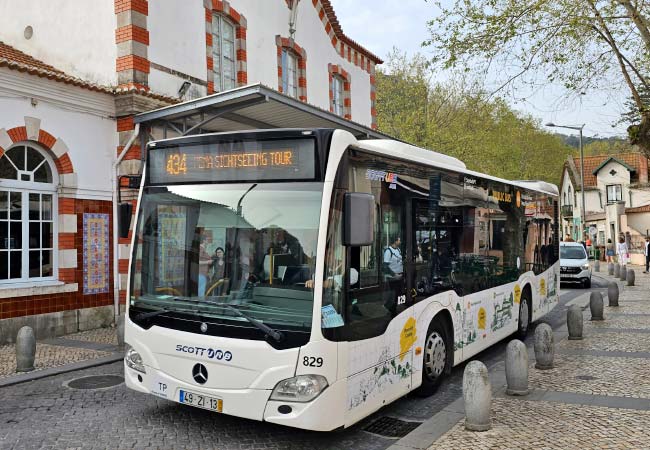
The 434 bus waiting outside the train station
Walking from the station to the historic centre
The walk from Sintra train station into the historic centre is one of the small pleasures of the day. There is no need for a taxi, and the 434 bus is far better saved for the climb up to Pena. The signage at the station is poor, which is the only reason this short walk causes any confusion at all. From the far end of the platforms, take the road bearing right, Avenida Dr. Miguel Bombarda, and follow it into town.
I really like this walk. It takes a little longer than you might expect, around fifteen minutes, as the road weaves around the head of a deep valley rather than crossing it. The walk is scenic and a pleasant introduction to Sintra. The Palácio Nacional de Sintra sits across the valley, its two white conical chimneys rising out of the wooded hills, and in summer the pavement fills with stalls selling handicrafts and gifts of better quality than most Portuguese tourist towns offer.

The whimsical styled Câmara Municipal
Travelling to Sintra from...
Lisbon airport to Sintra
Getting from Lisbon airport to Sintra is easier than most arrivals will expect. Take the red metro line from the airport three stops to Oriente, walk upstairs to the train station that sits directly above the metro, and board the next train to Sintra. The whole connection, including a typical wait, takes around an hour.
The metro fare from the airport to Oriente is €1.90, loaded onto a Navegante card in the usual way. The distance is only 2.5km, so if you are travelling with luggage or several people, a taxi for €7-10 is often the easier option. Inside the Estação do Oriente, the metro is on the lower level and the train platforms are upstairs.
Related articles: Travel from Lisbon airport
Lisbon intercity train service to Sintra
Portugal has an excellent express train network connecting Porto, central Portugal, and the Algarve to Lisbon, and almost every intercity service terminates at the Estação do Oriente. From here the connection to Sintra is straightforward: walk to the same platform level you have just arrived on and board a Sintra-bound urban train.
Lisbon's other intercity station, Santa Apolónia, is far less convenient for Sintra. The connection involves catching the green metro line to Rossio and then walking across to Rossio train station, which is fine in principle but adds time and two changes to the journey. If you have a choice of intercity service, Oriente is the one to book.
Lisbon intercity bus service to Sintra
Lisbon has two main intercity bus terminals, and the onward connection to Sintra depends on which one you arrive at.
Oriente bus station handles international services and private coach operators, and sits within the Oriente train station complex. From the bus, walk through the interchange to the train platforms and continue to Sintra on the Oriente line.
Sete Rios bus station is the home of Rede Expressos, Portugal's main domestic coach company. Connection to Sintra is via the neighbouring Sete Rios train station, which sits on the Oriente to Sintra line, so any Sintra-bound train calling here will take you the rest of the way. It is a short, well-signed walk between the bus terminal and the train station.
Related articles: Sete Rios bus station
Our most popular guides to Sintra


About this guide I'm Philip Giddings. I have been exploring Portugal since 2001, and writing the independent guides at Sintra-Portugal.com since 2008. I live in Lisbon with my Portuguese wife, Carla, who first took me up to Sintra on one of my earliest trips to the country. We have been going back ever since: summer crowds, autumn fog, the quiet Sunday afternoons of January. The region has changed a great deal in twenty-five years of visits, and we have watched it happen.
The site takes no payment from tourist boards, tour operators, or attractions for inclusion. It is funded by affiliate commissions on tour bookings, disclosed on every page that contains them. Every practical detail in these guides (ticket prices, opening hours, bus routes, time-slot policies) is checked against the official Parques de Sintra site, and verified in person on visits two or three times a year. Read my full bio here.
 -
-


If you've found our content valuable, we'd welcome your support.
The digital publishing landscape has evolved significantly. As a small independent publisher, we face growing challenges. Search engines increasingly favour paid content over organic results, while AI-generated content often reproduces original work without attribution.
To support our work, please consider bookmarking this page (press Ctrl + D) for quick access. If you find an article helpful, we'd be grateful if you'd share it with friends on social media.
For specific questions, please see our Reddit community at r/LisbonPortugalTravel.
Should you notice any outdated or incorrect information, please contact us at [email protected]
Thank you for helping us continue to provide valuable content in an increasingly challenging digital environment.