Sintra-Portugal.com
The best independent guide to Sintra
Sintra-Portugal.com
The best independent guide to Sintra
Castelo dos Mouros, Sintra: an independent tourist guide for 2026
A castle that was lost to the forest for 700 years.
That is the story of the Castelo dos Mouros, the ruined Moorish stronghold that snakes along a craggy ridge high above Sintra. Built in the 8th century to guard the Atlantic approaches, captured by Christian crusaders in 1147, then slowly forgotten, swallowed by the dense woods of the Serra de Sintra, and battered by lightning and earthquake until barely a wall stood straight. By the 1830s, it was little more than a tumble of granite among the trees.
What you walk through today is not quite the castle the Moors built. It is the castle a Romantic king dreamed back into existence. King Ferdinand II, the same Bavarian-born monarch who conjured the Palácio da Pena out of a ruined monastery on the next peak, fell for the picturesque decay of the Moorish ruins and rebuilt them as a showpiece in the grounds of his palace. Every restored battlement, every winding forest path, every framed view back to Pena was placed there by design. You are not visiting a Moorish castle. You are visiting Ferdinand's idea of one.
The Castelo dos Mouros is not the headline act of Sintra. The Palácio da Pena holds that title, and rightly so. But this is a place I find myself coming back to: for the long views down to the coast, for the walk along 450 metres of battlements above the treetops, and for the quiet of the Caminho de Santa Maria pathway as it threads back down to the town.
I have been exploring Portugal since 2001, and have lost count of the times my Portuguese wife and I have walked friends up to the Castelo dos Mouros. This guide will help you decide whether the castle is worth your time, when to go to dodge the crowds and the fog, how to pair it with Pena, and what to look for inside the walls.
Personal highlights of the Castelo dos Mouros
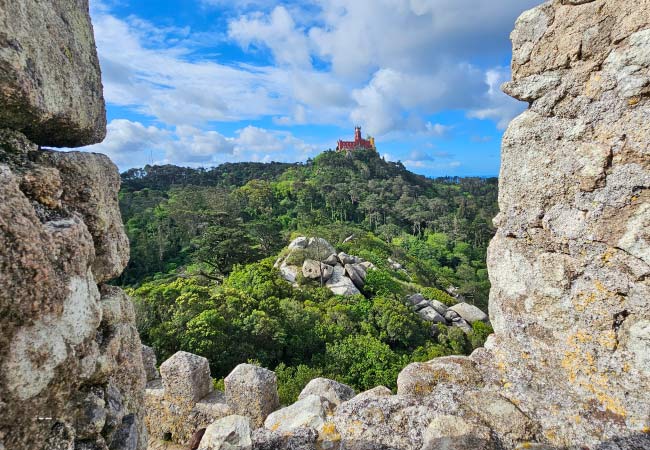
The Torre Real (King's Tower). The highest point of the castle, and Ferdinand's favourite spot on the ridge. Two hundred and twenty steps up. At the top, the whole Serra opens out, with Pena rising on the next peak and the Atlantic glinting beyond.
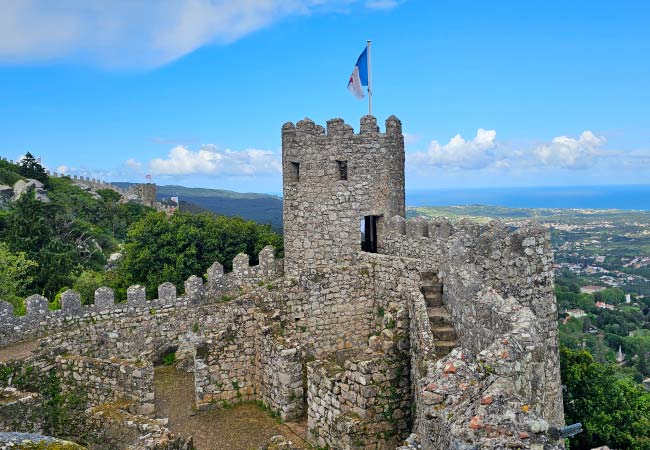
The Alcáçova. The original keep, and the last place the Moors would have fallen back to in a siege. Narrow stone steps lead up to the battlements. The wind up here rarely lets up, even on a still day in Sintra below.
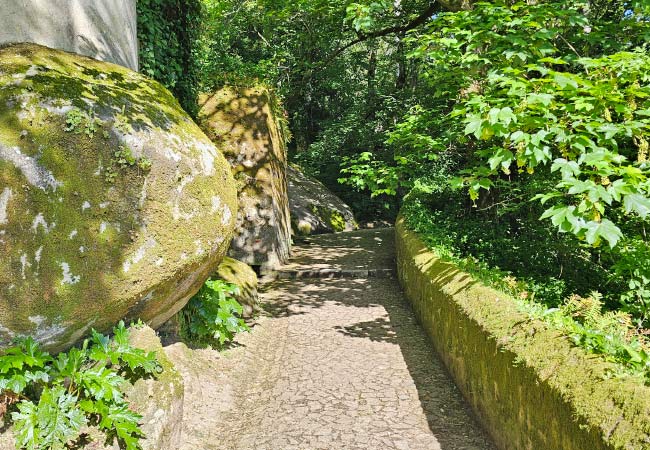
The Caminho de Santa Maria. The footpath down to Sintra through the woods, past the outer walls and the great granite boulders the castle was built around. I would always take this over the 434 bus, even with tired legs. (Caminho de Santa Maria guide).
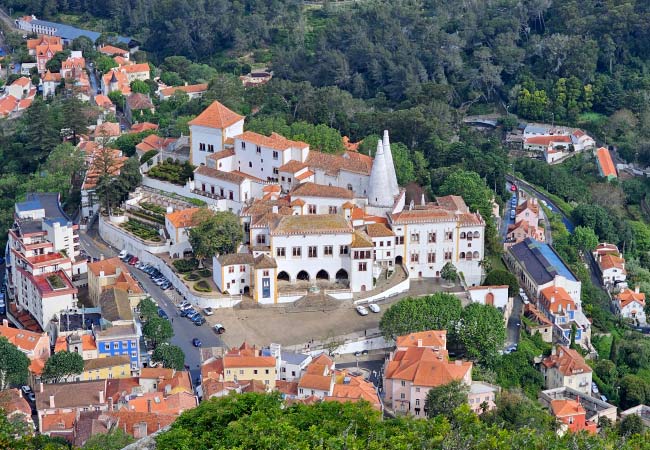
Views over Sintra. On a clear day the coast unrolls all the way to Mafra and Ericeira, with the red roofs of the old town directly below and the Palácio Nacional at its centre. The Moors built here for the sightline. Ferdinand restored it for the view. Both made the right call.
What to expect from the Castelo dos Mouros
I love the Castelo dos Mouros for the clamber of it. The views, the woods, the long walk along the walls, and the even longer walk back into Sintra. Not everyone agrees. Friends I have brought here have called it just a castle, with nothing to anchor a visit and a lot of uneven steps to climb. I would not bring my five-year-old nephew here either. The walls are uneven, the drops are real, and there are no guard rails.
Come prepared to climb. Reaching the towers and the high viewpoints means a lot of steps, and the castle is bigger than it looks: more than 450 metres of battlements and five towers, all open to walk. The battlements are narrow and unprotected. If you have vertigo, skip the castle.
The setting does a lot of the work. The upper walls ride a ridge of massive granite boulders. The lower walls disappear into old forest. If you come to a castle for the exploring as much as the history, this one delivers.
Sintra has four headline sights. Most rankings put Mouros fourth, behind Pena, Quinta da Regaleira, and Monserrate. That ranking is fair. The other three each have a single image that visitors come to photograph: the painted terraces at Pena, the Poço Iniciático at Regaleira, the intricate stonework at Monserrate. Mouros has no equivalent. What it has instead is the ridge, the walk along the ruined walls, and the views.
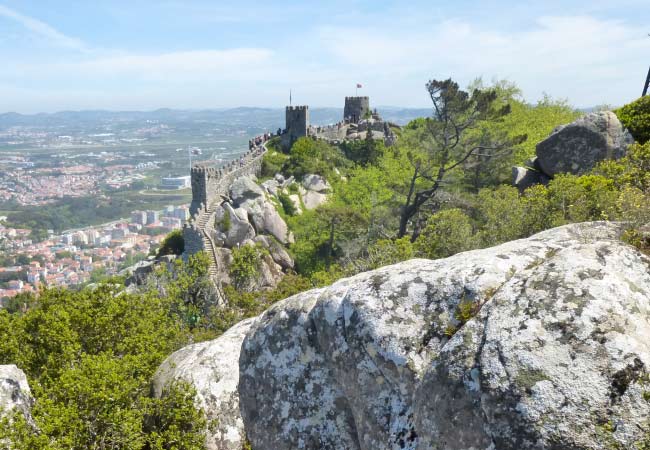
The Castelo dos Mouros was constructed around massive boulders
Tourist information for the Moorish Castle
Adult admission is €12. Reduced tickets are €10 for youths (6–17) and seniors (over 65), and a family ticket covering two adults and two children is €33. Children under five go free. Tickets can be bought through GetYourGuide here. The family ticket is the only one I would call good value. Otherwise the prices are what they are, and Sintra has long since stopped pretending its sights are cheap.
The good news is that you do not have to book in advance. Unlike most of the other sights in Sintra, tickets at the Castelo dos Mouros are sold at the gate and entry is not timed. That makes it a useful pairing with the Palácio da Pena, where queues are long and entry slots are strict. If your Pena slot is at 11:00, do the Mouros first.
Insight: It is only 200m from the entrance of the Castelo dos Mouros to the ticket office of the Palácio da Pena. Walk it. There is no need for the crowded 434 bus, a taxi, an Uber, or a tuk-tuk.
The castle is open from 9:00 to 18:00, with last admission an hour before closing. Allow 60 to 90 minutes once you are inside. Less if you skip the longer battlements, more if you take your time on the Torre Real.
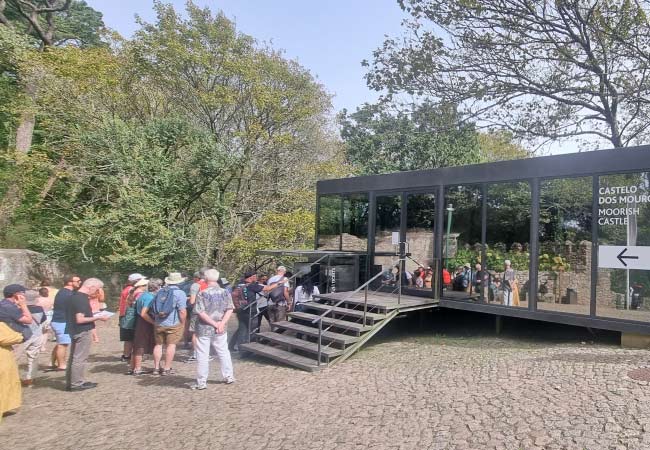
Summer time queues for the ticket machines
Peak hours are 10:30 to 12:00 and 13:00 to 15:00. The battlements get tight in those windows, and I have had to squeeze past other visitors more than once, stepping closer to the unguarded edge than I would like to let them pass. Go early or go late to avoid this happening to you. Late afternoon (post 4pm) is my own preference, especially in summer, when there is no shade on the battlements and the climb to the Torre Real is hard work in the midday sun.
Outside the summer months, fog is the bigger problem. The hills above Sintra trap it, and it can sit on the ridge all day. The views are most of why you are here. If the fog is in, come back another day. The same goes for rain. I was caught here during a winter downpour once, and the granite battlements were slick and treacherous for hours afterwards.
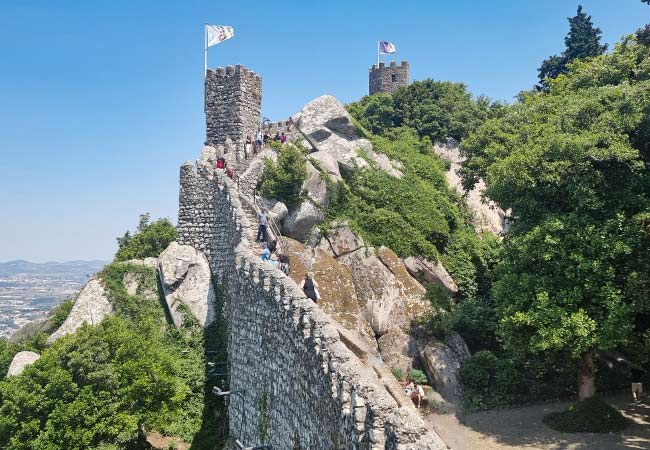
The narrow pathways and steps of the battlements
The café onsite is basic and the options are limited. Bring your own snacks, and plan to have lunch back down in Sintra town, where the choice is far better than anything at the top of the hill. The toilets are better news. There are two sets, one by the café and another on the main road opposite the ticket office.
Accessibility: There has been a push to make the Castelo dos Mouros more accessible, with ramps and powered stairs in places. The landscape and the nature of the castle mean it will always be one of the least accessible sights in Sintra.
Would a tour suit you better?
After twenty-five years of visits, I know how tiring a day in Sintra can be. A well-run tour takes that hassle off your hands. These are the Sintra tours I've used and happily recommend to friends and family:
The links above are affiliate links, which means I earn a small commission if you book through them, at no extra cost to you. I really appreciate it, as it helps me keep this site free and running.
Sights of the Castelo dos Mouros
There is not much to see inside the walls. Four or five things, depending on how you count. But walk past them without knowing the stories, and you will have walked past most of what makes the castle interesting.
The Igreja de São Pedro de Canaferrim
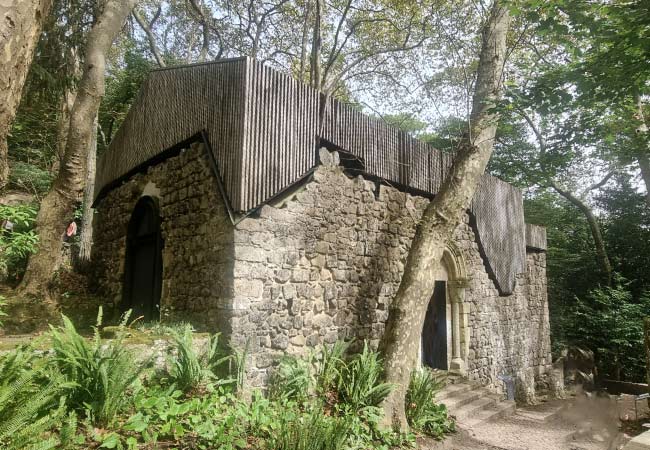
Just inside the outer walls stands the oldest Christian building in Sintra. A small 12th century chapel, raised within a few years of the Christian conquest in 1147 on the footprint of what had been a Moorish prayer room. It served as the first parish church of Sintra until the 14th century, before the long centuries of abandonment began.
The roof you see today is not original. The chapel sat open to the sky for hundreds of years, and was only re-roofed in 2013, when the building was turned into the small museum that occupies it now, the Centro de Interpretação do Castelo dos Mouros. Inside, a small collection of finds from the digs around the castle. Pottery shards. Coins. An iron key, a bone die, fragments of daily life from the families who lived on this ridge a thousand years ago.
The standout piece, for me, is older still. A complete ceramic pot dating from the Neolithic period, around 5,000 BC, turned up by digs that found traces of human settlement here long before either the Moors or the Christians. It is a small thing, in a small case, easily missed.
The graveyard outside the chapel went on taking the dead of Sintra for three hundred years after the Moors were gone. Recent digs identified 33 Christian graves, most holding the bones of more than one person. Ferdinand built a small ossuary against the chapel wall for the remains turned up during his works and it still stands there today.
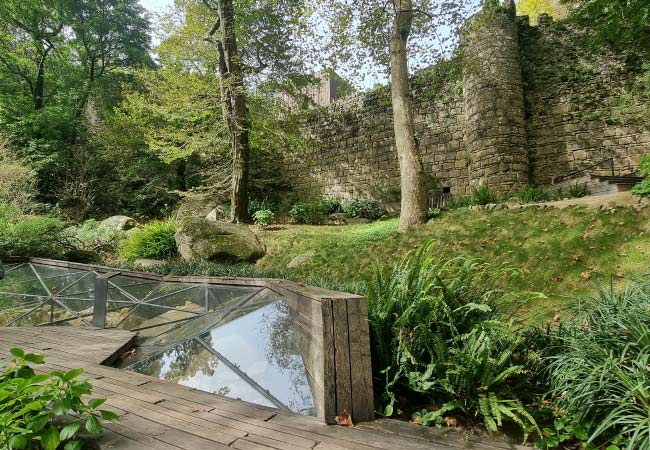
The Torre Real
The Torre Real is the highest point of the castle, at the southern end of the walls. The view from the top is the one you will remember. Ferdinand called it the royal tower because it was his favourite spot on the ridge, and the story goes that he could see it from his bedroom window at the Palácio da Pena, across the saddle. The whole reconstruction was, in part, a piece of staging for his own window. Stand at the Torre Real, look back to Pena, and the alignment is no accident.
The view does the rest. The Atlantic to the west, Pena rising on the next peak, and on the clearest days, the coast unrolling as far as Ericeira to the north and the Serra da Arrábida to the south. On a fogged-in day, none of it is there.
The climb will make you puff. Two hundred and twenty steps from the courtyard, narrow and uneven in places, and there is no shade once you are on the upper section. In high summer, save it for the cooler end of the day. I have made the climb at midday in August and would not do it again.
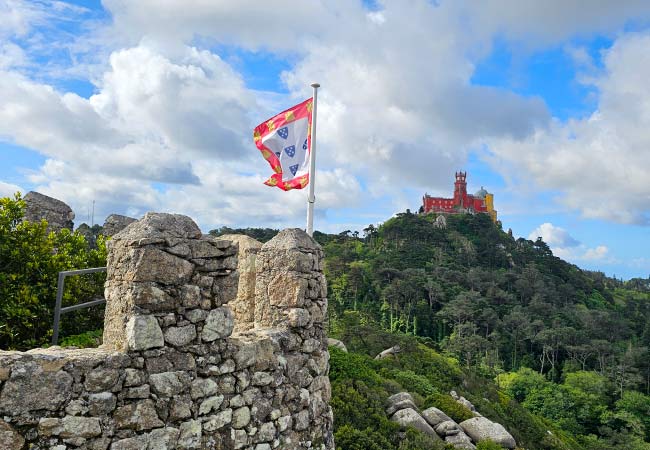
The battlements and the five towers
The walls are what make this castle. More than 450 metres of battlements ride the spine of the ridge, linking five towers, and you can walk every metre. The path is narrow, the stone is uneven, and the drops on either side are sheer and unprotected. The towers themselves are not much more than stone shells, but each one gives you a different angle on the ridge, the woods, and the coast beyond. Walk it slowly.
The Praça de Armas
The flat open space at the heart of the castle is the old parade ground. The Praça de Armas, where the Moorish garrison would have drilled. Ferdinand replaced it with a small Romantic garden in the 19th century, and Parques de Sintra has restored the flowerbeds to match a map from 1898.
Two flags fly here. The Portuguese flag, and a green one with the word Sintra written in Arabic script, marking the centuries when the Moors held the ridge.
The cistern
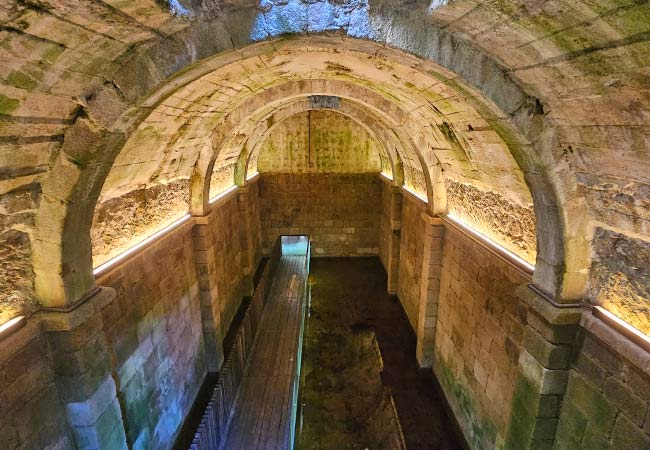
Half-buried near the entrance is the castle's great rainwater cistern. The Moors built it to outlast a siege. The engineering was good enough to keep doing the job long after the castle itself had been forgotten. It holds around 600 cubic metres of water, fed by rainfall and ventilated by two stone chimneys at the top of the vault. It was still supplying water to the town of Sintra in the early 20th century, more than a thousand years after it was first dug. The interior is open to visitors, with a pointed-arch doorway leading inside. Look for the low stone structure to your left as you come in from the ticket gate.
The Moorish silos
Outside the walls, the Moors dug a series of deep silos into the rock to store grain. The early Christians had no idea what they were for, and used them as rubbish pits. A good portion of what is now in the chapel museum was pulled out of those silos centuries later.
The silos themselves are easy to miss. But they are one of the few traces of Moorish daily life left on the site, along with the foundations of houses and a communal bread oven uncovered during the recent excavations.
The Porta da Traição
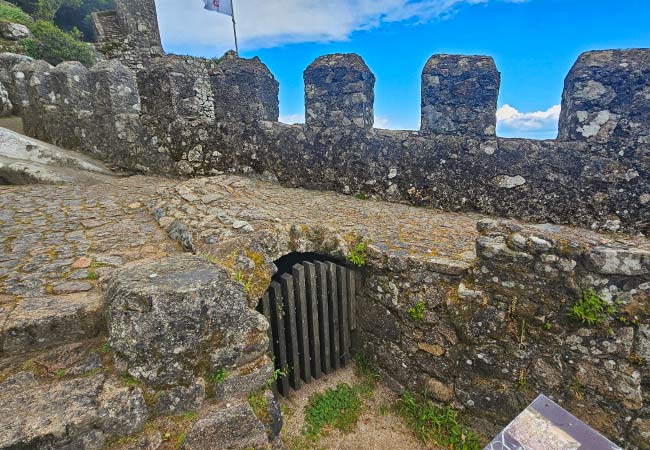
At the highest point of the walls is a small gate, which allowed defenders to secretly escape the castle in times of siege. It could also act as a way to let attackers in, and hence was known as the Porta da Traição, or "Door of Betrayal."
Travel to the castle from Sintra
The Castelo dos Mouros sits 500 metres from the centre of Sintra as the crow flies, and 210 metres above it as the legs feel it. The summit stands at 450 metres, and the climb up from the town is not a gentle one.
The sensible way up is the 434 tourist bus. It runs a one-directional loop from the train station to the Castelo dos Mouros, then on to the Palácio da Pena, then back down through the town centre and round to the station. The 24-hour ticket costs €15 and gives you unlimited use across the day, which most people end up using twice: once up to the castle and Pena, and once back down.
It is worth a warning about driving. Do not drive into the historic centre of Sintra on a day trip. The roads are narrow, the parking is almost non-existent, and the Estrada da Pena (the road up to the castle itself) is closed to non-residents at peak times. I have watched visitors lose hours of their day to a parking space that never turned up.
There are two hiking trails up, the Caminho de Santa Maria and the Vila Sassetti path. Both are pretty, both are steep, and both are too long and too demanding for most visitors making a day trip to Sintra. Going down is a different matter.
The walk back via the Caminho de Santa Maria takes about 25 minutes and is one of the prettiest stretches of footpath in Sintra. Cool, shaded, threaded through old forest, and quiet in a way the 434 never is.
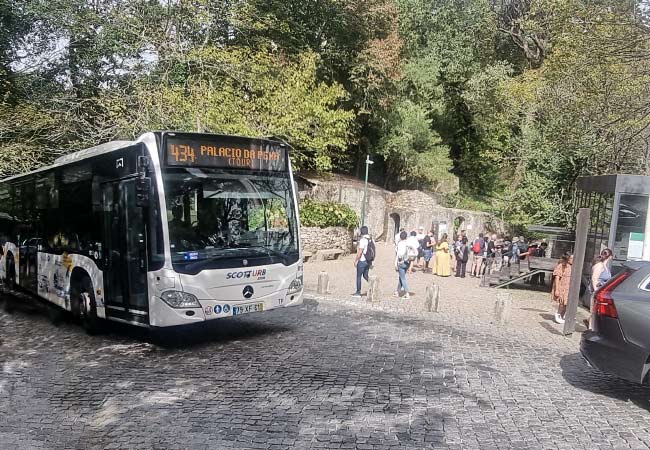
The 434 bus at the entrance to the Castelo dos Mouros
The Castelo dos Mouros or the Palácio da Pena?
If you only have time for one, make it Pena. I say this as someone who loves the Castelo dos Mouros, and who has just spent two thousand words telling you why it is worth your time. But the two are not in the same league.
The Palácio da Pena is the headline act of Sintra, and rightly so. The painted facades, the tiled domes, the carefully restored interiors left as the royal family fled them in 1910. There is simply more to see, more to remember, and more that you will be sorry to have skipped. The Castelo dos Mouros is the ridge, the walls, and the views. Worth the climb, but a thinner day out by comparison.
The catch with Pena is the queues. In summer, tickets sell out days ahead, and the time slots are strict. Book online before you leave home, and treat the slot as the fixed point your day is built around.
That fixed point is what makes the Castelo dos Mouros so useful. Tickets are sold at the gate, entry is not timed, and the castle absorbs whatever time you have around your Pena slot. If your slot is at 14:00, do the Mouros first. If your slot is first thing in the morning, do Pena first and walk down to the castle afterwards. Either way, the order writes itself once you have your Pena ticket in hand.
Related articles: The Palácio da Pena
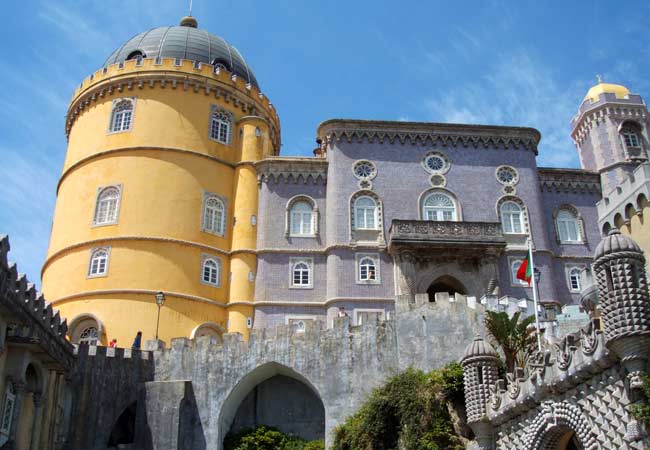
The colourful Palácio da Pena is always a highlight to Sintra
History of the Castelo dos Mouros
The Castelo dos Mouros was built in the 8th century, in the first wave of the Moorish expansion north from North Africa across the Iberian Peninsula. The site was chosen for its sightlines. From the ridge, the Moors could watch the coast in both directions, with Peniche visible to the north and the Serra da Arrábida to the south on a clear day. From up here, a hostile sail could be spotted long before it reached the Tagus.
Arab chronicles describe Sintra as a region of unusually rich cultivated land, and the castle as one of the most important fortifications in the territory. More important, in fact, than the castle at Lisbon.
The first Christian crusade against the Moors, led by King Alfonso VI of Castile, took the Castelo dos Mouros in 1093. Their hold did not last. Within a year the small Christian force had been driven back out of Sintra, and the castle returned to Moorish control for another half century. What followed were the strongest decades in the castle's history. The fortifications were greatly strengthened, the population grew, and the ridge became one of the most heavily defended positions in the region.
It was not enough. In 1147 a far larger Christian army arrived as part of the Second Crusade, a force of mostly English, Flemish, and German fighters who had stopped in Portugal on their way to the Holy Land. They liberated Lisbon, sacked it almost immediately, and the Castelo dos Mouros surrendered without a fight a few weeks later.
Early Portuguese kings strengthened the walls and kept a small garrison on the ridge, but the royal court had already settled in Lisbon, and the castle slid into a long, slow decline. By the 15th century its only inhabitants were a small Jewish community. When the Jews were expelled from Portugal in 1497, the castle was abandoned altogether.
The ruin that followed was thorough. In 1636 a lightning strike caused a fire that destroyed the central keep. In 1755 the great Lisbon earthquake levelled much of what remained of the walls and battlements. By then the castle was so far out of mind that it was not even mentioned in the post-earthquake reconstruction plans for the region. The forest grew back over the stones, and there it might have stayed.
What saved the castle was a Bavarian-born king with Romantic tastes. Ferdinand II was obsessed with the medieval, the picturesque, and the theatrical, and in 1840 he bought the ridge along with the ruined monastery on the next peak that would become the Palácio da Pena. He ordered the walls consolidated, the towers rebuilt, and the surrounding hillsides planted with thousands of trees from across the world. The castle was restored not as a working fortification, but as a Romantic ruin to be admired from the windows of his palace and walked through on contemplative afternoons.
That, in the end, is the castle you visit today. Not the Moorish stronghold of the 8th century, not the medieval Portuguese garrison of the 13th, but Ferdinand's idea of both, staged on the ridge his Moors had chosen a thousand years before.
Discover more of Sintra with our most popular guides


About this guide I'm Philip Giddings. I have been exploring Portugal since 2001, and writing the independent guides at Sintra-Portugal.com since 2008. I live in Lisbon with my Portuguese wife, Carla, who first took me up to Sintra on one of my earliest trips to the country. We have been going back ever since: summer crowds, autumn fog, the quiet Sunday afternoons of January. The region has changed a great deal in twenty-five years of visits, and we have watched it happen.
The site takes no payment from tourist boards, tour operators, or attractions for inclusion. It is funded by affiliate commissions on tour bookings, disclosed on every page that contains them. Every practical detail in these guides (ticket prices, opening hours, bus routes, time-slot policies) is checked against the official Parques de Sintra site, and verified in person on visits two or three times a year. Read my full bio here.