Sintra-Portugal.com
The best independent guide to Sintra
Sintra-Portugal.com
The best independent guide to Sintra
Sintra weather and when to visit: an independent guide for 2026
Sintra makes its own weather. While Lisbon bakes under a cloudless June sky thirty kilometres away, a sea fog will be drifting through the battlements of the Castelo dos Mouros, with the Palácio da Pena lost in cloud above it.
The Serra de Sintra is the first high ground the Atlantic winds strike after crossing the ocean, and the town pays for that geography in mist, in rain, and in temperatures that run three to five degrees below the capital all year round. It is also the reason Portuguese kings retreated here every summer for six centuries. What feels like a curse in February is, in August, the single best argument for getting on the train.
If I were planning your trip, I would send you in the shoulder season. Late spring, from May to mid-June, and mid-autumn, from late September to mid-October, give you warm sunny days, queues you can live with, and a fighting chance of seeing Pena before it disappears into the cloud. July and August bring the heaviest crowds and the hottest days of the year, and I would think twice before sending a friend up here at the peak of summer without a careful plan.
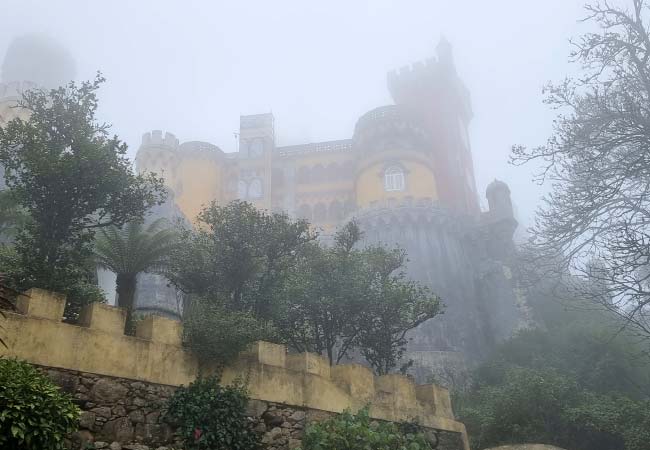
Fog can linger for much of the day, as I found out on in my trip in November
From November to March the town is quiet, the palaces are yours, and the weather is the gamble. A bright winter morning in Sintra is one of the loveliest sights in Portugal. A wet one is miserable, and I will tell you below when to stay in Lisbon instead.
I have been exploring Portugal since 2001, and together with my Portuguese wife I have made countless trips up to Sintra in every season and at every hour of the day. This guide draws on those visits to help you choose the right month for your trip, understand the microclimate before it catches you out, and plan a day that works whether you arrive in August sunshine or January mist.
The weather in Sintra
Sintra runs cooler, wetter, and cloudier than the rest of the Lisbon coast, and the gap is wider than the map suggests. Two to five degrees separates the town from the capital, and in the depths of winter the difference between a dry afternoon in the Baixa and a fog-bound one on the Serra can feel like two different countries. The Atlantic does the work. Moist air rolls in off the ocean, hits the 500-metre wall of the Serra de Sintra, and climbs until it cools and condenses. The result is the mist that drifts through the forests of Pena Park on a July morning, and the rain that closes in for days at a stretch in January.
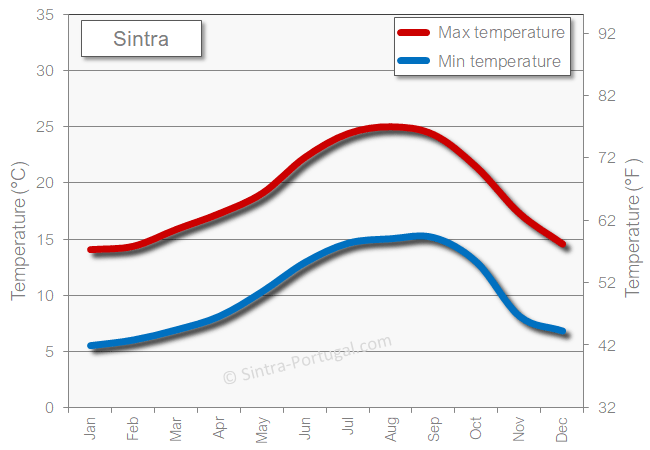
The average temperature of Sintra – the maximum daytime and night time minimum
Summer in Sintra, from June to September, is hot, sunny, and reliably dry. Daytime highs in July and August settle at 25°C, three or four degrees below Lisbon, and a constant breeze off the Atlantic takes the edge off the midday sun. You will rarely see a drop of rain between mid-June and mid-September. What you will see, on many mornings, is a low blanket of sea fog that hangs in the hills until ten or eleven o'clock before burning off. I have stood at the gates of Pena in August unable to see the palace fifty metres away, only to watch it emerge into bright sunshine an hour later. Plan for it.
Winter, from December to February, turns the picture on its head. Daytime highs hover around 14°C, nights drop to 8°C, and more than half the days in these months see some rain. January and February are the wettest months of the year, with rainfall that can run to 130 millimetres a month and storms that roll in off the Atlantic for days at a time. The hills stay green, the forests stay lush, and the palaces stay open. But you are gambling on the weather, and on a wet day the exposed terraces of Pena and the Castelo dos Mouros are no place to be. Pick your day carefully.

The average hours of sun per day in Sintra against the amount of rainfall per month
Spring and autumn are when Sintra is at its best. From April to early June, and again from late September to October, daytime temperatures sit between 17°C and 22°C, the rain eases off, and the sun comes out for six or seven hours a day. The October light is some of the loveliest in Portugal, a low golden wash across the painted facades of Pena that the summer sun sits too high to deliver. Mornings can still be misty even in May, and a light jumper for the evenings is a good idea, but these are the months I would choose every time.
A warning about wet weather in Sintra
Do not go to Sintra in the rain. I have made every version of this mistake, and not one of them is worth repeating. I have walked the Castelo dos Mouros on a wet winter morning, with the wind driving rain sideways across the battlements and the ancient stone turning to a slick of moss and water under my boots. I have been caught out by a spring storm halfway through Pena Park, with nowhere to shelter except the pines, and I spent the rest of the day cold and damp, with the chill ruining what was meant to be the highlight of the trip. And I have taken friends up to Sintra on a bright October forecast, only to find the hills wrapped in a fog so dense we could barely see the painted facades of Pena from the courtyard, while Lisbon stayed sunny and warm thirty kilometres south.
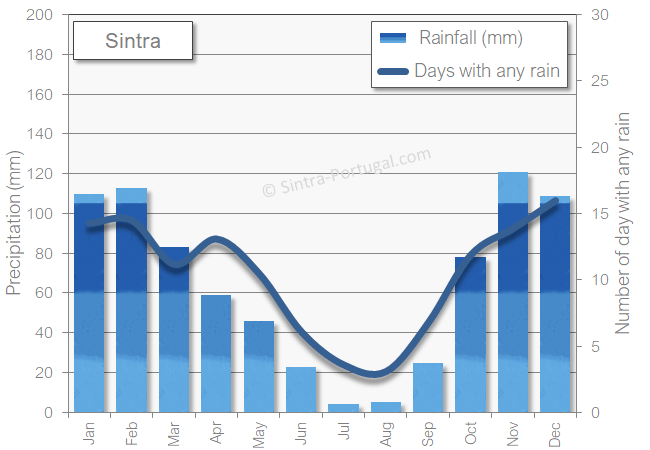
The bars show the average monthly rainfall (mm), while the line indicates the number of days with any rain. It can be very wet in Sintra between the end of October to the end of April
The problem is the geography. The town's headline attractions sit high on exposed hillsides, with very little shelter once you are inside the grounds. The terraces of the Palácio da Pena, the battlements of the Castelo dos Mouros, and the steep granite footpaths between them are no place to be in driving rain. The stone gets dangerously slippery, the views you came for disappear into the cloud, and the wind off the Atlantic finds every gap in your jacket. A day that should have made your week becomes a long, cold walk between things you cannot properly see.
If you are visiting between October and April, when rain is far more likely, keep your plans loose. Watch the forecast across your whole trip and give the first clear, dry day to Sintra, even if it means rearranging the rest of your itinerary. Seeing the palaces without the summer crowds is a real prize, but not at the cost of being cold and soaked for eight hours. Wait for the weather. Sintra will be there.
How to manage the summer crowds
Sintra in July and August can be brutal. From mid-morning until mid-afternoon, the historic centre is a slow-moving river of tour groups, the 434 bus up to Pena is standing room only by the second stop, and the ticket queue at the Quinta da Regaleira can swallow an hour of your day. I often hear from visitors who arrived at Pena at eleven in the morning expecting to walk straight in, only to lose two hours of their trip waiting to enter the state rooms. None of this is necessary. Beat the peak hours, book the right tickets, and Sintra in summer is still one of the great days out in Portugal.
The single most important step is to buy every ticket online before you leave home. The state rooms of the Palácio da Pena and the Quinta da Regaleira run on strict timed entry, and in July and August the slots routinely sell out one day ahead. Turn up without a booking and the next available entry will likely be hours away, if you can get in at all. Booking in advance is the only way to guarantee the time you want and to build a day that flows rather than stutters.
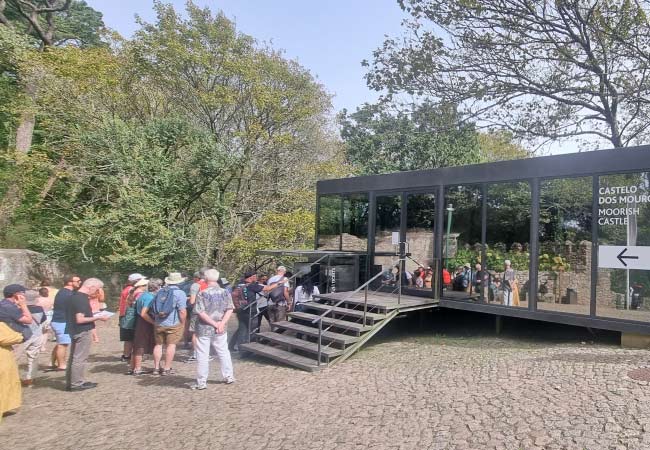
Long queues to use the ticket machines at the Castelo dos Mouros
With your tickets secured, the next thing to get right is timing. The peak hours in Sintra run from roughly 10:30 am to 3:00 pm, and your job is to be somewhere else during them. I would book Pena for the earliest slot of the day, ideally before 10 am, and be at the gates when they open. You will have the painted terraces noticeably quieter for the first hour, before the coach tours grind up the hill. The Quinta da Regaleira works the opposite way round. It is at its busiest in the mornings, and noticeably calmer after 3 pm, so I would leave it for the back half of the day. During the midday crush, the Castelo dos Mouros, the Palácio Nacional, and the wider grounds of Pena Park are your friends.
If you would rather sidestep the headline sights altogether, the Palácio de Monserrate is the answer. A tri-towered pink villa in the Mughal style, set within thirty hectares of botanical gardens three kilometres west of the town. On most summer days you can walk its rooms in near silence while the queues build at Pena. The Palácio Biester, a Neo-Gothic mansion at the edge of the historic centre, is the other quiet choice. Neither sees a fraction of the crowds at the headline palaces, and both, in my view, deserve far more attention than they get.
One last piece of advice, and it is the one most often ignored. Eat early or eat late. The restaurants in the historic centre fill up between 12:30 and 2:00 pm, and a thirty-minute wait for a table is the last thing you want in the middle of a packed day. Lunch before noon or after 2 pm, and you will walk into any restaurant you like.
Would a tour suit you better?
After twenty-five years of visits, I know how tiring a day in Sintra can be. A well-run tour takes that hassle off your hands. These are the Sintra tours I've used and happily recommend to friends and family:
The links above are affiliate links, which means I earn a small commission if you book through them, at no extra cost to you. I really appreciate it, as it helps me keep this site free and running.
Dealing with a hot summer's day in Sintra
The Atlantic breeze is a liar. It will fool you into thinking 30°C feels like 25°C, and you will believe it until about two in the afternoon, when the granite paths are radiating heat back at you, the climb up to the Castelo dos Mouros has emptied your water bottle, and the queue for the 434 bus back down to the station is twenty minutes deep in full sun. Sintra runs cooler than Lisbon, but it is not cool, and a hot day on these hills will exhaust you faster than you expect. Plan for the heat, and the day stays a pleasure. Ignore it, and you will be wrecked by mid-afternoon.
The principle is simple. Save the sun-exposed sights for the cooler hours, and head into the shade for the hottest part of the day. I would do the exposed places first: the terraces of Pena, the battlements of the Castelo dos Mouros, the climb up through Pena Park. Get them done before midday. Then, for the worst of the heat between one and four o'clock, retreat into the gardens.
The wooded grounds of Pena Park and the Quinta da Regaleira are heavily forested and noticeably cooler than the open hillsides, often by four or five degrees, with shaded paths winding through ferns, camellias, and centuries-old trees. Most of Regaleira's mystery lies underground, in a network of grottoes and tunnels that connect the gardens to the famous Initiation Well, a spiral staircase descending twenty-seven metres into the rock. Down there, the air is cold enough that you will wish you had a jumper, even on a 35°C afternoon.
For an even deeper escape from the heat, the Convento dos Capuchos sits a fifteen-minute drive west of the town, a humble 16th-century monastery built into the living rock and surrounded by dense oak forest. It is the coolest, quietest, and most atmospheric place in the whole Sintra region, and on a busy August afternoon it is where I would send you.
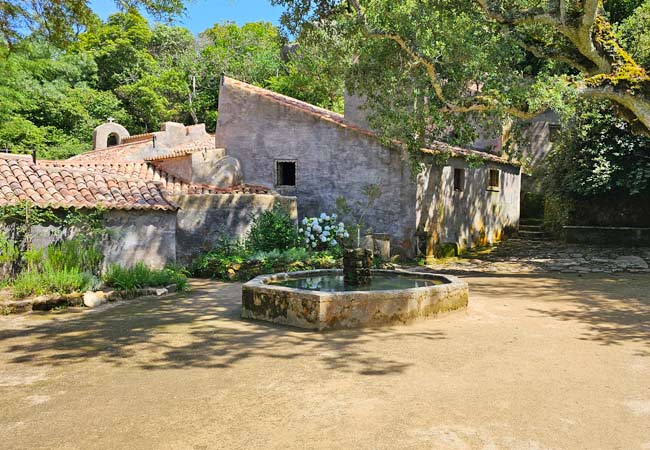
The cooling forest of the Convento dos Capuchos
One rule above all others on a hot day. Do not walk up to Pena from the historic centre. The climb is two kilometres of relentless uphill on tarmac, with barely any shade, and in 30°C heat it will ruin your morning before you have seen anything. Take the 434 tourist bus. It is what it exists for. Carry more water than you think you need, wear light, loose clothing, and put a hat on before you leave the station rather than after you have started to burn.
The other strategy, and the one I would choose if I were here for more than one day, is to split your time between the hills and the coast. Spend the morning at the palaces and the afternoon at the beach. Praia das Maçãs and Azenhas do Mar both sit on the Atlantic ten kilometres west of Sintra, reachable by a short bus ride from the historic centre, and the temperature drops noticeably the moment you crest the hills and start the descent to the sea.
The cold Atlantic waters
It will take your breath away. Literally, in the first second after you go under. The Atlantic along the Sintra coast is cold all year round, and even in the dead heat of August, when the air is at 30°C and the sand is too hot to walk on, the water rarely climbs above 18 or 19°C. I have watched my nieces jog confidently down the beach at Praia das Maçãs in July, hit the first wave, and emerge thirty seconds later wide-eyed and swearing they would not be going back in.
The cause is the Canary Current, a cold flow of water that sweeps south down the Atlantic from the latitudes of northern Europe, hugging the Portuguese coast on its way to the tropics. It is the same current that keeps the seas off Lisbon and the Algarve far cooler than the Mediterranean at the same latitude. The upside is that the cold water moderates the summer heat along the coast, which is why a beach afternoon at Praia das Maçãs or Azenhas do Mar feels so much fresher than the inland hills. The downside is that swimming is, to put it kindly, refreshing.
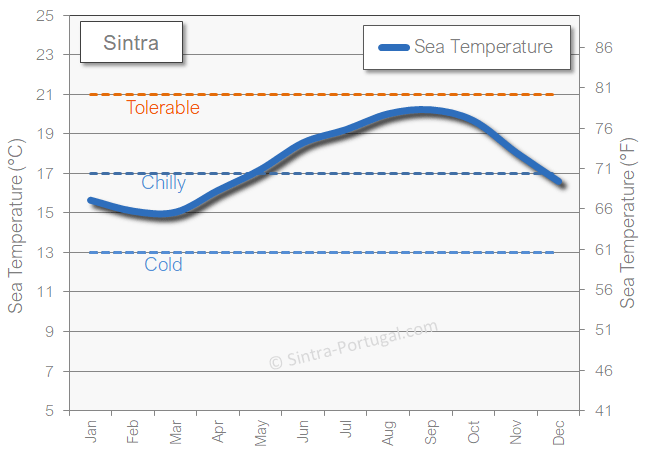
The sea temperature of the Sintra coastline
Our most popular guides to Sintra
Discover more of Sintra with our most popular guides


About this guide I'm Philip Giddings. I have been exploring Portugal since 2001, and writing the independent guides at Sintra-Portugal.com since 2008. I live in Lisbon with my Portuguese wife, Carla, who first took me up to Sintra on one of my earliest trips to the country. We have been going back ever since: summer crowds, autumn fog, the quiet Sunday afternoons of January. The region has changed a great deal in twenty-five years of visits, and we have watched it happen.
The site takes no payment from tourist boards, tour operators, or attractions for inclusion. It is funded by affiliate commissions on tour bookings, disclosed on every page that contains them. Every practical detail in these guides (ticket prices, opening hours, bus routes, time-slot policies) is checked against the official Parques de Sintra site, and verified in person on visits two or three times a year. Read my full bio here.