Sintra-Portugal.com
The best independent guide to Sintra
Sintra-Portugal.com
The best independent guide to Sintra
The best beaches in Sintra: a local's guide for 2026
Sintra is a delightful Portuguese town famed for its wondrous palaces and extravagant 19th-century villas, all set within the lush hills of the Serra de Sintra. While celebrated for its hilltop sights, the region also boasts a dramatic and rugged Atlantic coastline along its western edge.
This coastline is one of raw natural beauty, defined by towering cliffs, windswept headlands, and magnificent sandy beaches. The beaches here are exposed to the full force of the Atlantic Ocean, with powerful waves and strong sea breezes creating an untamed atmosphere.
In complete contrast, the coastline to the south of Sintra is known as the Portuguese Riviera. Its beaches are much more sheltered from the Atlantic's wind and waves, offering the calmer waters and golden sands of popular resort towns like Cascais and Estoril. To the north of the Serra de Sintra, the Ericeira coastline has vast beaches with mighty waves ideal for surfing, but a car is required to travel there from Sintra.
This article provides a guide to the beaches of the Sintra region, helping you find the best location for your beach day trip.
The Best Beaches of the Sintra Region
The Sintra region offers two distinct coastal experiences. To the west lies the wild Serra de Sintra coastline, with its untamed natural beauty, powerful surf, and dramatic cliffs. To the south is the Portuguese Riviera, a stretch of sheltered, family-friendly beaches with calm sea waters and lively resort towns.
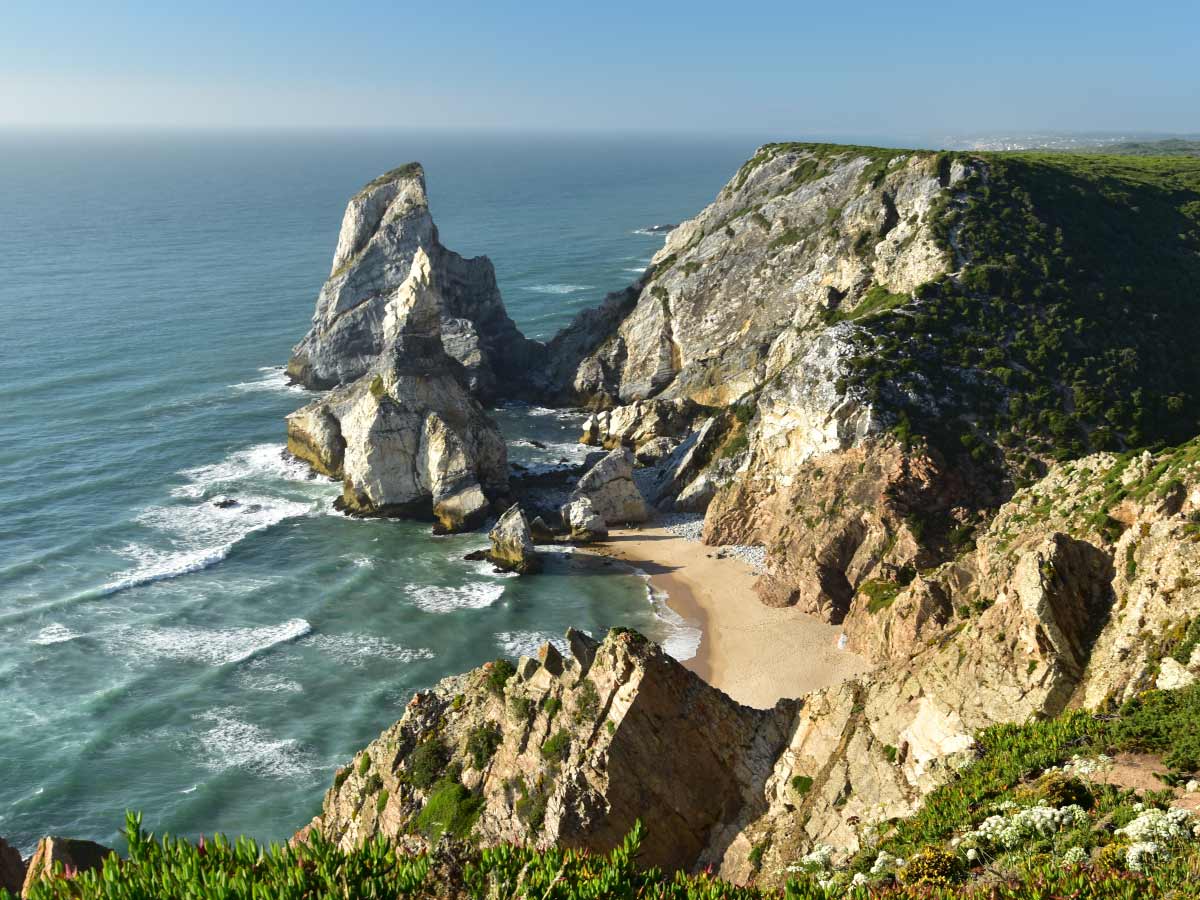
The Praia da Ursa on the western coastline
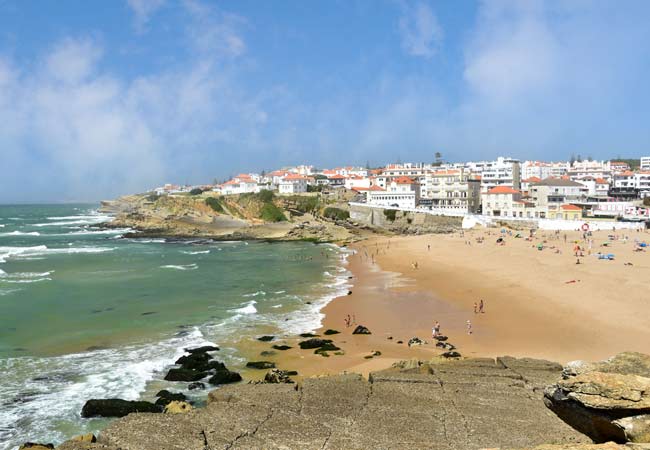
The Praia das Maçãs is the best beach for your beach trip while based in Sintra
Highlights of the Serra de Sintra Coastline
This coastline is defined by its raw, windswept scenery. Its beaches are ideal for surfing, hiking, and those who appreciate dramatic landscapes over calm waters.
• Praia das Maçãs: The best all-around beach for a day trip from Sintra, offering a wide stretch of sand and a charming village connected by a historic tram.
• Praia Grande: The largest beach on this coast and a popular surfing destination with a younger, energetic atmosphere.
• Praia da Ursa: Considered the most stunning beach in the region due to its remote setting and unique offshore rock formations.
• Praia do Guincho: A world-famous beach for kitesurfing and windsurfing, known for its strong breezes and spectacular natural setting.
• Praia da Adraga: A beautiful beach nestled between cliffs, offering more shelter than others on this coast and popular with Portuguese families.
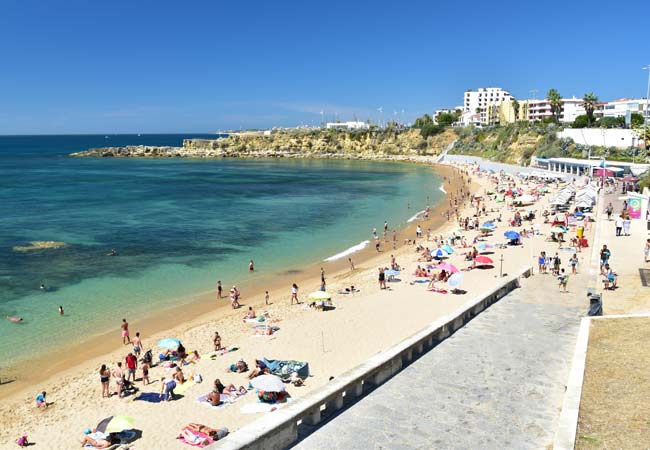
The calmer, family-friendly beaches of the Portuguese Riviera
Highlights of the Portuguese Riviera
This is the classic beach holiday destination. The coastline is sheltered from strong winds, and its towns are well-connected to Lisbon by train, making the beaches very popular in the summer.
• Praia de Carcavelos: The most popular beach in the Lisbon region, it boasts a vast expanse of golden sand, great facilities, and waves suitable for beginner surfers.
• Praia da Duquesa & Conceição: These two adjoining beaches form the main stretch of sand in Cascais, offering calm, clear waters and many activities right in the heart of the town.
• Praia de Santo Amaro (Oeiras): A wide, sheltered beach with very calm waters, making it a favourite for families with young children.
• Praia do Tamariz: The principal beach of Estoril, offering a slightly less hectic alternative to the main beaches in Cascais.
Below is a map showing the beaches in the Sintra region. The beaches of the Serra de Sintra are marked in green, the beaches of the Portuguese Riviera in yellow, and the beaches of southern Ericeira in blue. The historic centre of Sintra is point 15, marked in grey. (Note: zoom out to see all of the points)
Beaches of the Atlantic coastline (green): 1) Praia das Maçãs 2) Praia Grande 3) Praia da Ursa 4) Praia do Guincho 5) Praia da Adraga 6) Praia do Magoito
Beaches of the Portuguese Riviera (yellow): 7) Praia de Carcavelos 8) Praia de Santo Amaro 9) Praia da Duquesa 10) Praia do Tamariz 11) Praia de São Pedro do Estoril
Beaches of south Ericeira (blue): 12) Praia de São Julião 13) Praia da Foz do Lizandro 14) Praia da Baleia 15) historic centre of Sintra
Note: A guide to all of the beaches is found after the next section.
Sintra as a Base for a Beach Holiday
While the Sintra region boasts magnificent coastlines, it is important for visitors to understand that the historic town is not a coastal destination. Sintra is situated inland, within the cooling hills of the Serra de Sintra. The nearest sandy beach, Praia das Maçãs, is a 10km drive or a 25-minute bus journey away.
For this reason, Sintra is an outstanding base for sightseeing, but it is not the ideal choice for a holiday focused purely on the beach. Travellers wanting a beach-centric holiday would be better served by staying in one of the coastal towns. Excellent alternatives include Cascais, Estoril, and Sesimbra, or the town of Ericeira for a trip dedicated to surfing.
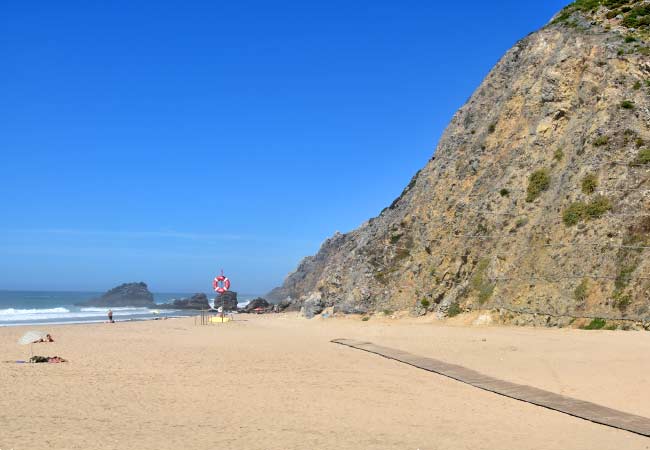
The Praia da Adraga
Serra de Sintra weather
The beaches of the Serra de Sintra are some of the most beautiful in the Lisbon region, but they are fully exposed to the Atlantic Ocean. This means they are often subject to strong sea breezes and a unique microclimate that visitors should be aware of.
During the peak summer months (July and August), the region is typically bathed in sunshine. However, there can still be a persistent and strong breeze blowing in from the Atlantic. Any wind felt inland will be significantly more powerful on this coastline. If you find it is a blustery day, you will have a much better experience by heading to the more sheltered beaches of the Portuguese Riviera, such as those in Cascais.
Outside of the summer, the hills of the Serra de Sintra can create very localised damp weather, including lingering mists, low cloud and patchy rain that may not exist just a few kilometres away. It is always wise to check a local weather forecast before a trip to this coastline, as conditions can be very different from those in Lisbon.
Advice: The weather is warm enough for spending time on the region's beaches from May until the end of September. The beaches become very busy during the peak season of July and August.

The average hours of sun per day in Sintra against the amount of rainfall per month
The Easiest Beach Day Trips from Sintra
For visitors based in Sintra wanting a straightforward trip to the coast, the best and most easily accessible option is Praia das Maçãs. This beach offers a wide expanse of golden sand and is bordered by a delightful village with many cafes and restaurants. Praia das Maçãs is connected to Sintra by the 441 bus route and a charming historic tram, which provides a scenic journey to the coast.
As an alternative, particularly on a windy day or if you would prefer a livelier resort town, head to Cascais. This is a vibrant town with several beautiful sandy beaches, such as the Praia da Conceição and Praia da Duquesa, all within easy walking distance of the historic centre. The 403 bus route connects Sintra to Cascais, with a journey time of approximately 25 minutes.
These two destinations are ideal for the majority of visitors, offering a simple choice between the natural beauty of the Sintra coast and the lively atmosphere of the Portuguese Riviera.
Related articles: Praia das Maçãs - Cascais guide

The Praia da Ribeira lies at the heart of Cascais
The best beaches of Sintra - the Serra de Sintra coastline
Praia das Maçãs beach
Praia das Maçãs ("Apple Beach") is one of the Sintra region's most popular and family-friendly beaches, offering a traditional Portuguese seaside atmosphere.
The beautiful sandy beach sits at the mouth of a wide valley and is large enough to feel spacious even during the height of the summer season. As it is exposed to the Atlantic, there can be strong waves and currents, making it popular with bodyboarders and beginner surfers.
Behind the beach is the delightful resort town of the same name, which has a relaxed, welcoming feel. Here you will find a great selection of cafes and excellent seafood restaurants, along with a local market selling fresh produce.
Praia das Maçãs is one of the best choices for a beach day if you are based in Sintra, as it is easily accessible by public transport. It is connected to Sintra by the reliable 441 bus route, but for a more memorable journey, you can take the charming historic tram that has served the town since 1904
Insight: From Praia das Maçãs, it is a short walk south to the much larger surfing beach of Praia Grande. Alternatively, a scenic 1.5km coastal path leads north to the stunning clifftop village of Azenhas do Mar, which is one of the most picturesque locations along the Sintra coastline.
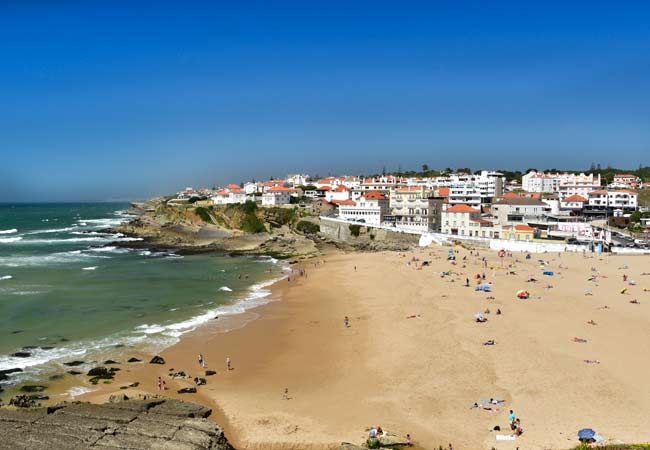
The Praia das Maçãs is a wide sandy beach that fills the valley carved out by a small river.
The Praia Grande
Praia Grande, true to its name meaning 'Big Beach', is the largest sandy expanse on the Serra de Sintra coastline, boasting an impressive 900m-long shoreline. It is renowned as one of Portugal's premier surfing and bodyboarding destinations. This reputation gives the beach a vibrant, energetic atmosphere that tends to attract a younger, sport-focused crowd.
A defining feature of Praia Grande is its two distinct sections. The northern end is more exposed to the Atlantic swells, making it the main hub for surfing action, with surf schools and a selection of cafes and restaurants. In contrast, the southern end is sheltered by massive cliffs, providing a calmer environment that is better suited for relaxing and sunbathing.
One of the most unique attractions is found etched into these southern cliffs: a set of remarkably preserved dinosaur footprints. A staircase provides access to view these 110-million-year-old fossilised tracks, left by Megalosaurus and Iguanodon dinosaurs on what was once a muddy flatland.
At the northern end of the beach stands the Arribas Sintra Hotel, which features one of Europe's largest saltwater swimming pools at an incredible 100m in length. This impressive pool is open to the public during the summer (for a fee) and is a fantastic option when the Atlantic waves are too powerful for a casual swim.
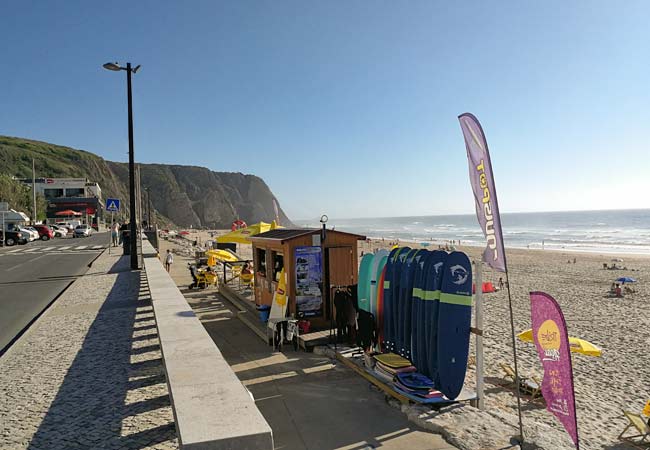
The Praia Grande is popular for surfing
Praia da Ursa
Praia da Ursa is widely regarded as the most stunning beach of the Serra de Sintra coastline, celebrated for its raw, untouched beauty and dramatic scenery. Its sense of pristine wilderness sets it apart, but visitors must be aware that reaching this secluded paradise requires effort and preparation.
The beach is distinctive for its two colossal sea stacks, sections of harder rock that have withstood millennia of Atlantic erosion. The rock formation to the south gives Praia da Ursa ("Bear Beach") its name, as it supposedly resembles a bear with its cub when viewed from the correct angle.
Access to the beach is via a steep and challenging dirt track from the clifftop road. The path is uneven, with loose stones, and the descent is not suitable for everyone.
It is important to remember that Praia da Ursa is a completely wild beach with no facilities of any kind. There are no cafes, toilets, or lifeguard supervision, and the powerful Atlantic waves and currents make swimming hazardous.
Insight: A trip to Praia da Ursa is often combined with a visit to the Cabo da Roca headland, the most westerly point of mainland Europe. A scenic 1.7km coastal path connects the two, offering breathtaking clifftop views along the way.
Related articles: Cabo da Roca
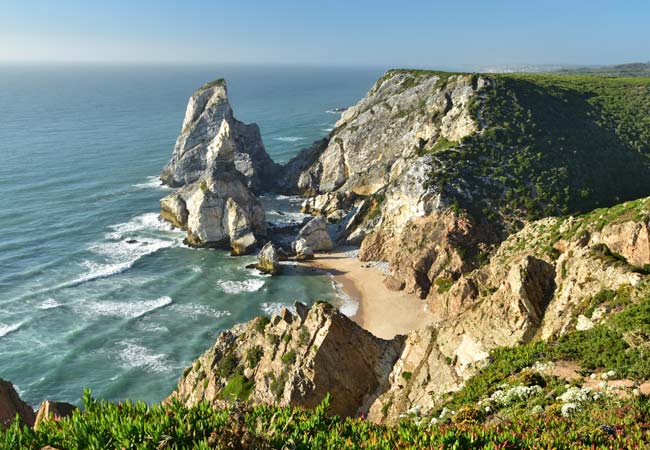
The Praia da Ursa as seen from the coastal footpath to the Cabo da Roca
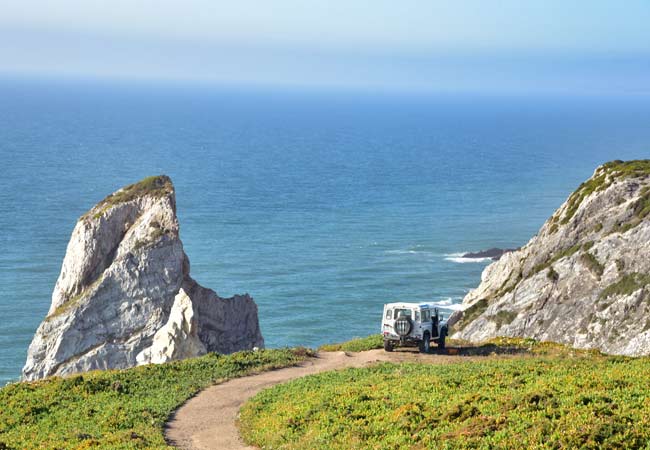
There are better locations to park in than this…
Praia da Adraga (19km drive from Sintra)
Praia da Adraga is the ideal choice for visitors who want to experience the wild beauty of the Sintra coastline without the difficult hike required for beaches like Praia da Ursa. It offers much of the same dramatic, natural scenery but with the major advantage of a paved access road and car park, making it a firm favourite with the Portuguese for a day trip.
The beach itself is set in a picturesque deep valley, with towering cliffs on either side that provide good shelter from the strong Atlantic winds. Adraga is celebrated for its dramatic rock formations, including a magnificent sea arch and numerous caves that can be explored at low tide.
Right on the beach is the renowned Restaurante D'Adraga, one of the best seafood restaurants in the region, which serves freshly caught fish and is a destination in itself.
Insight: The main challenge when visiting Praia da Adraga is the very limited parking. The small car park at the end of the narrow valley road fills up extremely quickly, especially on summer weekends.
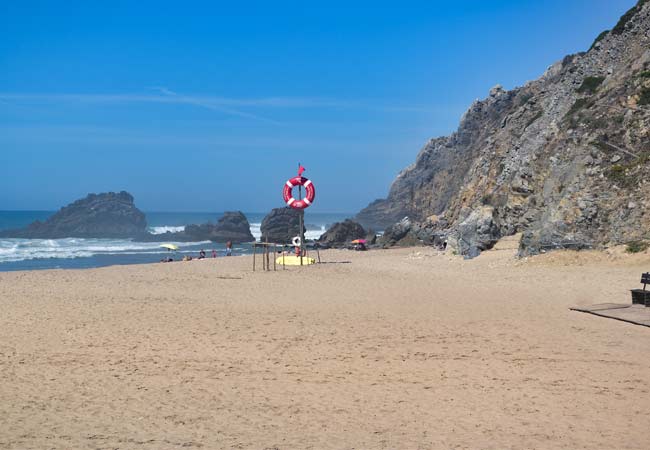
The Praia da Adraga
Praia do Guincho
Praia do Guincho is arguably the most famous and visually striking beach of the Serra de Sintra coastline. Set against the wild backdrop of the Serra de Sintra-Cascais Natural Park, its vast expanse of golden sand and powerful waves have made it an iconic location.
The beach gained international fame as one of Portugal's original surfing hotspots and famously featured in the 1969 James Bond film On Her Majesty's Secret Service. Today, it is a world-class destination for kitesurfing and windsurfing, thanks to the reliable and powerful "Nortada" wind that is especially common during the summer.
Visitors must understand that Guincho is not a tranquil or relaxing beach. There is an almost constant breeze blowing in from the Atlantic, and very little shelter from it. This makes it challenging for sunbathing, and the strong currents and waves mean it is often unsafe for casual swimming. On the rare, calm summer's day, Guincho is magnificent, but most of the time it is too windy for a conventional beach day.
The spectacular natural scenery is a major draw in itself. Behind the beach lies the protected Cresmina-Guincho dune system, which can be explored via a network of elevated wooden boardwalks. These paths offer a wonderful way to experience the unique landscape and provide fantastic views over the entire coastline.
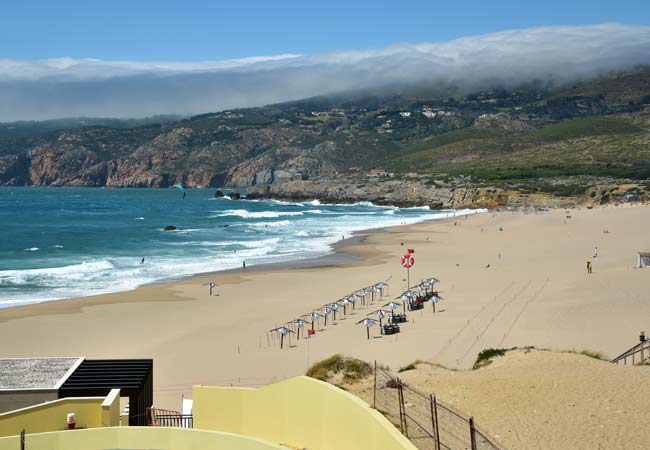
The moisture-laden Atlantic winds often form clouds over the Serra de Sintra hills
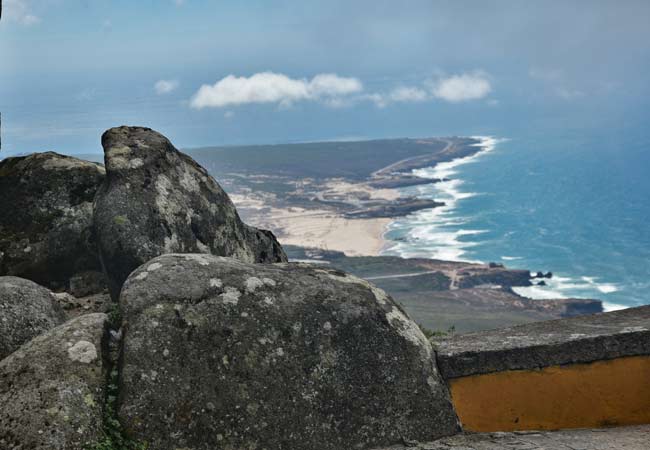
The Praia do Guincho beach and Serra de Sintra coastline as seen from Peninha viewpoint
Beaches of the Portuguese Riviera
In complete contrast to the wild Atlantic coast, the beaches of the Portuguese Riviera offer a more traditional seaside experience. This is the affluent coastline that extends from Lisbon to Cascais, renowned for its sheltered sandy bays and calm, family-friendly waters.
A major advantage of this coastline is its accessibility. A regular train service connects Lisbon to all of the resort towns, making these beaches very easy to travel to. This convenience also means they are extremely popular, and the entire region becomes a vibrant hub of activity during the summer as residents of Lisbon head to the coast.
Praia de Carcavelos
The Praia de Carcavelos is the largest beach of the Portuguese Riviera and the most popular beach in the Lisbon region.
It boasts a vast expense of golden sands, medium-sized waves that are suitable for surfing, and a shoreline filled with beach bars, restaurants and cafes. Praia de Carcavelos has a lively atmosphere and offers a host of activities (surfing, beach sports and boat rides), making it a favourite with Portuguese families.
Our Opinion: Carcavelos beach is the beach we recommend to all visitors who are on holiday in Lisbon.
Related articles: Praia de Carcavelos
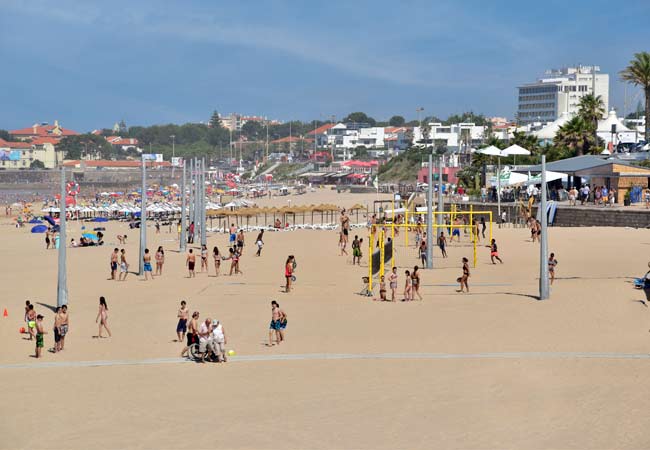
The Praia de Carcavelos is a huge beach where most of Lisbon heads to on a sunny day
Praia de Santo Amaro (Oeiras Beach)
The Praia de Santo Amaro is the main beach of Oeiras and is often just referred to as Oeiras Beach. This is another glorious beach, with a wide expanse of sand, calm sea waters and amazing facilities. Santo Amaro beach is the most sheltered beach of the region and is a popular choice for families and young children. During the summer, Oeiras beach attracts a younger crowd and has a lively, jovial atmosphere.
Insight: Praia de Santo Amaro is the beach closest to Lisbon that has guaranteed clean waters. Beaches further to the east of Oeiras (and closer to Lisbon) are within the tidal mixing zone of the Tejo Estuary, where the water quality may not be as good.
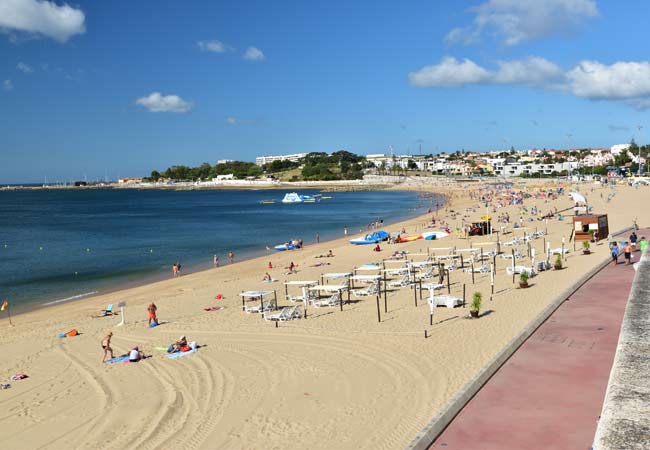
Praia da Conceição and Praia da Duquesa beaches
The largest stretch of sand in Cascais is divided into two beaches - the Praia da Conceição and Praia da Duquesa. These beautiful beaches offer golden sands, calm sea waters and an abundance of beach activities (including sea inflatables, beach bars and boat rides).
The Praia da Duquesa is a slightly larger beach that is closer to Cascais, while to the east is the Praia da Conceição. The beaches are a hive of activity during the summer, with cocktail-drinking tourists, excitable children and powerboats towing banana inflatables. The Conceição and Duquesa beaches are suitable for children, as there are no waves or currents, and the beach is supervised by lifeguards.
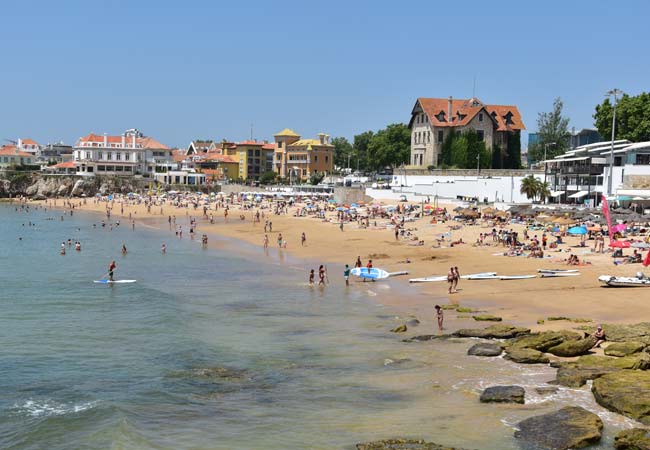
The Praia da Duquesa (near) and the Praia da Conceição (on the far side) are separated by a small headland and the 19th-century Casa Faial villa
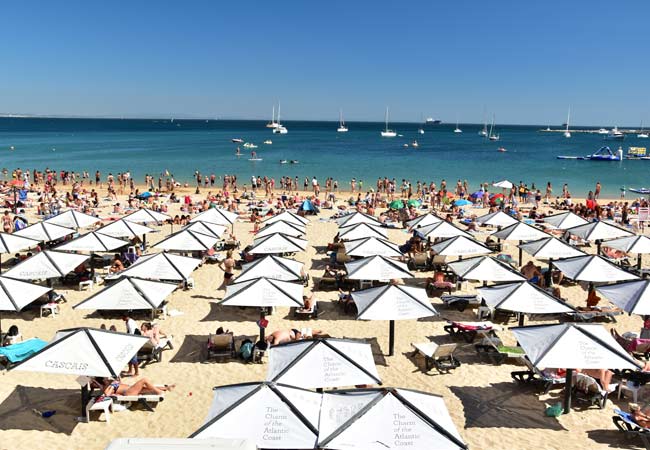
The Praia da Conceição on a hot summer’s day
Praia de São Pedro do Estoril
The Praia de São Pedro do Estoril is one of the most underrated beaches of the Portuguese Riviera, and is an excellent choice for a relaxing beach day.
São Pedro tends to be quieter than the other beaches detailed in this guide so far; there will be fewer screaming kids or overly excited teenagers, with no boat rides departing from the beach. If you want a peaceful beach day (or the quietest possible for the Portuguese Riviera), head to the Praia de São Pedro do Estoril.
The Praia de São Pedro is a pretty sheltered beach
Praia do Tamariz beach
The Praia do Tamariz is the main beach of Estoril, which is just a 17-minute walk from central Cascais.
The beach has many similarities to Praia da Conceição and Praia da Duquesa, but is less hectic and without all of the sea activities. On the eastern side of the beach, beyond the sea wall, is a seawater-filled swimming pool known as the Piscina Oceânica do Tamariz. This is great for young children and will have much warmer water than the sea.
My opinion: The Praia do Tamariz provides a pleasant alternative to the beaches of Cascais.
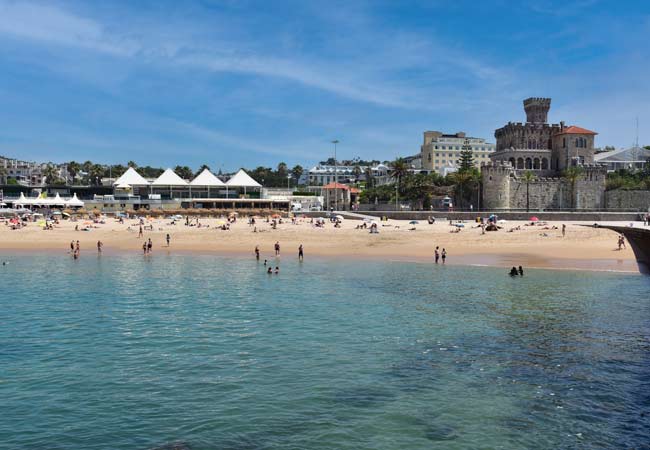
The Praia do Tamariz is a fantastic beach
Praia da Torre
The Praia da Torre is a beautiful sandy beach that lies on the leeward side of the Forte de São Julião da Barra, a colossal 16th-century fort. This beach is a short walk from Praia de Carcavelos and is a good alternative if Carcavelos is too crowded or blustery.
Insight: Beginning at the Praia da Torre is the Passeio Marítimo de Oeiras, a scenic coastal footpath that leads to Paço de Arcos. This is the best short walk of the Portuguese Riviera.
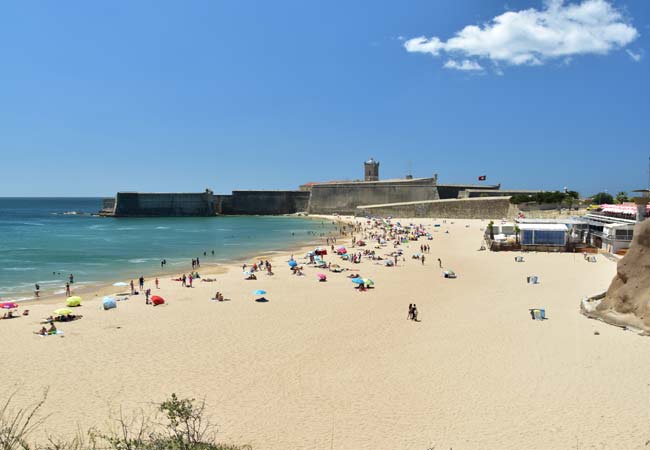
The huge walls of the Julião da Barra fort tower over the beach
Discover more of Sintra with our most popular guides


About this guide I'm Philip Giddings. I have been exploring Portugal since 2001, and writing the independent guides at Sintra-Portugal.com since 2008. I live in Lisbon with my Portuguese wife, Carla, who first took me up to Sintra on one of my earliest trips to the country. We have been going back ever since: summer crowds, autumn fog, the quiet Sunday afternoons of January. The region has changed a great deal in twenty-five years of visits, and we have watched it happen.
The site takes no payment from tourist boards, tour operators, or attractions for inclusion. It is funded by affiliate commissions on tour bookings, disclosed on every page that contains them. Every practical detail in these guides (ticket prices, opening hours, bus routes, time-slot policies) is checked against the official Parques de Sintra site, and verified in person on visits two or three times a year. Read my full bio here.