Sintra-Portugal.com
The best independent guide to Sintra
Sintra-Portugal.com
The best independent guide to Sintra
Palácio da Pena (Pena Palace), Sintra: a guide for 2026
By Philip Giddings · Last updated
No other building in Portugal looks quite like it. A sprawling fantasy of canary yellow towers, blood red battlements, and tiled domes. It sits on a forested peak 480 metres above the Atlantic. The Palácio da Pena is what happens when a 19th-century king with a Bavarian imagination is handed a ruined monastery and an entire mountain to play with.
The result is one of the finest examples of Romanticist architecture in Europe, and the building every visitor to Portugal already knows by sight. Every friend who asks me about Lisbon asks about Pena. They have already seen the photograph: yellow towers above a sea of morning cloud. These photographs leave a few things out. The awkward journey up from Sintra station. The timed tickets that sell out days ahead. The queues snaking across the courtyards by ten. None of it has ever stopped a friend going. After twenty-five years of visits, I would not let it stop you either.
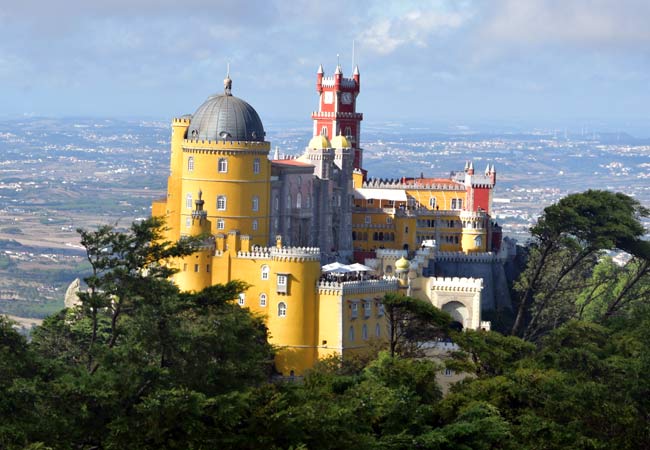
The stunning Pena Palace is always the highlight of any trip to Sintra
There is more to Pena than the painted facades. The interior has been carefully restored to how it appeared in 1910, the morning the royal family fled the revolution, their half-full coffee cups left on the table. Beyond the palace walls, Ferdinand had conjured a forest. Shaded footpaths thread through fern gardens and past hidden lakes, up to the mock-Alpine Chalet of the Countess of Edla, and out to quiet viewpoints where you can look back at the palace alone. Most visitors try to cram Pena into a half-day rush through Sintra. I've spent days wandering these grounds. Give it the time.
I have been exploring Portugal since 2001, and after five years of living in Lisbon with my Portuguese wife and countless trips up to Sintra, I have learned how Pena works, and where its quiet corners lie. This guide will help you plan your trip, choose the right ticket, time your arrival, and see beyond the painted terraces to the palace.
My highlights of the Palácio da Pena
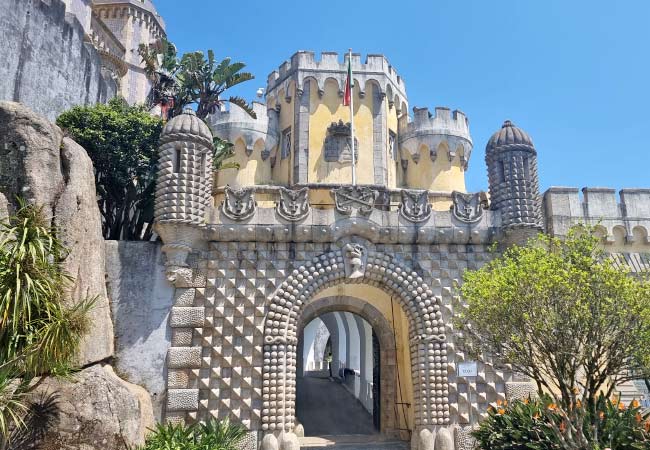
The exterior. A pantomime of carved stone and painted plaster. Yellow towers, red battlements, blue tiles, mythological beasts. A snarling Triton glowers down from the main gateway, half man, half fish, holding the whole palace on his back. There is nothing else like it in Portugal, and arguably nowhere else in Europe.
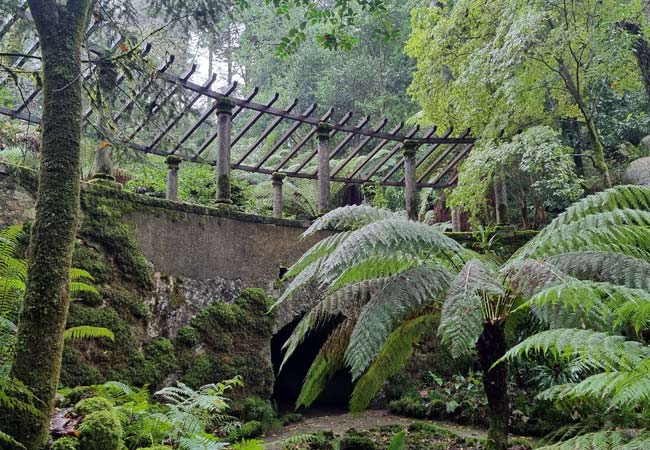
The Parque da Pena. Ferdinand II planted a forest. Two hundred hectares of cedar, sequoia, tree ferns, and rhododendron, laid out in the 1840s on what had been bare hillside. Footpaths wind through it for hours. Cool fern gullies for August afternoons. Steep climbs to the Cruz Alta, the highest point in the Sintra hills. Most visitors never leave the palace courtyards. They are missing the better half of the estate.
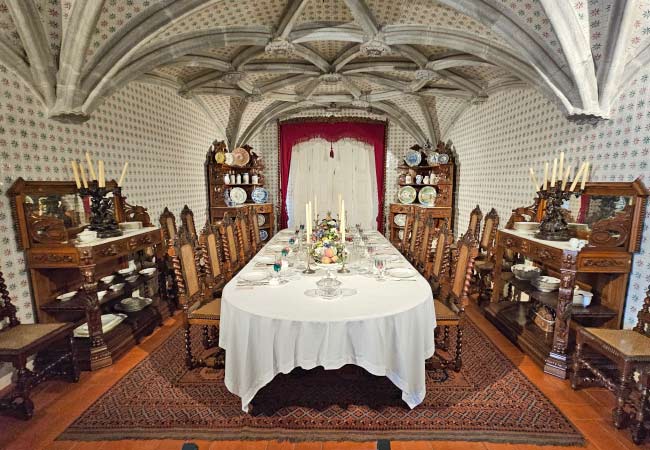
The interior. Restored to the morning of 5 October 1910, when the royal family fled Portugal. The rooms feel paused rather than preserved. King Carlos's painting studio, Queen Amélia's tea set, the Saxon porcelain still arranged for a dinner that never happened. The plan is strange because the palace wraps around a 16th-century monastery, and the monks' cloisters and cells survive at its heart.
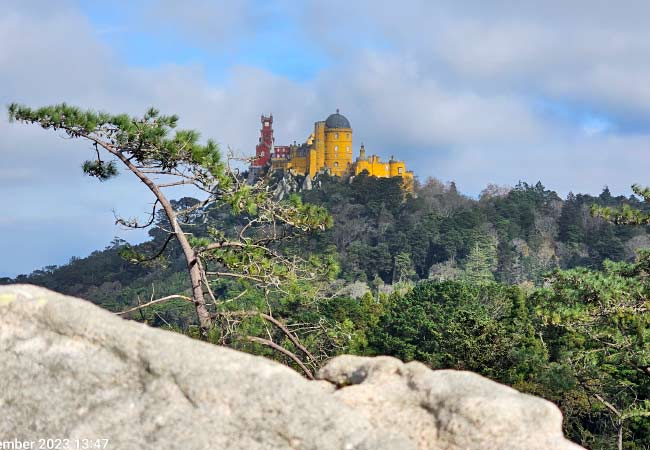
The Alto do Chá. The third-highest peak in the Serra de Sintra, and almost no one climbs it. A scramble over granite boulders to a viewpoint that frames Pena from the south, with the Atlantic behind. I have sat up there for an hour and seen no one. The best photograph of the palace you will take is from this hill.
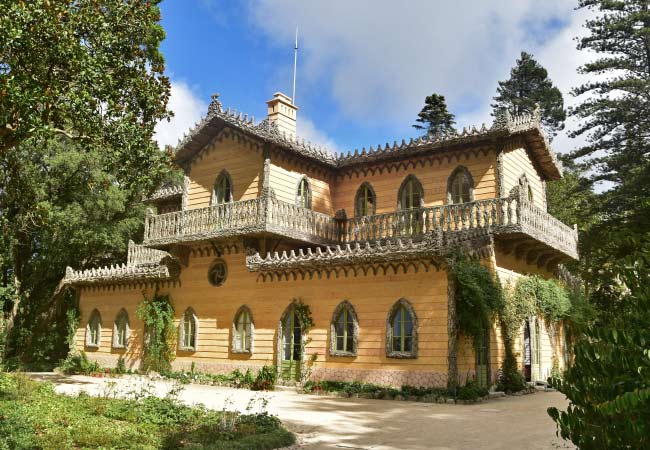
The Chalet da Condessa d'Edla. Built in 1869 by Elise Hensler, the Swiss-American opera singer who became Ferdinand II's second wife. A Bavarian chalet in the Sintra woods, walls clad in cork, ceilings painted with vines. It is the closest thing to a private house on the estate, and feels like one.
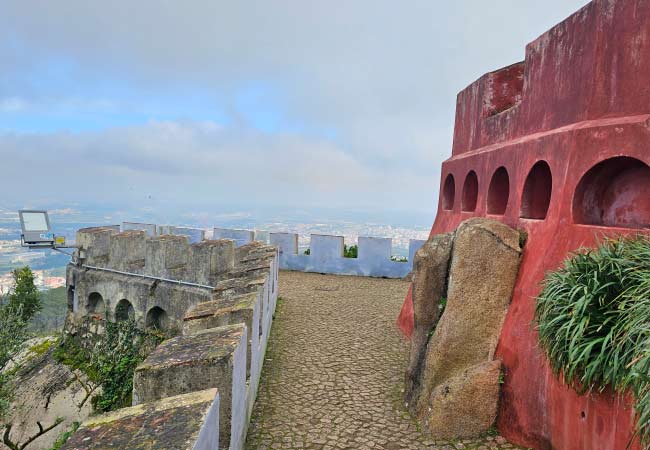
The Caminho de Ronda. A narrow path tracing the rocky outcrop the palace sits on. The wind here is fierce in any season. So is the view: across the forest to the Atlantic, and up to the painted walls above. The entrance is easy to walk past, and most visitors do.
Tickets and important information for the Pena Palace
The Palácio da Pena is not a destination for an impulsive visit. Tickets to the interior state rooms are sold as timed entry in 30-minute blocks, and these slots sell out quickly during high season (Easter to October). Combined with the difficulty of travelling up to the palace from the train station, a bit of planning the day before is essential.
There are two types of tickets for the Palácio da Pena: the 'full ticket' (€20) and the 'park ticket' (€12), both of which can be purchased from GetYourGuide. The 'park ticket' permits access to the terraces surrounding the palace but does not grant entry to the state rooms.
There are a limited number of 'full tickets' sold per day, and each ticket allows entry into the palace in a designated 30-minute time slot. These time slots are strictly enforced - do not miss your entry time.
During the high season, popular time slots such as mid-morning and after lunch sell out days before. Many tickets are also sold in bulk to tour operators and cruise companies.
If you just buy from the ticket office on the day of your visit, be prepared for potential wait times of up to three hours for your designated entry slot, or you may be unable to enter at all.
If you want to enter the palace, always buy your ticket at least one day in advance.
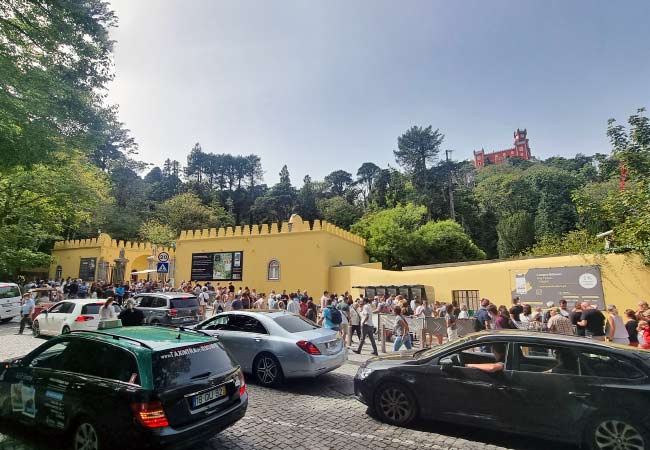
Even in October there can be very long queues for the ticket machines and to enter
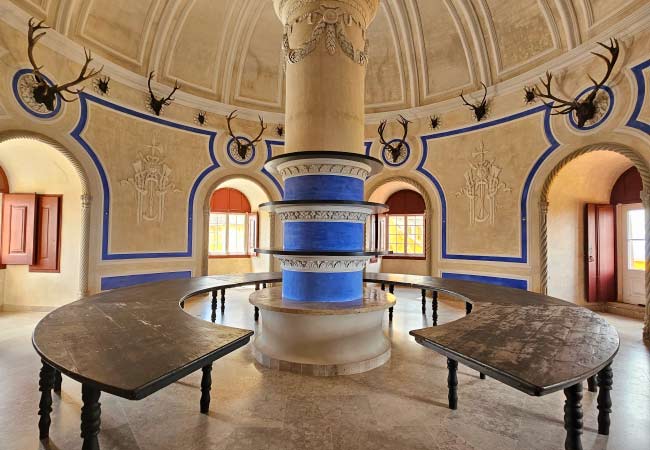
The Stag Room was designed as a banquet hall, and a unique circular table wraps around the central pillar.
The Palácio da Pena 'Park Ticket'
This is the ticket I often get when I just want to walk the grounds or when I am visiting with friends who have children. The 'Park Ticket' is the more affordable option, allowing access to the grounds and terraces but not the state rooms.
This ticket is a good option if you have little interest in Portuguese history or if all of the full-price timed tickets are sold out. The park ticket can be purchased from GetYourGuide for €12 here.
Insight: Up until autumn 2023, the 'Park Ticket' did not include access to the terraces. Parques de Sintra (the organisation managing the Palácio da Pena) may revise their policy again if the terraces become overly crowded in summer. It is advisable to check before purchasing this ticket, as the palace was barely visible from the former access area.
Insight: An advantage of buying through GetYourGuide is the option to pay in your home currency, which can help avoid conversion fees.
The Chalet of the Countess of Edla is worth a visit if you have longer to explore the grounds
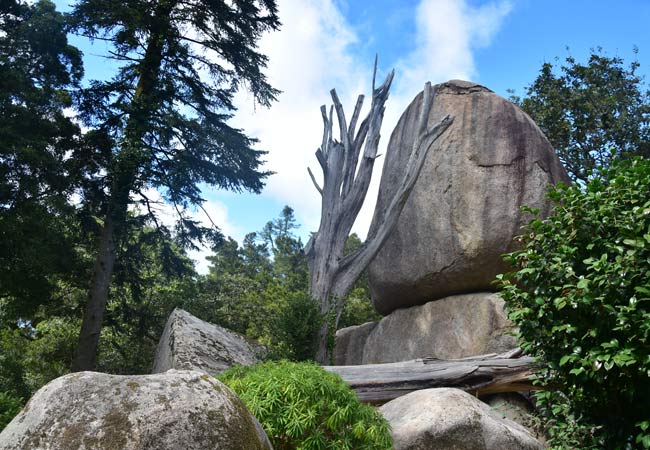
There are huge boulders dotted about the forests of the Parque da Pena
How long to spend in the Palácio da Pena?
In my experience, visitors never factor in enough time to see the Palácio da Pena and its grounds. This is understandable, as most visitors are limited by time and want to see as much of Sintra as possible.
There is also a trend that visitors who spend the least time here are the ones who complain the most about overcrowding or not enjoying their experience. Do not make this mistake and plan at least half a day within the complex.
At the bare minimum, you will need two hours. The interior of the palace takes 40 minutes to visit, while the terraces, Caminho de Ronda, and chapel take another 30 minutes, as you'll probably take lots of photos here.
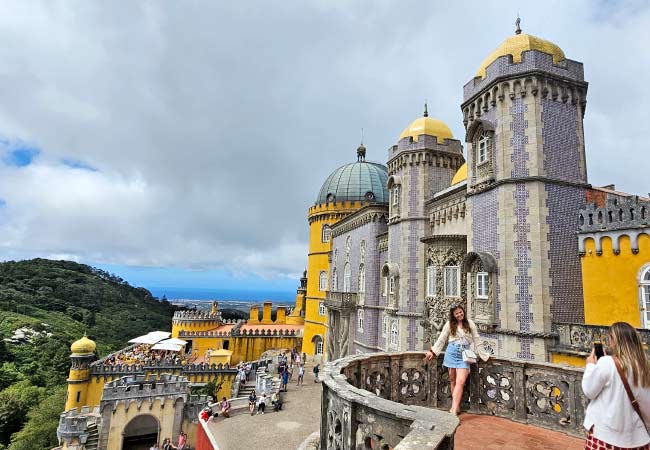
The south-facing Terraço da Rainha (Queen’s Terrace) is always a popular location for photos
The steep uphill walk from the ticket office to the palace takes around 15 minutes, and you will be standing in queues for at least 15 minutes (either to enter the palace or to show tickets at the entrance). The remaining 20 minutes could be used to briefly see the grounds, have a drink on the terrace, and walk back to the entrance
Exploring the Parque da Pena will greatly extend your visit and add to your enjoyment of the Palácio da Pena. Close to the palace are the ornamental lakes (Vale dos Lagos), the Warrior Statue and the Feteira da Rainha (Queen's Fern Garden), all connected by shaded footpaths.
Further out are the Cruz Alta peak (603m), the Alto do Chá (Tea Hill - the best viewpoint of the region), and the Chalet da Condessa d'Edla, an enchanting Alpine-inspired chalet.
Personal insight: For a longer visit, I recommend exploring the palace's terraces twice: once at the beginning of your visit and again before you leave. The terraces can become quite crowded, especially during peak hours. By visiting twice, you increase your chances of experiencing these stunning viewpoints when they are less busy.
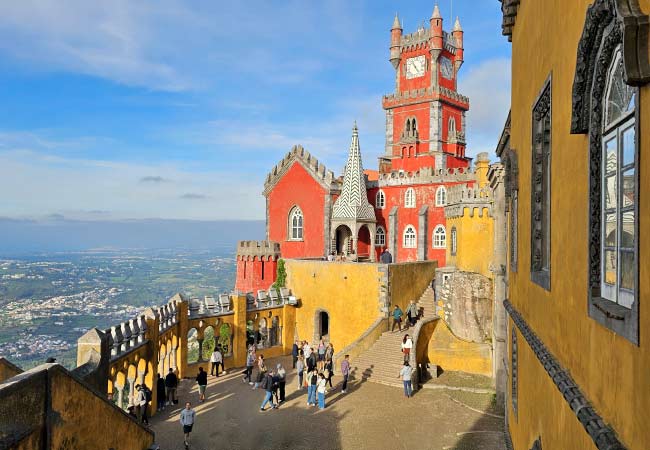
Pátio dos Arcos (Courtyard of Arches) with its views over the hills and out to the Atlantic Ocean. The red building to the rear is the old chapel that was here prior to the construction of the palace.
The dining room on the lower level of the palace was converted from the refectory of the original convent
Would a tour suit you better?
After twenty-five years of visits, I know how tiring a day in Sintra can be. A well-run tour takes that hassle off your hands. These are the Sintra tours I've used and happily recommend to friends and family:
The links above are affiliate links, which means I earn a small commission if you book through them, at no extra cost to you. I really appreciate it, as it helps me keep this site free and running.
Don't miss your time slot!
If you miss your time slot, you will be denied entry into the palace state rooms (but not the grounds). This is strictly enforced, as the palace has a legal capacity limit.
When booking a time slot, ensure you can make it. Factor in how long it will take you to travel to Sintra (if coming from Lisbon or the coastal towns) and then up to the palace.
The 434 bus from Sintra train station up to the Palácio da Pena takes at least 30 minutes, and there can be awful traffic through the town mid-morning. Taxis and Ubers may be more convenient, but follow the same route as the bus and will get stuck in the same traffic (full details of travel up to the palace are provided here).
Once at the palace, it is a 10 to 15-minute uphill walk from the ticket office to the palace (and official documentation states 30 minutes). I recommend joining the timed queue at least 10 minutes before your scheduled entry, as each time slot accommodates up to 300 visitors.
Insight: I suggest arriving at the entrance to the Palácio da Pena one hour before your time slot. This allows time to enter, walk up to the palace, explore the terraces, and be at the front of the queue for your time slot.
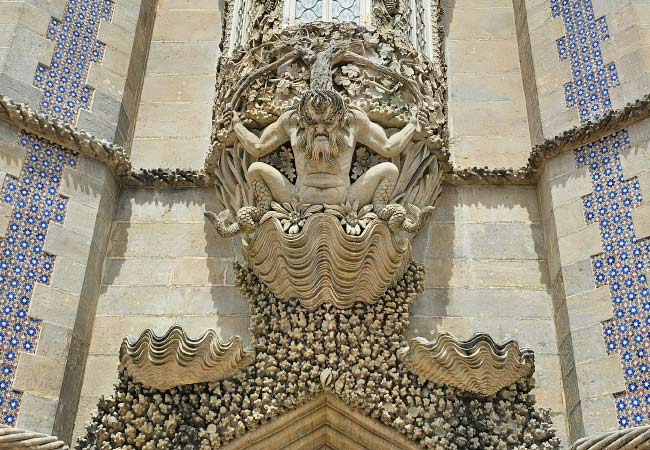
A statue of Triton guards the entrance to the palace
The many hills of the Palácio da Pena
During any visit to the Palácio da Pena you will be walking up a lot of steep hills, climbing steps and traversing uneven surfaces, often under the intense Portuguese sun. Even the most fit visitor will find a visit to the Palácio da Pena draining.
If you have limited mobility or fitness consider if a visit is really for you – Monserrate Palace is much more accessible and equally beautiful.
At Pena there is a bus service which transports visitors from the ticket office to the base of the palace’s entrance. This costs €4.50, but like everything associated with the Pena Palace there can be long queues as the small bus fills up. For most fit and able visitors, there is no need for this bus.
If you are travelling with young children, also be prepared for the steep climbs and the cobbled paths around the palace. There are particularly challenging for buggies with small wheels.
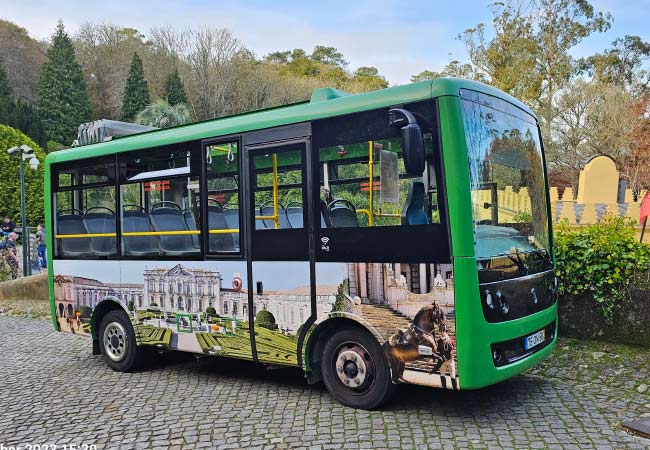
The bus from the ticket entrance up to the palace
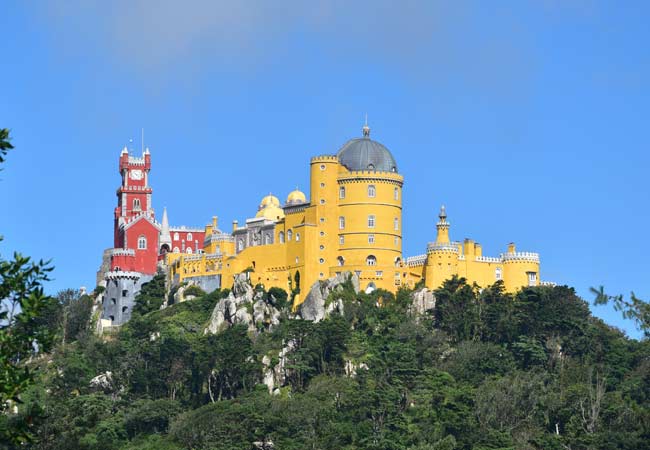
The magnificent palace perches on the second-highest point of the Serra de Sintra hills
The Palácio da Pena as part of a day trip
If you have limited time to explore Sintra, it's understandable to try and fit in as much as possible.
A typical day trip route includes the Palácio da Pena, Castelo dos Mouros (optional), the historic centre of Sintra, and either Quinta da Regaleira or the Palácio Nacional de Sintra in the afternoon. This route is convenient as it follows the direction of the 434-tourist bus and starts and ends at Sintra train station. For this suggested day trip, lunch would be taken in Sintra town centre after visiting the Palácio da Pena or Castelo dos Mouros.
Related articles: Day trip to Sintra
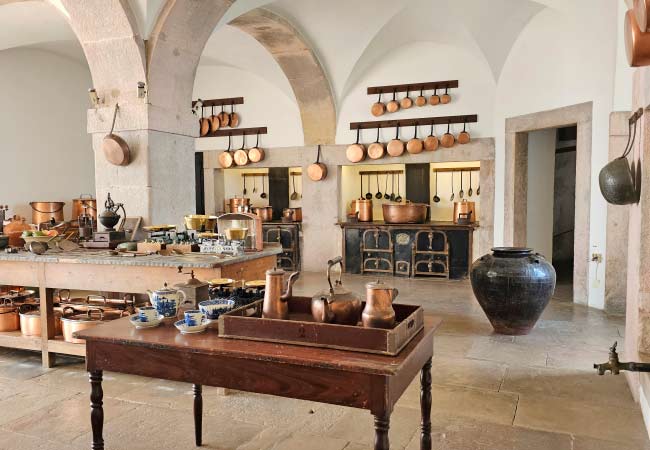
All of the copper utensils in the kitchen have PP (for Palácio da Pena) stamped on them to prevent theft!
Notable designs of the Palacio Nacional da Pena
The Palácio da Pena sits atop a jagged rocky outcrop – the second highest peak (480m) of the Serra de Sintra hills.
The site was originally a Hieronymite monastery, which had been abandoned for a long time by the time Fernando II purchased the area in 1838. Sections of the original monastery can still be seen – the main courtyard is a two-storey Manueline cloister, and the Nossa Senhora da Pena chapel has remained largely unaltered since the 16th century.
The chief architect of the Palácio da Pena, Wilhelm Eschwege, a German national, took inspiration from the Neuschwanstein Castle in Bavaria, as well as from his travels through Asia, Africa, and Portugal itself.
The rose-red painted tower shares many characteristics with the Torre de Belém in Lisbon, while the spikes on the gateway resemble those of the 16th-century Casa dos Bicos in Lisbon's Alfama district.
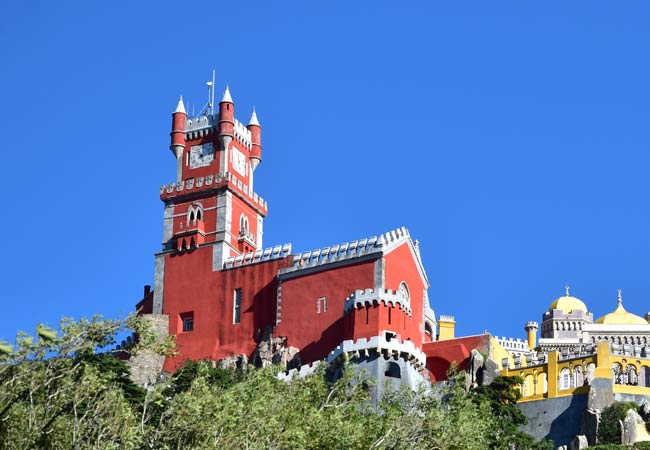
The red tower and the Torre de Belém have many similarities
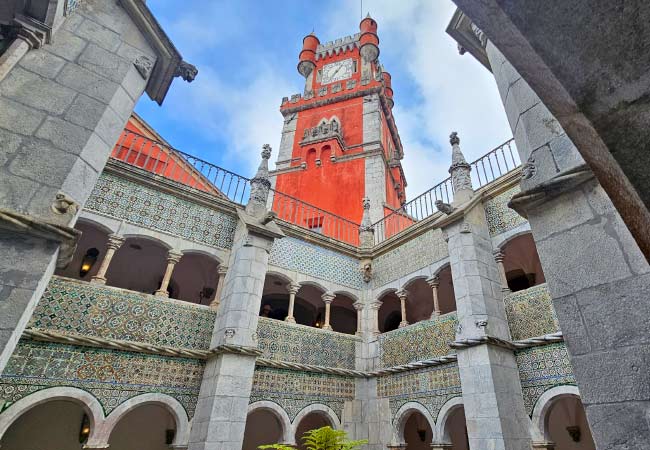
The central courtyard of the palace was the cloister in the monastery
The brilliant colours of the palace had gradually faded since their original application in the mid-19th century, and by the 1990s, the palace's appearance had become rather drab and dreary.
In 1996, the Pena Palace underwent an extensive restoration project, which included repainting the exterior walls in their original colours. This vivid colour scheme initially horrified some of the more conservative residents of Sintra. Fortunately, the work to reinvigorate the building continued, allowing the palace to be viewed in its original splendour once again.
Travel to the Palácio da Pena
The Palácio da Pena sits high above Sintra (390m higher than the train station), and it is a very demanding uphill hike along the Caminho de Santa Maria footpath footpath to reach it.
The recommended means of travel from the train station is by the 434 tourist bus, which follows a one-directional loop from the train station to the Castelo dos Mouros, Palácio da Pena and Sintra town centre, before returning to the station.
A single ticket costs €4.55 or there is a 24-hour ticket for €10.96. This 24-hour ticket is actively pushed by the bus company, but two singles (up to the palace and down from it) at €9.10 is all that is needed by most visitors.
Never plan to drive to the Palácio da Pena or Sintra, as there is very little car parking. During the summer, the town becomes completely gridlocked as frustrated drivers search for car parking spaces.
Related articles: 434 bus - Lisbon to Sintra
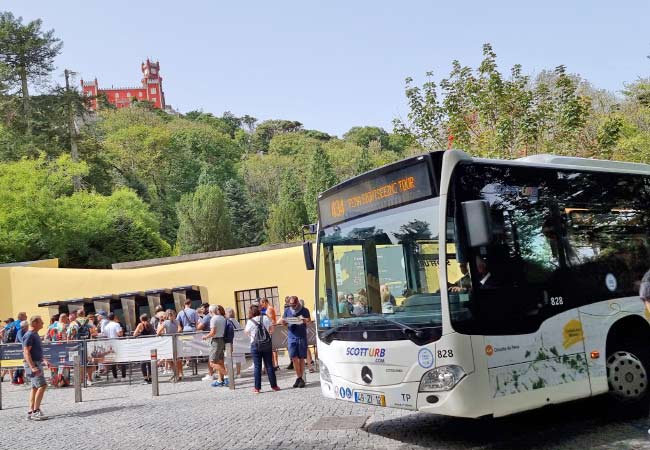
While you may grumble about the high entrance fees, the non-profit organisation Parques de Sintra reinvests all revenue into the region's monuments. Over the last fifteen years, there have been notable improvements in facilities, restoration, and maintenance in Sintra, all funded by tourism.
The most overrated sight of the Palácio da Pena
Cruz Alta viewpoint – While this is the highest point of the Serra de Sintra hills, from the top of the rocky outcrop, the Pena Palace is not visible. Many visitors leave Cruz Alta feeling that the 20-minute walk from the palace was not worthwhile. For a much better view, go to Alto do Chá.
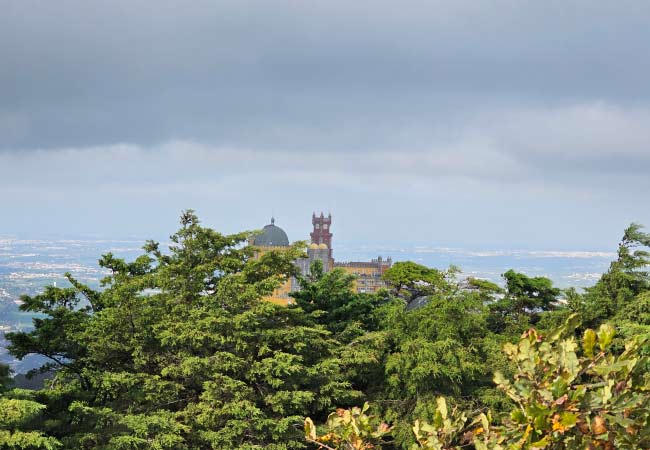
The disappointing tree blocked view from Cruz Alta
Discover more of Sintra with our most popular guides


About this guide I'm Philip Giddings. I have been exploring Portugal since 2001, and writing the independent guides at Sintra-Portugal.com since 2008. I live in Lisbon with my Portuguese wife, Carla, who first took me up to Sintra on one of my earliest trips to the country. We have been going back ever since: summer crowds, autumn fog, the quiet Sunday afternoons of January. The region has changed a great deal in twenty-five years of visits, and we have watched it happen.
The site takes no payment from tourist boards, tour operators, or attractions for inclusion. It is funded by affiliate commissions on tour bookings, disclosed on every page that contains them. Every practical detail in these guides (ticket prices, opening hours, bus routes, time-slot policies) is checked against the official Parques de Sintra site, and verified in person on visits two or three times a year. Read my full bio here.