Sintra-Portugal.com
The best independent guide to Sintra
Sintra-Portugal.com
The best independent guide to Sintra
Sintra on foot: a guide to the hills, paths and tourist buses for 2026
Sintra was built for kings, not for tourism. Every great sight here sits at the top of something. Every great view demands a climb. The town spills down the slopes of the Serra de Sintra in a tangle of cobbled lanes and forested ravines. Its palaces sit on summits the 19th-century romantics chose precisely because they were hard to reach. Two centuries later, that difficulty remains.
This catches a lot of visitors off guard. They arrive with a Lisbon mindset, expecting a flatter, prettier version of the capital, and find themselves struggling up to the Palácio da Pena in 32-degree heat, wondering why nobody mentioned the gradient. Sintra is one of the most physically demanding day trips in Portugal. The Palácio da Pena sits 480 metres above sea level. The Castelo dos Mouros asks you to climb 220 steps along its ramparts to reach the Torre Real. Even the walk from the ticket office to the painted terraces of Pena is a steep ten-to-fifteen minute slog on a paved ramp that surprises almost everyone.
None of this should put you off. Every day, people in their seventies and eighties walk these hills. So do families with young children and travellers with mobility issues. The great majority leave having seen what they came for. The trick is knowing which sights to walk, which to skip, and where to take your time. After twenty-five years of trips up from Lisbon with my Portuguese wife, I know where the shortcuts are. This guide shows you how the hills work, how to play the 434 bus and the footpaths against each other, and how to plan a day in Sintra that moves at your pace instead of fighting it.
Walking Sintra’s Sights
The Palácio da Pena
Pena is the sight everyone comes for, and the one that catches most visitors out. The journey here is not over when the bus drops you off. The 434, every Uber, and every tuk-tuk stops at the main ticket gate, which sits well below the palace itself. From there, you face a steep 10-15 minute climb on a paved ramp before the famous red and yellow terraces come into view.
There is a small internal shuttle bus that covers this final stretch. It costs an extra €4.50, and in peak season the queue for it can swallow much of the time you would have saved. I would only take it if you genuinely struggle with hills, and even then, expect to wait.
Once you have reached the palace, the work is not quite over. The wider Parque da Pena spreads across the mountainside for nearly 200 hectares, and the paths that thread through it climb, dip, and double back across uneven ground. A full visit, palace and grounds together, takes most people three to four hours of steady walking. The good news is that the palace terraces themselves are relatively level once you are up there, and there are plenty of benches along the main park paths if you need to stop. If your legs are tiring, skip the longer walks out to the Cruz Alta or the Chalet of the Countess of Edla, and stay close to the palace itself. The views from the terraces are reason enough to come.
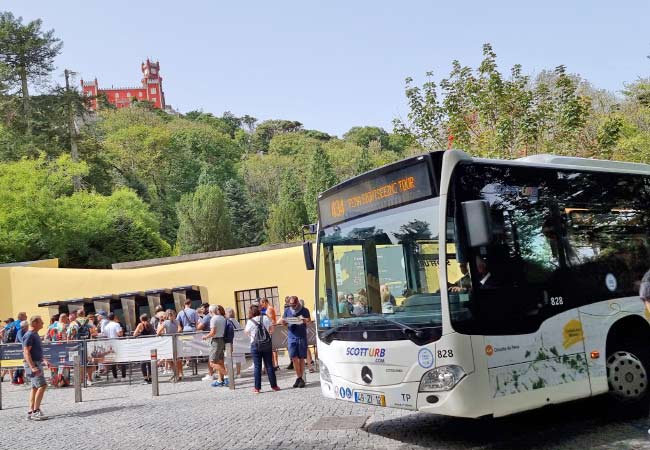
The entrance to the Palácio da Pena while the palace (the red tower) is much higher up

The bus from the ticket office up to the Palácio da Pena
The Castelo dos Mouros
Of all Sintra's sights, the Castelo dos Mouros asks the most of your legs. The whole point of a visit is to walk the battlements, and that means stone steps worn smooth by a thousand years of footfall, uneven surfaces, and long stretches without a handrail to steady yourself on.
The walls run for nearly half a kilometre along the ridge of the mountain, rising and falling with the rock beneath them. Walking the full perimeter is hard work, and the climb to the Torre Real, the castle's highest point, takes you up 220 steps along the ramparts. The view from the top is one of the great panoramas in Portugal, looking across to Pena on one side and the Atlantic on the other.
If you have any concerns about balance, knees, or vertigo, this is the sight to think carefully about. The Mouros is best suited to visitors who are steady on their feet and comfortable with sustained climbing.
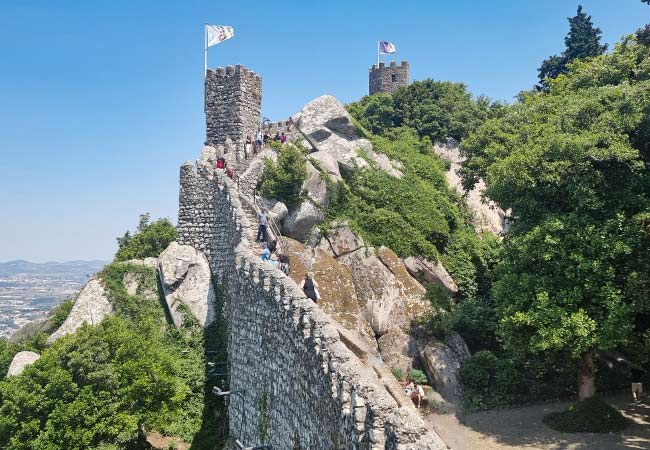
The narrow battlements and steps to the watch towers of the Castelo dos Mouros
The Quinta da Regaleira
The Quinta da Regaleira is the easiest of Sintra's major sights to reach. It sits a flat ten-minute walk from the historic centre, and you will not need the 435 bus or a taxi to get there.
The walking begins once you are inside. The estate is laid out across a sloping hillside, with gravel paths threading between grottoes, towers, and hidden chapels in a layout designed to feel mysterious. The famous Poço Iniciático, the initiation well, draws every visitor down a long spiral staircase carved deep into the rock, and the route then continues through a network of dark, uneven tunnels that emerge somewhere unexpected in the gardens. None of this is impossibly hard, but the steps are narrow, the lighting is dim, and the surfaces underfoot are rarely level.
If the well descent is not for you, do not worry. There is a separate path that loops around the gardens above ground, taking in the chapel, the monuments, and the main palace without going underground at all
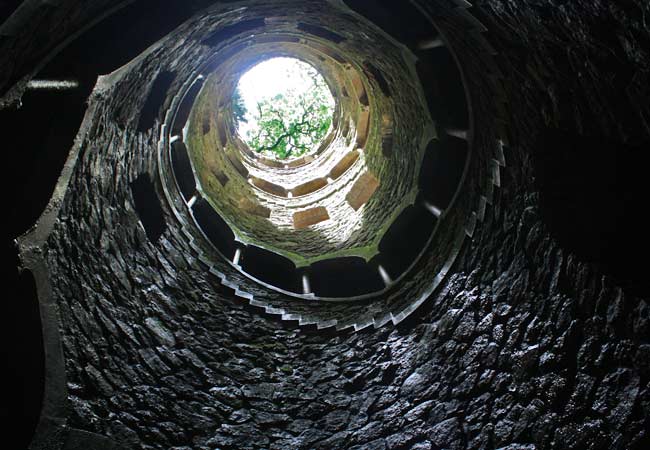
The steps leading down the Poço Iniciático
Palácio de Monserrate
Monserrate sits about 3.5 km west of the historic centre, along a road that winds up and down through the hills. You will need either the 435 tourist bus or an Uber to reach it, as the walk is long, narrow, and shares a winding road with traffic.
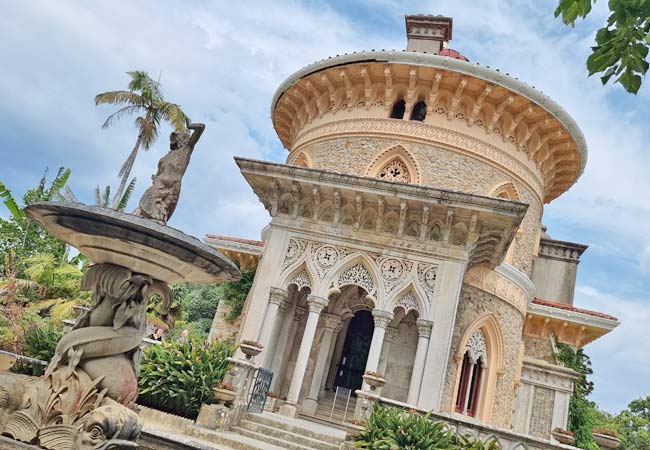
The good news is that once you arrive, Monserrate is the gentlest of Sintra's great estates. The paths around the palace itself are wide, well-kept, and almost completely level, and the rose gardens and main lawns can be enjoyed without any climbing at all. The wider estate is larger than it looks. The full garden circuit runs to around 2 km and includes some climbing through the fern valley and up to the ruined chapel, so pace yourself if you plan to do the lot. If you want the easiest possible visit, stick to the palace, the rose garden, and the main lawn. You will see the best of Monserrate and barely climb a step.
Would a tour suit you better?
After twenty-five years of visits, I know how tiring a day in Sintra can be. A well-run tour takes that hassle off your hands. These are the Sintra tours I've used and happily recommend to friends and family:
The links above are affiliate links, which means I earn a small commission if you book through them, at no extra cost to you. I really appreciate it, as it helps me keep this site free and running.
A word on the weather
Rain changes Sintra completely. The cobbles turn slick, the forest paths run with water, and the steep streets of the historic centre become genuinely treacherous underfoot. I would strongly advise against visiting in wet weather, and particularly in the depths of winter when the mountain sits in cloud for days at a time.
If you are planning a winter trip, keep your dates flexible. Watch the forecast, choose the driest day in your window, and be ready to swap Sintra for something else if the weather turns. Lisbon has plenty of indoor options on a wet day. Sintra, sadly, does not.
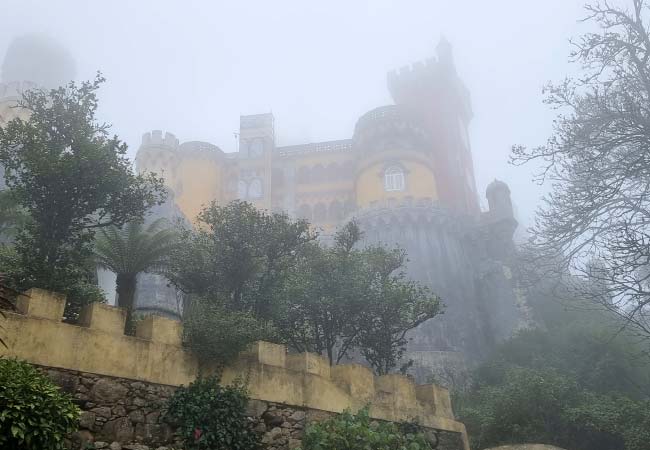
Fog can linger for much of the day, as I found out on in my trip in November
The 434 Tourist Bus
If you are visiting the hilltop sights, you are taking the 434 bus. There is no realistic alternative. The walk from the historic centre up to Pena is a 3 km climb up a steep, traffic-heavy road with little shade and less footpath, and in the summer heat it is the kind of mistake you only make once.
The 434 runs as a one-way loop. It picks up at the train station, climbs the hill to the Castelo dos Mouros and the Palácio da Pena, drops back down to the historic centre (Sintra Vila), and returns to the station. A 24-hour ticket costs €10.96, and in high season the buses leave the station roughly every fifteen minutes.
A few things are worth knowing before you board. The 434 is almost always full, and you will almost certainly stand. The journey from the station up to Pena is longer than the map suggests, taking at least 30 minutes and stretching past 40 in peak season. The reason is simple. The bus has to follow a narrow, one-way ring road that loops the mountain, and in the middle of the day that road is clogged with every taxi, Uber, tuk-tuk, and tour van trying to do the same thing.
This brings me to the question I am asked most often. Would a taxi or Uber be faster? No. They sit in the same queue on the same road, and at the height of summer many drivers will simply turn the fare down once they see where you are going. Save the money and take the bus.
For all its faults, the 434 remains the right answer. It is the most practical way to get from the train station to the top of the mountain.
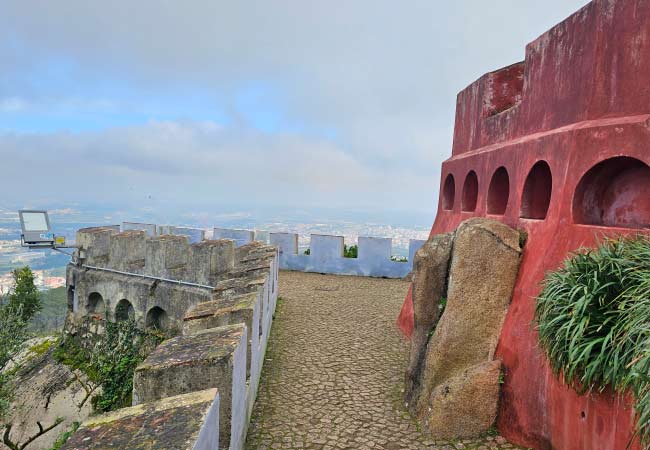
Sintra's footpaths can be treacherous on wet days – This is the Caminho de Ronda, the footpath around the base of the Palácio da Pena
Tips for visitors with mobility concerns
If hills are a worry, Sintra is still very much within reach. You will need to plan the day a little more carefully than the average visitor, but the main sights are achievable with the right approach. Here is what I would suggest:
• Base yourself in the historic centre. Everything you need for the day, including the 434 bus, the train station, and a good run of cafés and restaurants, sits within a flat ten-minute walk.
• Lean on the 434 bus. It will take you door to door between the train station, the Castelo dos Mouros, and the Palácio da Pena, and saves you the worst of the climbing.
• Arrive early or visit late in the afternoon. The sun is at its harshest between 11am and 3pm, and the slopes feel twice as steep in the heat.
• Carry water. Summer temperatures regularly reach 35°C, and there are long stretches between the palaces where you will not pass a shop.
• Split the visit over two days if you can. Pena and the Mouros on one day, Regaleira and Monserrate on the next is a far gentler rhythm than trying to fit all four into a single trip.
Sintra Hiking routes
Santa Maria Trail (Caminho de Santa Maria)
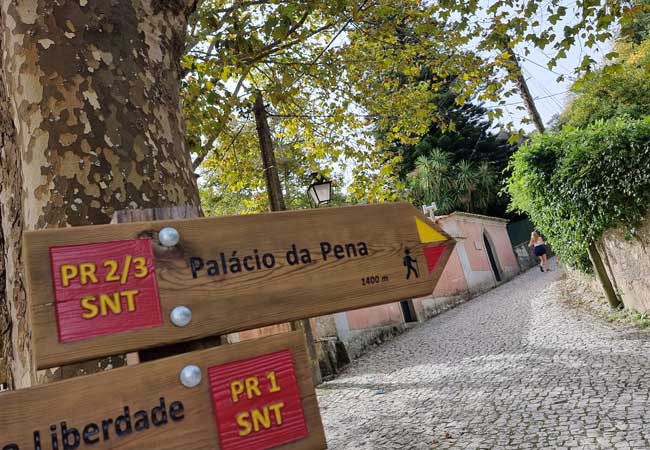
The Santa Maria Trail stretches 2 km from Sintra's historic centre up to the Castelo dos Mouros, and can continue to the Palácio da Pena. This challenging route follows ancient cobblestone paths through dense forest and craggy rocky outcrops.
The trail begins from the Palácio Nacional de Sintra, but most visitors pick it up from the top of the Parque da Liberdade. From the Igreja de Santa Maria, it rises steeply through a series of historic stone steps and winding paths.
The ascent typically takes between 45-60 minutes, though many walkers require longer due to the consistently steep gradient. During summer months, the trail becomes particularly demanding, with temperatures often rising above 30°C by mid-morning. The dense tree canopy provides some shelter, but proper preparation is essential. Early morning starts are strongly recommended to avoid the heat. The path can become treacherous after rainfall, as the historic cobblestones turn slippery.
The reverse of the route is a pleasant way to return to Sintra after exploring the Castelo dos Mouros, and avoids the hassle of catching the 434 bus.
For a full guide to the Caminho de Santa Maria, click here.
Capuchos Monastery Trail
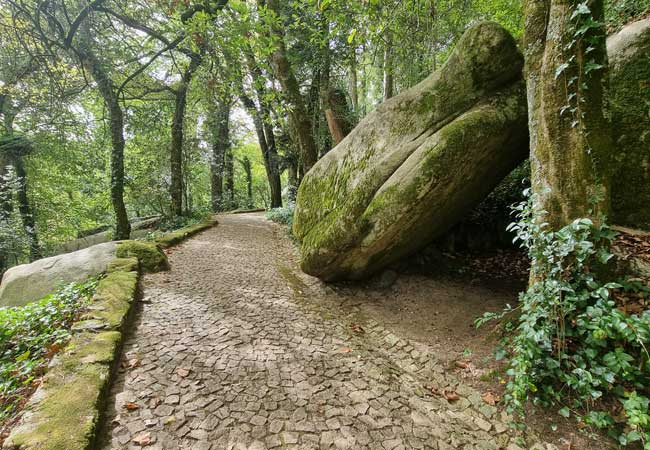
The Capuchos Monastery Trail extends 7 km from Sintra town to the Convento dos Capuchos. This moderate to challenging route passes through some of the region's most pristine native woodland, offering a genuine glimpse into the natural environment that has shaped Sintra's character for centuries.
The route follows the N375 out of Sintra to the Palácio de Monserrate (approximately 3 km) and then heads south along gravel paths to the Convento dos Capuchos, passing the Lagoa dos Mosqueiros lake.
The destination, Convento dos Capuchos, stands as one of Sintra's most unique monuments. This austere monastery, with its cells lined with cork for insulation, provides a stark contrast to the opulent palaces elsewhere in the region. The trail follows historic paths used by monks, passing natural springs and ancient stone markers. Walking time averages 3-4 hours depending on fitness levels and stopping frequency. The return journey can be made via the same route or by taking public transport from near the monastery.
A shorter version is possible by catching the 435 bus to the Palácio de Monserrate.
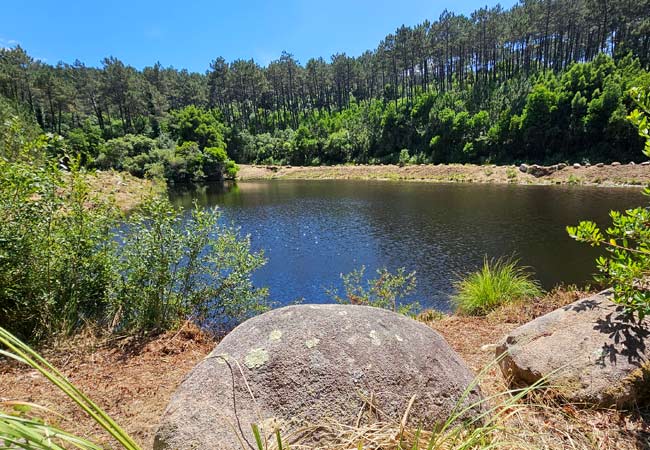
The Lagoa dos Mosqueiros
Cruz Alta Circuit
The Cruz Alta Circuit is a shorter route within the grounds of the Palácio da Pena. This 4.5 km circular walk begins from the palace and passes through the highest sections of Pena Park. This moderate difficulty trail circles the summit of Serra de Sintra, offering spectacular views across to Lisbon and the Atlantic coastline.
The circuit's highlight is the Cruz Alta monument itself, standing at 529 m above sea level. This stone cross marks Sintra's highest point and provides a natural rest stop with panoramic views. The trail surface alternates between well-maintained gravel paths and sections of original stone paving. While the route includes some elevation changes, these are generally gentle compared to other Sintra trails. The entire circuit typically takes 1-1.5 hours, allowing time for sightseeing and rest stops.
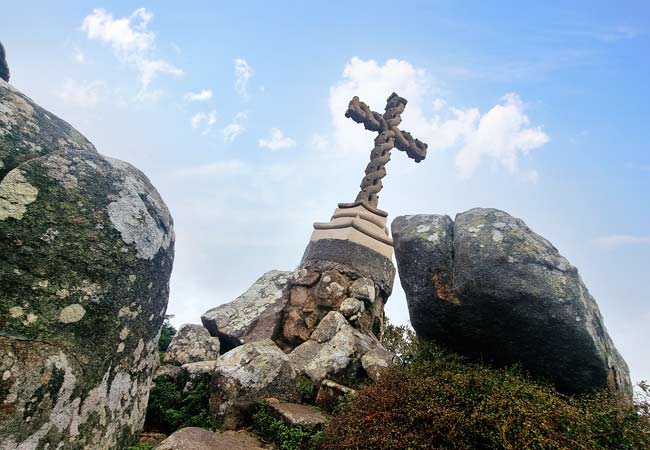
The cross at the top of Cruz Alta
Discover more of Sintra with our most popular guides


About this guide I'm Philip Giddings. I have been exploring Portugal since 2001, and writing the independent guides at Sintra-Portugal.com since 2008. I live in Lisbon with my Portuguese wife, Carla, who first took me up to Sintra on one of my earliest trips to the country. We have been going back ever since: summer crowds, autumn fog, the quiet Sunday afternoons of January. The region has changed a great deal in twenty-five years of visits, and we have watched it happen.
The site takes no payment from tourist boards, tour operators, or attractions for inclusion. It is funded by affiliate commissions on tour bookings, disclosed on every page that contains them. Every practical detail in these guides (ticket prices, opening hours, bus routes, time-slot policies) is checked against the official Parques de Sintra site, and verified in person on visits two or three times a year. Read my full bio here.