Sintra-Portugal.com
The best independent guide to Sintra
Sintra-Portugal.com
The best independent guide to Sintra
Day trip to Sintra from Lisbon: an independent guide for 2026
A king's romantic fantasy. A Moorish castle on a ridge. An inverted tower descending nine storeys into the earth. All within twenty kilometres of central Lisbon, and all reachable for the price of a five euro train ticket.
Sintra is the day trip every visitor to Lisbon hears about before they have even unpacked, and the reputation is earned. A forested microclimate where the Atlantic mists hang in the trees. A hilltop palace painted in canary yellow and ochre red. A town of cobbled lanes that has been drawing visitors since the poet Byron called it a glorious Eden in 1809. What lifts Sintra above every other day trip from the capital is the sheer density of what sits on these hills: a 9th-century Moorish fortress, a 19th-century Romanticist palace, and an esoteric Edwardian garden of grottoes and initiation wells, all within walking distance and all part of a UNESCO-listed cultural landscape.
What the photographs and social media posts do not show you is the logistics. The timed tickets that sell out a week ahead in summer. The 434 tourist bus inching up a single-lane ring road. The queue snaking around the Initiation Well by eleven. None of this is a reason to stay in Lisbon, but all of it is a reason to plan the day before you arrive. Get the order of sights right, book the two big tickets in advance, and Sintra becomes one of the finest days you will spend anywhere in Portugal. Get it wrong, and you will spend half of it standing in queues.
I have been exploring Portugal since 2001, and together with my Portuguese wife I have made the trip up from Lisbon to Sintra more times than I can count, in every season and at every pace. This guide is what I have learned: the order to visit the sights, the tickets you must book ahead, the bus that everyone underestimates, and the small choices that turn a stressful rush into the day Sintra is meant to be.
The three sights of a Sintra day trip
The Palácio Nacional da Pena

The image you have already seen of Sintra. Vivid yellow towers, wine-red battlements, and tiled domes rising from a forested peak 480 metres above the Atlantic. King Ferdinand II built it in the 1840s from the ruins of a hilltop monastery, mixing Gothic spires, Moorish arches, and Manueline stonework into the finest Romanticist palace in Europe. The interior has been preserved as the royal family left it on the morning of the 1910 revolution, but the painted terraces and battlements outside are what you will remember - Palácio da Pena guide
The Quinta da Regaleira
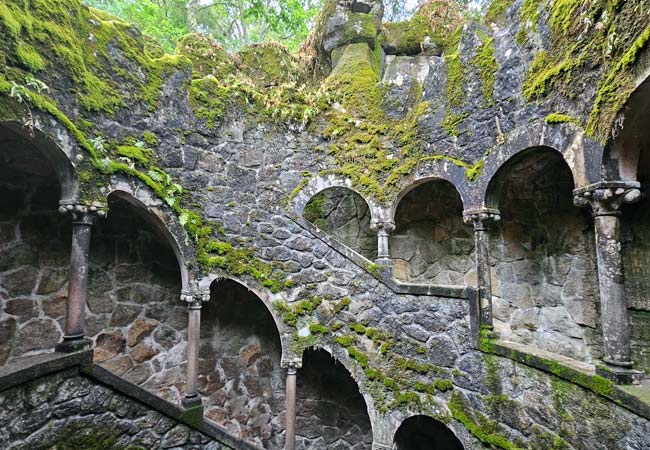
The palace itself is a flamboyant Neo-Manueline confection, but the real wonder at Regaleira lies underground. Beneath the gardens runs a hidden network of tunnels, grottoes, and waterfalls, all radiating from the estate's strangest feature: the Poço Iniciático, an inverted tower spiralling nine storeys into the earth. Built at the turn of the 20th century for António Carvalho Monteiro, a millionaire with a deep interest in the esoteric, the whole estate is coded with the symbolism of alchemy, the Knights Templar, and Masonic ritual. There is nothing else like it in Portugal - Quinta da Regaleira guide
The Castelo dos Mouros

The oldest sight in Sintra and, if I am honest, the one I love most. These 9th-century walls were built by the Moors to guard the road to Lisbon, and they snake along the rocky ridge above the town in a way that feels older and wilder than anything else in Sintra. The fortress was abandoned after the Christian reconquest, restored in the Romantic style by Ferdinand II in the 19th century, and now commands the finest views in the region. From the highest tower you will look down on the historic centre, across to the painted facades of Pena, and out over the forests of the Serra de Sintra to the Atlantic - Castelo dos Mouros guide
A note on tickets: The interior staterooms of the Palácio da Pena and the entire Quinta da Regaleira require timed entry tickets, and both must be booked online in advance. In peak season the morning slots sell out a week ahead, and you cannot count on same-day availability. Buy both through GetYourGuide.com.
A recommended itinerary for a Sintra day trip
A popular and recommended itinerary for a day trip to Sintra from Lisbon is:
• Train from Lisbon to Sintra (50 min)
• 434 bus from the station to the Palácio da Pena (20-30 min)
• Palácio da Pena terraces (30 min) and staterooms (40 min)
• Pena grounds (optional, 1 to 2 hours)
• Castelo dos Mouros (optional, 1 to 2 hours)
• 434 bus down to the historic centre (15 min)
• Lunch in central Sintra
• Sights of Sintra town (45 min)
• Walk to the Quinta da Regaleira (10 min)
• Quinta da Regaleira (80 min)
• Walk back to the train station (20 min)
• Train to Lisbon (50 min)
This is a long day, but the three main sights (Pena, Mouros, and Regaleira) are all achievable if you start early. If that sounds like too much, drop the Castelo dos Mouros and keep Pena and Regaleira; this is the shorter day I would recommend to anyone with less stamina or less time.
The whole itinerary is built around the route of the 434 bus, which loops between the train station and the hilltop sights. I put Pena first because it is the headline act, because the queues build fast, and because you want to be there with your legs and your patience intact.
Arriving at Pena before 10 am is the single most useful thing you can do all day. It is the difference between walking onto the terraces and queueing on the access road for an hour. This assumes you have your timed ticket already, which you should.
Regaleira works the other way round. It opens at 10 am, it sits a short walk from the historic centre, and it fills up by late morning with everyone who came up from Lisbon on a later train. By mid-afternoon (after 3 pm) the crowds thin, and you won’t be so rushed through the tunnels.
Plan to have lunch in the historic centre of Sintra, as the food options near the Palácio da Pena and Castelo dos Mouros are very limited.
The interactive map below details the suggested day trip. The yellow markers indicate the sights, while the blue line shows the route of the 434 bus.
Sights of the day trip: 1) Palácio da Pena 2) Castelo dos Mouros 3) historic centre of Sintra 4) Quinta da Regaleira 5) Palácio Nacional de Sintra 6) train station
The 434 bus route (blue): 7) Train station 8) Castelo dos Mouros bus stop 9) Palácio da Pena bus stop 10) Sintra Vila bus stop 7) Train station
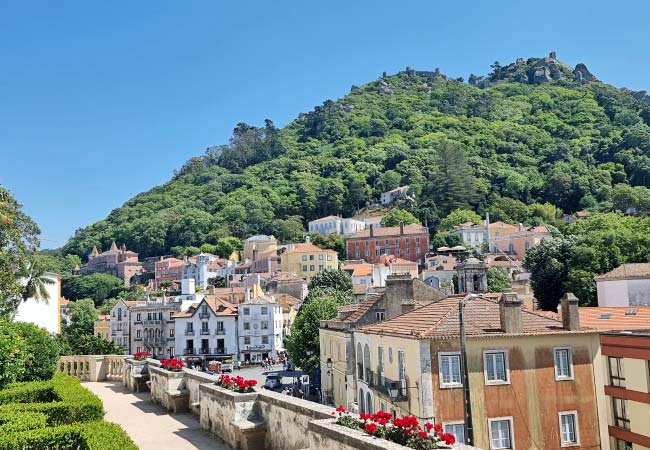
Sintra has a pretty town centre
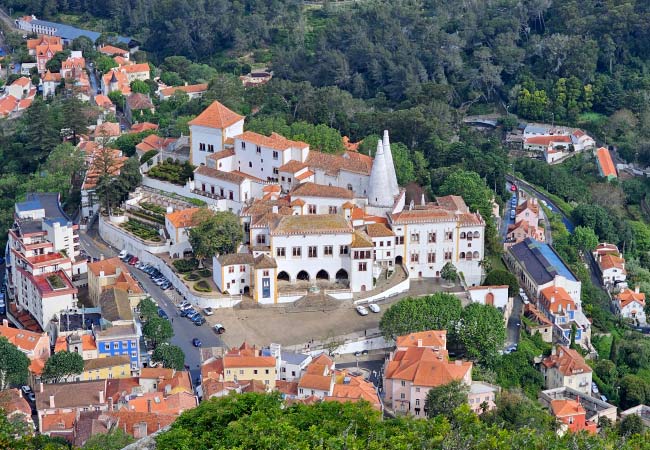
The Palácio Nacional de Sintra is an enjoyable alternative to the Quinta da Regaleira if you are interested in Portuguese history
Would a tour suit you better?
After twenty-five years of visits, I know how tiring a day in Sintra can be. A well-run tour takes that hassle off your hands. These are the Sintra tours I've used and happily recommend to friends and family:
The links above are affiliate links, which means I earn a small commission if you book through them, at no extra cost to you. I really appreciate it, as it helps me keep this site free and running.
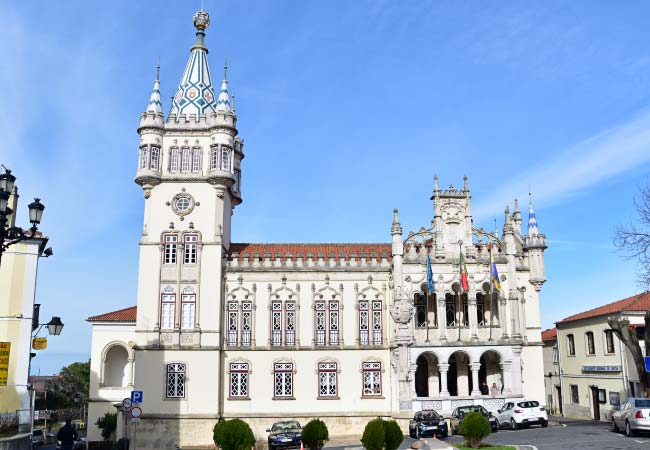
The Câmara Municipal de Sintra (Sintra town hall)
The cost of a day trip to Sintra
Sintra is not cheap. Following the full itinerary in this guide, I would budget €100 per adult: around €71 for transport and entrance fees, and another €29 for food and drinks. Current prices:
• Return train fare: €5.10
• 434 tourist bus (24-hour ticket): €13.50
• Palácio da Pena full ticket: €20 (book in advance)
• Castelo dos Mouros: €12
• Quinta da Regaleira: €20 (book in advance)
• Lunch in a restaurant: €18-€25
• Snacks and drinks: €7-€12
Alternative prices
• Palácio da Pena (park only ticket): €12
• Palácio Nacional de Sintra: €13 (as an alternative to the Quinta da Regaleira)
• One-way taxi from the station to the Palácio da Pena: approximately €15
• Uber from central Lisbon to Pena Palace: approximately €35
You can do Sintra for much less. Walk between the sights instead of taking the bus, skip one or two of the paid monuments, and bring your own lunch, and you can spend a good day here on under €20. For the full version of that approach, read my guide to the free sights of Sintra.
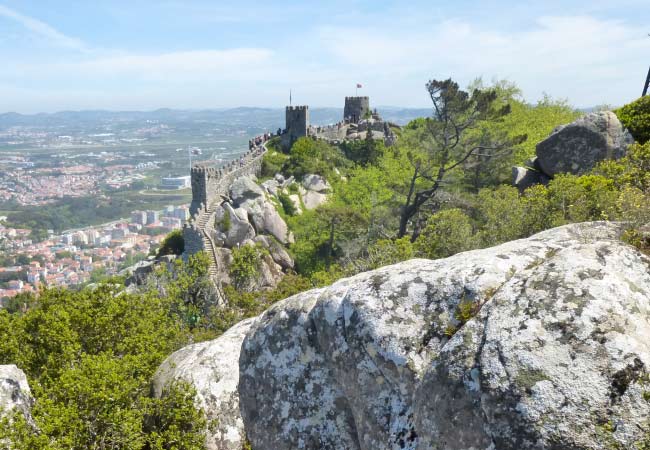
The Castelo dos Mouros with its amazing views over the region
An in-depth guide for your day trip to Sintra
What follows is the long version of the day, with everything I would tell a friend who asked me to plan it for them.
Lisbon to Sintra
Take the train. Two lines run from central Lisbon directly into Sintra, both inexpensive and both frequent, and choosing between them comes down to where you are starting the day:
• Rossio station (central Lisbon) to Sintra
• Oriente station (eastern Lisbon) to Sintra
I take the train from Rossio almost every time. The station sits right in Baixa, a few minutes from most central hotels, and the building itself is worth a glance on the way in. Oriente is the better choice if you are coming from the airport, staying on the eastern side of the city, or arriving in Lisbon by intercity train.
The two routes are almost identical in length: 40 minutes from Rossio, 47 from Oriente. A return fare is €5.10 for an adult and €2.60 for a child. Trains run roughly every 20 minutes from early morning until late at night, so you do not need to plan around a timetable.
Uber and Bolt are the alternative, and for some trips they are the better answer. The base fare from central Lisbon to Sintra is around €35, and I have used it more than once at the end of a long day when the thought of a packed evening train with tired children was the last thing anyone wanted.
If you are coming from Cascais or Estoril instead of Lisbon, take the bus. Services run from the Cascais bus station and from outside the Estoril train station.
Related articles: Lisbon to Sintra - Cascais to Sintra

The train to Sintra waiting in Rossio station
From the train station: your next step
Sintra station is the end of the line, but the main sights are still a bus ride or a walk away. The historic centre lies 1.5km to the west, and the Palácio da Pena and Castelo dos Mouros sit high on the wooded hill above the town. You will need to decide which way to go before you step out of the station, because the moment you do you will be approached by touts.
You have two choices.
Option 1: Pena first (what I recommend): Walk straight out of the station and take the 434 bus from the stop directly in front of the station. Do not try to walk up to Pena. It is a 50-minute climb, and you will arrive at Pena with no energy left for the palace itself. If you do wish to walk, the guide is here.
Option 2: The historic centre first: A 15-minute walk west, past the town hall and the Fonte Mourisca, a Moorish-style drinking fountain. The route is lined with small stalls selling ceramics and trinkets, and the walk is the gentlest introduction to Sintra you can ask for. The drawback is that you lose the early-morning window at Pena, when the queues are shortest.
A warning about the touts
The moment you walk out of the station you will be approached by drivers, guides, and tuk-tuk operators offering tours of Sintra. They are not scams, but they are expensive, and they rely on the fact that most arriving visitors have no plan. The 434 bus does the same hill for a fraction of the cost. If you want a guided day trip, book one in advance from your accommodation, which will include a transfer from Lisbon.
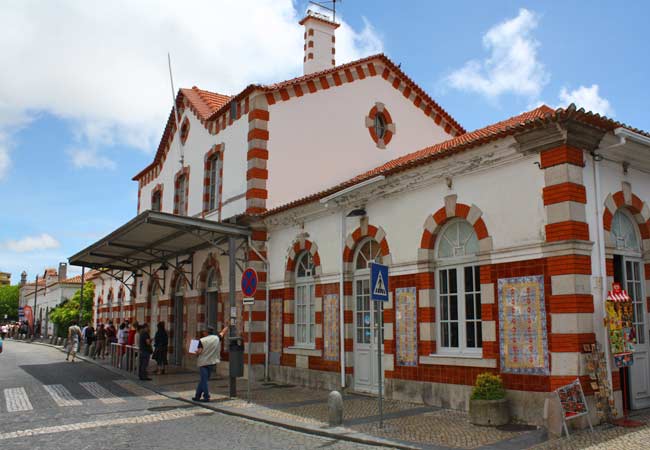
Sintra train station
The 434 bus
The 434 bus service is designed for tourists and follows a one-way loop that connects the train station to the Castelo dos Mouros and Palácio da Pena. It then descends to the historic centre of Sintra before returning to the station.
A 24-hour ticket, which allows for unlimited use on all Sintra buses, costs €13.50. While this may seem expensive, it is more economical than a return taxi journey or a tuk-tuk ride.
Be prepared for the journey itself, especially during peak season. Buses are frequently packed, with standing room only. The ride to the palace is surprisingly long, taking at least 30 minutes and often more than 40 in heavy traffic. This is due to traffic being banned from the centre of Sintra and a narrow, winding ring road that gets clogged with tourist vehicles. Given the twists and turns, it is always a good idea to try to get a seat if possible.
It is important to note that taking an Uber, Bolt, or tuk-tuk will not be any faster. All vehicles use the same congested road to reach the palace. You will also face long waits for ride-hailing services, and drivers often decline the difficult fare from the station or town up to the palace due to the traffic.
Crucially, the bus route's one-way loop means that to get from the historic centre up to the Palácio da Pena, the bus must first travel back down to the train station. Therefore, it is much more efficient to visit the Palácio da Pena at the start of your day, taking the bus directly from the train station upon arrival.
Related article: The 434 tourist bus
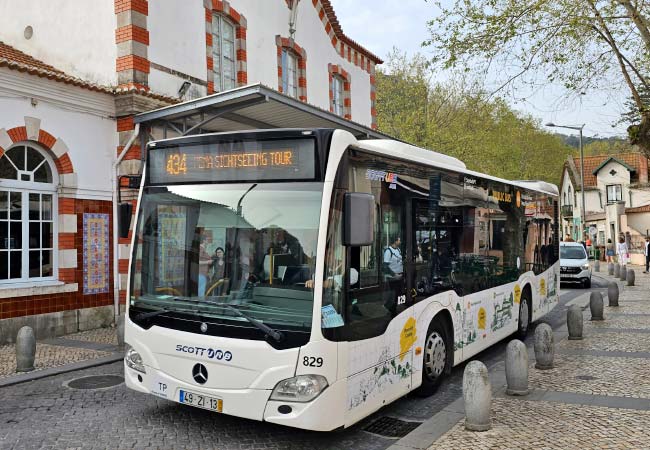
The 434 tourist bus waiting at Sintra train station
Where to Eat for Lunch in Sintra
The historic centre of Sintra has many restaurants, but it can be difficult to find good value among the tourist-focused eateries. For a satisfying lunch that won't be overpriced, consider one of these highly regarded options that are popular with both locals and informed visitors.
Apeadeiro (Traditional Portuguese, €€) This traditional Portuguese restaurant is a local favourite, serving generous portions of classic fish and meat dishes. It provides an authentic, no-frills dining experience with very reasonable prices for the area - link to Google maps
Tascantiga (Modern Portuguese Tapas, €€) An extremely popular and compact restaurant serving creative, modern versions of Portuguese petiscos - link to Google maps.
Tacho Real (Traditional Portuguese, €€-€€€) Located within a historic building with stone walls, this restaurant offers a traditional dining atmosphere - link to Google maps.
Palácio da Pena
The Palácio da Pena is one of Europe's most distinctive palaces and will almost certainly be the highlight of your day in Sintra. This vibrant spectacle of colour was the fantasy creation of King Ferdinand II in the 19th century, built from the ruins of a monastery that once stood on the high rocky peak.
The palace is a masterpiece of Romanticist design, mixing Gothic towers, Moorish arches, and decorative Manueline details. The interior is just as interesting, preserved as it was in 1910, the year the Portuguese monarchy was overthrown by revolution.
Due to its immense popularity, entry to the palace requires careful planning:
• Timed-Entry Tickets: To visit the staterooms (the interior), you must book a ticket for a specific 30-minute time slot. These slots, especially for morning times, sell out far in advance during the high season, so it is essential to book them online before your trip.
• Park-Only Tickets: A cheaper ticket (€12) provides access to the extensive grounds and, crucially, the famous exterior terraces and battlements of the palace. This is a fantastic option if interior time slots are sold out or if you are more interested in the architecture and views.
Insider Tip: The main entrance to the Pena grounds is at the bottom of the hill. From here, it is a steep 10-15 minute uphill walk to the palace itself. To save energy, you can take the shuttle bus that runs from the entrance to the palace (€3).
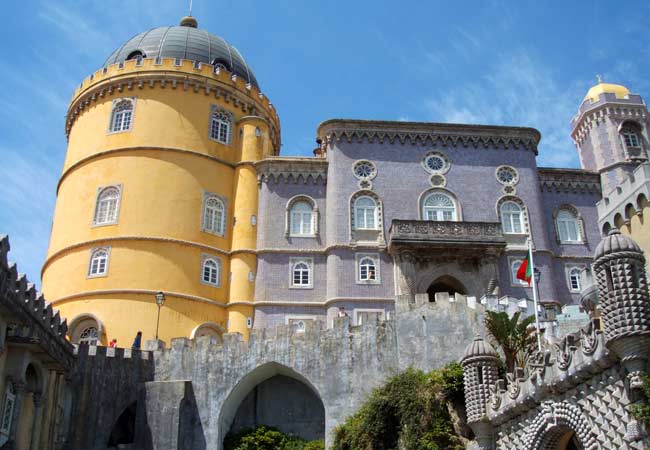
The colourful terraces of the Palácio da Pena
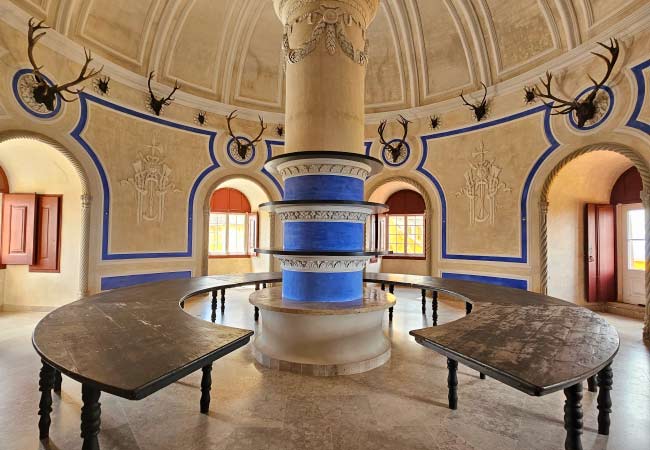
The Sala dos Veados (Stag Room) inside the palace
The Parque da Pena (Pena Park)
The Palácio da Pena sits within the vast Parque da Pena, a 200-hectare forested parkland designed by King Ferdinand II to be a romantic and mystical landscape. A half-day could easily be spent exploring its winding paths, exotic plants, and hidden viewpoints.
For a day trip, it is best to focus on a few key highlights. On a hot day, the shaded paths through the Valley of the Lakes (Vale dos Lagos) and the lush Queen's Fernery (Feteira da Rainha) offer a cool escape.
For the best views, there are two unmissable spots. The Cruz Alta (High Cross) is the highest point in the Serra de Sintra hills (529m) and is a 20-minute walk from the palace, providing panoramic views over the entire region. However, for the most iconic photograph of the palace itself, head to the Alto do Chá viewpoint.
Another significant attraction is the Chalet of the Countess of Edla, a charming Alpine-style house built as a private retreat for King Ferdinand II's second wife. This is located in a different section of the park and may require too much time for a packed day trip.
Advice: The park is a maze of trails. Pick up a map at the entrance to help you navigate and decide which points of interest you want to prioritise.
Related articles: The Parque da Pena
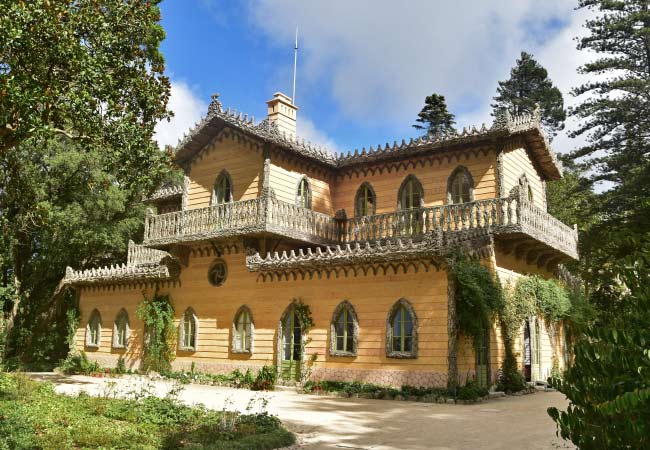
The Chalet da Condessa d'Edla
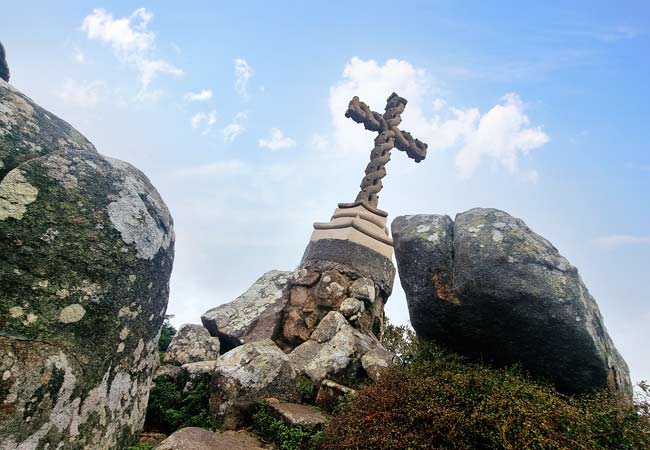
A 16th-century cross marks the Cruz Alta, the highest point of the Serra de Sintra
The Castelo dos Mouros
The Castelo dos Mouros is an excellent addition to your day, but it is the most logical sight to skip if you are short on time. A visit typically takes between 60 and 90 minutes.
This ancient fortress dates from the 9th century, when the Moors dominated the region. Its high stone walls and watchtowers served as a strategic viewpoint over the coastline and the lands leading to Lisbon. After falling into ruin for centuries, the castle was romantically restored in the 19th century by King Ferdinand II to be a dramatic feature in the grounds of his Pena Palace.
The main activity is walking the stone battlements, which follow the natural contours of the rocky landscape. The reward for climbing the towers is some of the best panoramic views in the entire Sintra region, looking down upon the historic centre and up at the colourful Pena Palace.
Advice: The entrance to the Castelo dos Mouros is just a short 400m walk from the Pena Palace entrance, so there is no need to take a bus between them. Be aware that the castle is very exposed and involves climbing many steep steps.
Related articles: Castelo dos Mouros guide
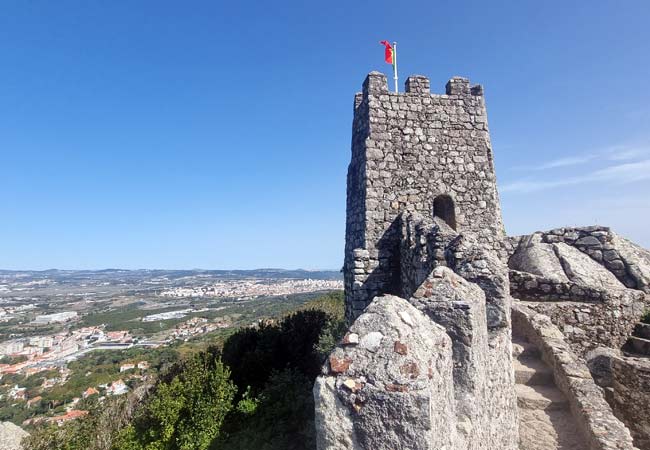
The impressive views from the battlements of the Castelo dos Mouros
The historic centre of Sintra
After visiting the hilltop sights, take the 434 bus down to the historic centre, getting off at the "Sintra Vila" stop. While there is a scenic footpath down from the Castelo dos Mouros (the Caminho de Santa Maria), it is a long walk that is difficult to fit into a single-day itinerary.
Sintra's historic centre is a charming maze of narrow cobbled lanes and traditional buildings, housing a variety of cafes and unique shops. It's an area best explored by simply wandering. Key landmarks include the flamboyant town hall and the main shopping street of Rua das Padarias. This is also the ideal location to stop for lunch, with a wide selection of restaurants.
Insider Tip: Sintra's Famous Pastries No visit to Sintra is complete without sampling its famous sweets. Be sure to try:
• Queijada: A small, sweet tart made with cheese, eggs, sugar, and cinnamon.
• Travesseiro: A warm, pillow-shaped puff pastry filled with a delicious almond and egg-yolk cream.
The most famous place to find both is the historic Piriquita bakery.
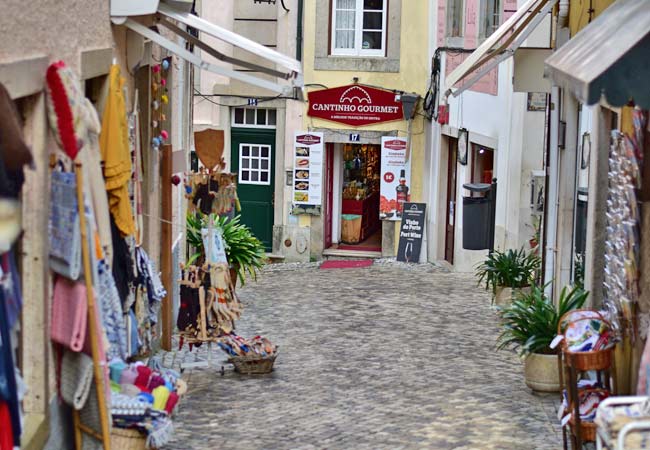
The Rua das Padarias and the warren of cobbled streets at the heart of Sintra
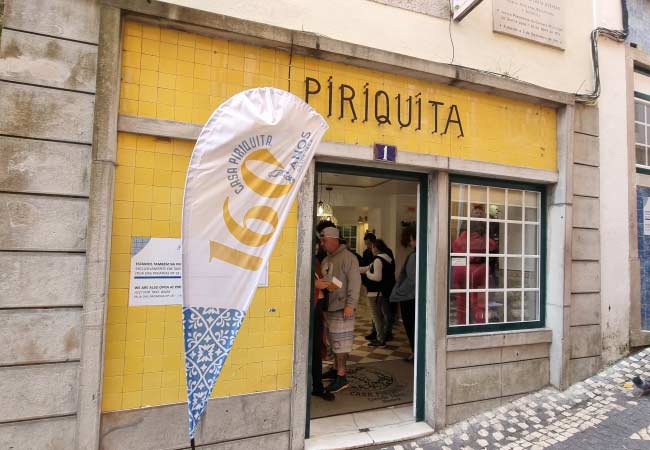
Casa Piriquita
Quinta da Regaleira
The Quinta da Regaleira is a mystical estate where the main attraction is not the flamboyant palace but its enchanting gardens. The grounds are a symbolic landscape filled with hidden tunnels, grottoes, and waterfalls, all connected to the estate's most famous feature: the Poço Iniciático, or Initiation Well.
This subterranean "inverted tower" spirals deep into the earth and is thought to have been used for secretive initiation rituals. Descending its staircase is a unique experience; at the bottom, the well connects to a network of tunnels that allow you to emerge from a cave hidden behind a waterfall. Just be prepared for a long queue to enter the Poço Iniciático at peak times.
The Quinta da Regaleira is a 10-15 minute walk from the historic centre. There is no need for a bus or taxi, but the entrance is on the western side of the estate, so you will need to walk along its long perimeter wall.
Advice: Due to its popularity, timed-entry tickets must be booked online in advance. If you arrive and find the queues for the Initiation Well are extremely long, the Palácio Biester next door is a wonderful, less crowded alternative.
Related articles: The Quinta da Regaleira
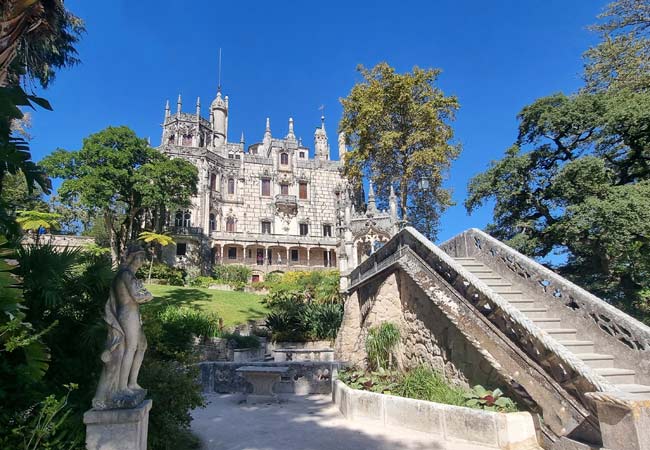
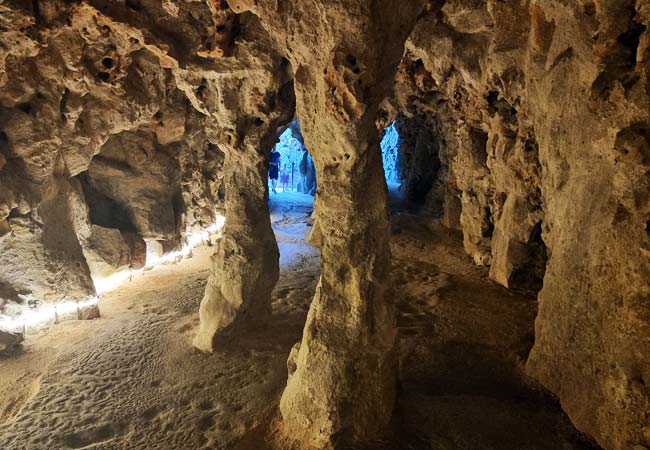
The hidden cave network below the gardens of the Quinta da Regaleira
Returning to the Train Station
From the Quinta da Regaleira, the best and most reliable way to get back to the train station is to walk. The journey takes approximately 20 minutes and leads you back through the historic centre, providing a final opportunity to browse the shops or grab a drink.
While it may be tempting to order an Uber or taxi after a long day of sightseeing, it is often faster to walk. At the end of the afternoon, demand for ride-hailing services is extremely high, and Sintra's traffic can cause long waits and slow journeys.
Discover more of Sintra with our most popular guides


About this guide I'm Philip Giddings. I have been exploring Portugal since 2001, and writing the independent guides at Sintra-Portugal.com since 2008. I live in Lisbon with my Portuguese wife, Carla, who first took me up to Sintra on one of my earliest trips to the country. We have been going back ever since: summer crowds, autumn fog, the quiet Sunday afternoons of January. The region has changed a great deal in twenty-five years of visits, and we have watched it happen.
The site takes no payment from tourist boards, tour operators, or attractions for inclusion. It is funded by affiliate commissions on tour bookings, disclosed on every page that contains them. Every practical detail in these guides (ticket prices, opening hours, bus routes, time-slot policies) is checked against the official Parques de Sintra site, and verified in person on visits two or three times a year. Read my full bio here.